
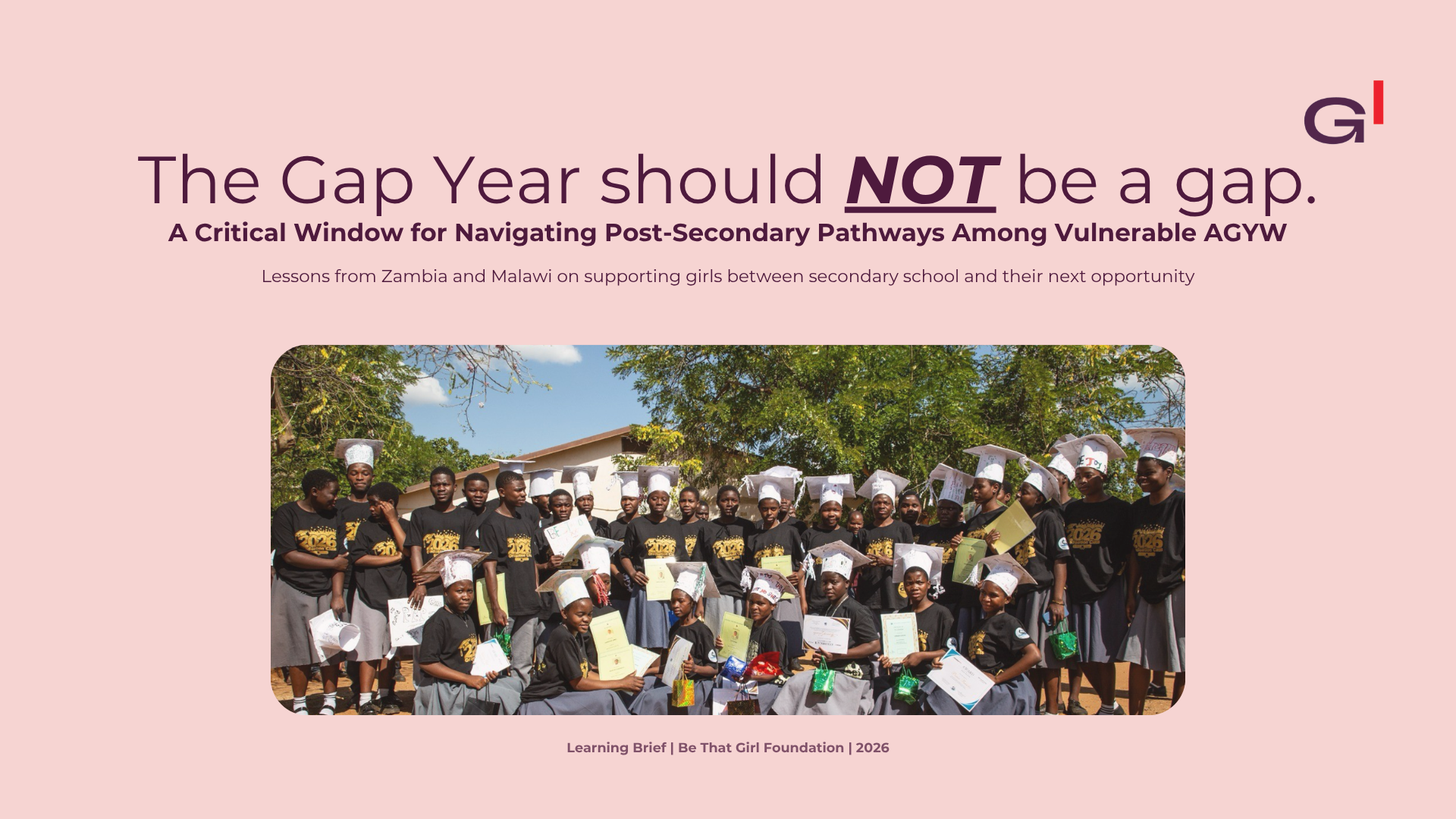
The Gap Year Is Not a Gap: A Critical Window for Navigating Post-Secondary Pathways Among Vulnerable AGYW
Lessons from Zambia and Malawi on supporting girls between secondary school and their next opportunity
Why Invest in the Gap Year?
For many vulnerable girls, the journey after secondary school does not begin with opportunity; it begins with uncertainty. Caught between aspiration and reality, many adolescent girls and young women (AGYW) navigate a period marked by limited information, financial constraints, social pressures, and few structured support systems. Yet this often-overlooked transition period can significantly influence whether girls progress into tertiary education, employment, entrepreneurship, or other productive pathways.
Recognizing the importance of this critical transition window, Be That Girl Foundation (BTG) embarked on a multi-country assessment in Zambia and Malawi to better understand the experiences, aspirations, barriers, and support needs of AGYW after secondary school. The findings reveal that the "gap year" is far more than a waiting period—it is a pivotal stage that can either strengthen or derail girls' future aspirations.
A Transition Marked by Uncertainty
AGYW currently in a gap year in Zambia consistently described life after secondary school as stressful, confusing, and uncertain. Many spoke about the sudden loss of structure that comes with leaving school and the challenge of determining what to do next while waiting for examination results, tertiary admissions, or employment opportunities.
Some girls described spending long periods at home without meaningful activities or clear direction. Others expressed frustration at watching their peers progress while they remained unable to move forward because of financial constraints or lack of information. For many, the gap year was characterized by waiting rather than purposeful transition.
Beyond Financial Barriers: What Makes the Gap Year Difficult?
While financial constraints were the most frequently cited challenge, girls' experiences during the gap year were shaped by multiple interconnected barriers. Participants reported limited access to information on tertiary education, scholarships, career pathways, and employment opportunities, making it difficult to make informed decisions about their futures. Limited exposure to professionals and role models further restricted girls' understanding of available pathways and workplace expectations.
Digital exclusion also emerged as a significant barrier. Many girls lacked access to computers, internet services, and digital skills, limiting their ability to access information, apply for opportunities, and prepare for tertiary education or employment. Tertiary students additionally described challenges adapting to the academic demands, independent learning environment, and digital requirements of higher education.
Socio-cultural expectations related to marriage, household responsibilities, and income generation created additional pressures for many girls, affecting their confidence and ability to pursue post-secondary opportunities.
Family expectations also emerged as an important influence during the transition period. Some girls reported pressure to prioritize household responsibilities or contribute to family income after completing secondary school, while others noted that parents and guardians often lacked information about post-secondary pathways. This highlights the importance of engaging families as partners in supporting girls' aspirations.
Together, these findings demonstrate that the gap year is not simply a period of waiting, but a critical transition phase during which girls require information, guidance, skills, support networks, and opportunities to successfully navigate their next steps.
What do girls need to successfully navigate life after secondary school?
Findings from focus group discussions with secondary school girls, gap year girls, tertiary students, mentors, and private sector representatives in Zambia and Malawi reveal that post-secondary transition is about far more than accessing education. Girls envisioned a Pathway Centre as a holistic support ecosystem that combines career guidance, digital literacy, mentorship, role models, entrepreneurship training, financial support, mental health services, workplace exposure, and family engagement.
Beyond academic and career support, girls repeatedly called for practical income-generating or "hustling" skills. Many viewed skills such as baking, hairdressing, tailoring, catering, digital services, and small business management as essential tools for earning an income, reducing dependence on others, and navigating the financial realities of the transition period. For many Adolescent Girls and Young Women (AGYW), these skills represent both immediate survival mechanisms and pathways to long-term economic empowerment.
From Findings to Action: The BTG Pathway Centre Model
The findings revealed that the period after secondary school is not a gap, but a critical window that can shape a young woman's future trajectory. In response, Be That Girl Foundation (BTG) designed the Pathway Centre, a holistic transition support model that recognizes that successful transitions require more than access to education alone. BTG plans to establish a Pathway Centre in Zambia and, in partnership with Andiamo, adapt and implement a similar model in Malawi.
The Pathway Centre will provide integrated support in career guidance, pathway navigation, digital literacy, mentorship, workplace readiness, psychosocial wellbeing, entrepreneurship development, and practical income-generating ("hustling") skills.
The model will also facilitate access to workplace exposure, internships, attachments, professional networks, and role models to help young women make informed decisions about their futures.
Through engagement with families, communities, mentors, employers, and AGYW themselves, the Pathway Centre aims to create a supportive ecosystem that strengthens confidence, agency, and self-determination.
Ultimately, the Centre seeks to enable vulnerable young women to successfully transition into tertiary education, employment, entrepreneurship, and other productive pathways.