
Nurturing Ethical Leaders for Africa: BTG Voices of Change Interview with Caren Wakoli, Founder and Executive Director of Emerging Leaders Foundation Africa
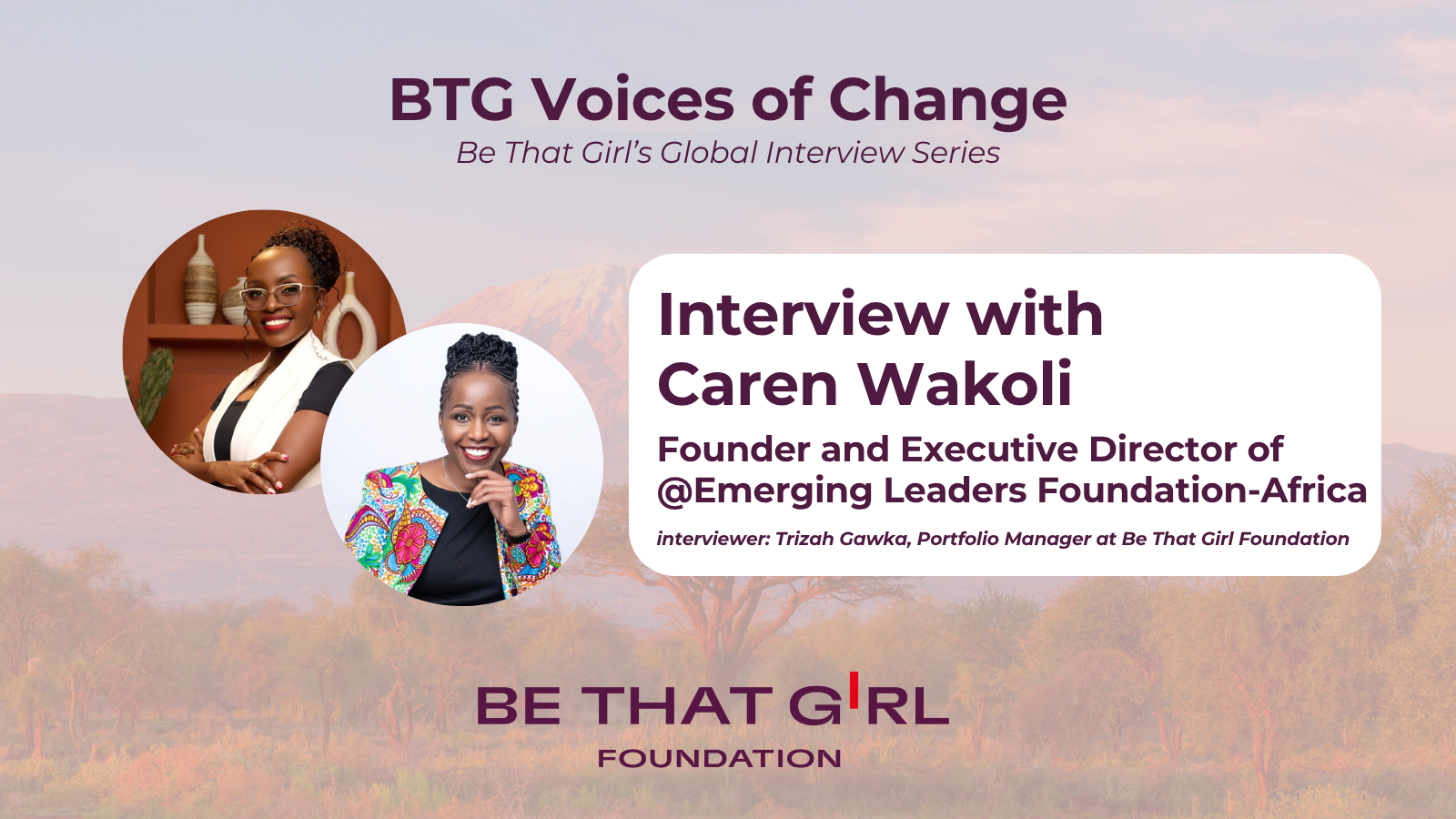
Nairobi, Kenya | Tue, May 26, 2026 - Welcome to the Voices of Change Interview Series, hosted by the Be That Girl Foundation. In this episode, Trizah Gakwa, Portfolio Manager at the Foundation, sits down with Caren Wakoli, Founder and Executive Director of Emerging Leaders Foundation Africa (ELF-Africa), for a powerful conversation on leadership, voice, agency, and self-determination.
Drawing from her personal journey and more than two decades of experience nurturing young leaders across Africa, Caren reflects on the importance of values-based leadership, the transformative power of storytelling, and the role of mindset in unlocking individual and collective agency. The discussion explores what it takes for women and girls to recognize their inherent power, overcome barriers, and lead meaningful change in their communities.
The interview also examines the relationship between personal and collective agency, the importance of creating spaces where diverse voices can be heard, and the responsibility of philanthropy and development actors to support locally led solutions through trust-based approaches. Throughout the conversation, Caren shares lessons on resilience, failure, growth, and the inner work required to build a more just and dignified future for all.
At its core, this conversation is a reminder that every person has a voice, every person has agency, and lasting transformation begins when individuals are empowered to own their stories, define their values, and step confidently into their purpose. Read the full interview below.
(This interview has been lightly edited for clarity and readability.)
Trizah: Welcome to this year's second episode of the Voices of Change interview series. I'm your host, Trizah Gakwa, and I serve as the Portfolio Manager at Be That Girl Foundation, which is a private foundation that works with locally led organizations to support women and girls to lead self-determined lives.
We have been hosting this interview series since last year. We usually have conversations with amazing women leaders who are working in this space of ensuring that women and girls attain self-determination.
And so I'm really excited to be hosting today's conversation because I am joined by the one & only amazing Caren Wakoli. Thank you so much, Caren, for making time to have this conversation today.
Caren: Thank you so much, and thank you for having me. I'm so looking forward to having this conversation with you.
Trizah: Caren is the Founder and Executive Director of Emerging Leaders Foundation Africa. Can you introduce yourself?
Caren: Yes! My name is Caren Wakoli. I serve as the Founder and Executive Director of Emerging Leaders Foundation Africa, where we nurture ethical and values-driven leaders to go and transform their communities, to promote human dignity for all.
When we started off, we were just focused on Kenya, and then we realized that the whole of Africa needs good, values-based leaders. And so we decided to go Africa. That is how we became Emerging Leaders Foundation Africa.
Because we do believe that it is possible for every African, every Kenyan, every Zambian, every Southern African, every African, generally speaking, and every human being in the world to live in dignity.
And so that is what we do. We nurture leaders because we believe that at the core of any change or any transformation is good, ethical, competent, character-based leadership.
And other than serving at Emerging Leaders Foundation, the core of me is that I am a lover of life, a student of life, a lover of nature, a curious mind, curious thinker. This is me. And something more important as well: I love God.
Trizah: Thank you, Caren. You talked about values-based leadership, and I want to ask you about that. Why do you think values-based leadership is important for us as a continent?
Caren: That's a really, really important question.
So let me ask you a question. Let me paint a picture for you and for our audience.
Picture somebody in a position of leadership. They are not competent, not informed. They are selfish, care about themselves. They don't listen to the people they lead. They don't pass good policies. They are corrupt. They steal public resources. They do crazy things.
That is one kind of person in a position of leadership. But not everybody in a position of leadership is a leader. For some of those people, leadership is coming to them as a result of the position they hold, the title they hold, or basically titles thrust upon them by society, by clans, by communities, and you know, all that.
So that is one kind of leader, let's say, leading community A.
And then we have a different kind of leader leading community B. This kind of leader is self-aware. They know themselves. They understand people. They are humble. They listen to people. They have character. They have a track record. They really genuinely care about the transformation of their communities and the people they lead.
So that is community B.
So I would like for you to picture this. We have these two leaders leading their communities. Where would you see transformation? Where would you see change? Where would you see lasting impact? Where would you see people living in dignity?
It is definitely community B.
That is why values are so core and key to leadership and to transformation in society. You could say that you could have a leader who doesn't care about people, who has no character, who is not self-aware, leading change. But the question is: “is that change going to be sustainable?”
Or is it just a one-time change that disappears after a while? The change is gone, the transformation is gone, and the institutions are weakened, because the people in positions of authority and power care more about themselves and those around them than about strengthening institutions, building communities, listening to people, and creating shared values where we grow and rise together.
So that is why values are so critical. You know what? Talent and wealth and these things can take you to the top. But unless you have values, talent cannot keep you at the top.
Like John Maxwell says, talent is not enough. We need more than just talent. We need values.
Trizah: Wow. That is powerful.
And it’s really unfortunate that we know many leaders in scenario A, and only a few in scenario B. That really underlines the importance of nurturing the kind of leaders who can bring about the change we want to see on our continent.
Which brings me to, really, where do we begin? And I want to begin with you. When did you realize that your voice matters? Do you remember that moment when you were like: “Caren, your voice matters”?
Caren: So let me actually respond to a question you asked before asking about the voice. You said, where do we begin? We begin with the self. Whether we're talking about voice or power or change or whatever it is, we begin with the self.
Who am I?
And one critical thing that we need to take note of is the fact that we are not our genders. We're not our histories. We're not our experiences. We're not what we do. We are a special being, a special kind of people. But we're not what we do.
So who are we? Who am I? What is my story?
Part of what we do at Emerging Leaders Foundation is we use the tool of storytelling. We really love stories. Of course, being an African, you would know that we love stories. We live for stories. Stories really make who we are. And again, it also depends on what story you're telling and who is telling your story.
Just like Chimamanda, the Nigerian author, puts it in her TED Talk, there's power in storytelling, and there's power in who tells the story, how many stories are told, and many other things.
And so we begin with the self. Who am I? What is my story? Have I owned my story? And do I realize that I can tell my story?
Because a lot of times, we rely on other people to tell our stories. Africa has been found in a space where other parts of the world or other people are telling the African story, and not Africans telling our stories.
And so that's where we are reclaiming the space to tell our stories as we know them. And that is really, really critical.
And so for me, coming back to your question on when did I discover that I have a voice? You can see that you can have a story, but not know that you have the power to tell that story in your own voice. Your voice matters, that you can tell your story in your own voice.
And so for me, I would actually say maybe this began when I was a little girl. I did mention to you when we were catching up earlier that I'm the eldest in a family of 10. And so being the eldest, especially in the African context, means that you're taking up leadership of your siblings, supporting them, speaking for them, and stuff like that.
But then it also so happens that I got thrust into leadership roles from childhood, from the family level to primary school, high school, church, university, post-university.
And so I feel like I found my voice when I was a little girl back in the village, because I could talk to my parents and they would listen. I would speak for my siblings and protect them, fight for them in situations where either they were getting bullied or something like that. And that counted.
But I think the concept of voice came to make more sense to me when I got to the university, because at that point, I got into leadership roles, taking care of students across the University of Nairobi through SONU (Student Organization of Nairobi University).
And so I would speak, and students would listen. The administration would listen. There are times when we would go on strike, and students are expecting the leaders to speak. Or you speak and say, yes, let's go to the streets. Or you speak and say, hey guys, let's negotiate. Or speak and say, oh, you know, there's this challenge in this hostel, or there's this challenge that students are facing, but let's talk about this.
And then I realized, oh my goodness, my voice matters. My voice counts. Our voices matter.
And so even in the later years, when I started Emerging Leaders Foundation, one of the critical things that I was sure that we needed to maintain and needed to have in our programming was the question of voice and agency. Because each and every human being has a voice, but not every human being knows that they have a voice.
Some people are voiceless. And that's why there's power in being a leader and being in a role of leadership, to then speak for the voiceless, but then amplify the voices of the unheard, the marginalized.
Like that is the essence of leadership. Make sure that everybody gets to be heard. Everybody gets to be seen because every voice matters. Every voice counts. It is really, really important.
And also in the national discourse or continental discourse or development discourse, it's really important that every voice is at the table: men, women, persons with disability, young people, children. Because it matters that every voice is listened to, that every voice is heard.
Every voice is at the table. And so really, that's why the question of voice and agency and stories are really critical for me.
Trizah: Wow. Thank you. That's beautiful. And I realize that we share a lot in common. We are firstborns and we both went to the University of Nairobi, all of which are very formative leadership experiences.
And like you, it's interesting because when I ponder on the question of “when did I realize that I have a voice”, for me, the realization was actually when people tried to take my voice. I always had a voice.
And my dad nurtured that in ways that I think about today and I'm like “oh, that was brilliant”. Simple things like, he would be invited to Harambee's fundraising community event, and he would take me with him and he would say ”I'm the guest of honor, so I raised the money, but I would not be the one to speak.” As a very little girl, he would give me the right to speak.
And somehow I had never known that I can't speak until I went to school and teachers got offended by my speaking. And that's when I realized “oh, my voice is causing trouble for people”.
But I think what I'm realizing is, whereas that is privilege. We have to acknowledge that we're privileged in that way. That's not the case for many young people.
And so I'm curious to hear from you. What has your experience been working with young people around this issue of voice and the impact that has on their sense of agency and self-determination?
Caren: I think some of the most transformative stories and stories of change I have the honor of listening to, are stories of young women and young men across different African communities saying, I came to ELF (Emerging Leaders Foundation). I went through the Changamka program, I went through the ILEAD fellowship, I went through the Public Service Emerging Leaders Fellowship, I went through Tunaweza. They mention the different programs and they say “and my life was never the same. I discovered myself. I discovered my passion. I found myself.” And they go on to share with us how the transformation has happened and how they are using what they learned to impact their society.
So it is really, really critical that any person working with young people, like we do at Emerging Leaders Foundation and what you do at Be That Girl, really supports young people to do the inner work, to get to know themselves, get to find their voice, and then realize that they have power, that their voices matter, that their voices have power. They can speak up even when they shake.
I remember 20 years ago I was just about to complete my university education, and I got appointed by the government of Kenya, the minister in charge of young people, to serve on the board of NACADA.
NACADA is National Campaign Against Drug Abuse. It's an agency of the government that works to make sure they end drug abuse and addiction and support rehabilitation of Kenyans.
And so I got appointed to serve on this board as a director, barely out of university. I get to this board, and I find people there, some of them telling me, you know, you're the age of my granddaughter. And then some of them were faces I was seeing on TV.
And then I went into that space and I was like “Oh my God, do I really belong here? Does my voice count?” and I was shaking.
And I remember this doctor who was representing the medical profession. Her name is Dr. Manguyu, a pediatrician. She called me aside during tea break and told me:
”Caren, I have seen you unsure of yourself, and you're shaking, you're scared, you look fearful.
But I need you to know that there is no expert on this board on youth matters like you. You are the expert. You may be young, but your voice is just as equal as my voice and equal to any other voice on this board.
So I need you to speak, speak up. You came here on a mission to represent young people, and you better play that role. I am here to support you, but make sure you speak up, share your opinion.
It doesn't have to be right. It doesn't have to be perfect. Just speak up. And even when you're shaking, when you're afraid, speak up.”
And she held my hand. She mentored me. She walked with me.
You know what? I became so confident and found my voice that I spoke on until guys were like “oh my goodness, where did this one come from?”. That was so critical.
And that is what I try to make sure that any young person that comes into contact with me, or any young person that comes into any of the Emerging Leaders Foundation programs, gets to find the confidence in themselves, in their voice, to know that they count, they matter, and that they have power.
The power is in them. They can do something as individuals, that is individual agency, but they can also do something and take action towards an issue, a societal issue, a community issue, school issue, or whatever it is, as a collective.
And so that is what we do.
And a number of our young people have started institutions, whether for-profit or non-profit organizations. They've taken part in media debates. They've written articles. They are leading change, transforming lives, and they're working across sectors.
Some of them are in the political space. Some of them are in environmental protection, climate change, food security, leadership, gender equality, child protection. They are spread across the board.
Trizah: Let me pause there just to say thank you. Thank you for this important, deeply meaningful, and needed work. It doesn't go unnoticed, and I appreciate it.
And there are several things we've said. We've talked about speaking for the voiceless or giving voice to those that are voiceless. We've talked about making sure that everyone's voice is heard.
And I'm wondering, how do you differentiate giving opportunity and giving agency? Is there a difference, and what does that look like, especially for young people?
Caren: So I would say every person has agency within themselves, just like every person has a voice. And also, every person is a leader, but not everybody knows or has the awareness that they are leaders, that they have agency, that they have a voice, that they have power in them.
And so that's why it takes other leaders to identify other leaders and nurture them and hold them, work with them, mentor them. That is actually a whole process.
And so there could be something like creating an opportunity for these young people to discover themselves and begin to thrive and inspire fellow young people. And then out of that, agency emerges, but every person has agency within them.
So sometimes it's just a matter of how do we tap into the power of this person to then realize their own individual agency, to work and take action to shape their own destinies, and how do they work with other people to shape collective destinies as a country, as a community, as a continent, as the globe.
Trizah: Absolutely. That is really important because in this space, in our sector, there are some things that we do from a place of, you know, really wanting the best that can potentially cause harm. And one of those is when we imagine that we're giving people what they already have.
And I love what you're saying, there are certain things that are inherent. Your dignity is inherent. People may try to take it away, all of them, but every human being is created with inherent dignity, inherent agency.
And then, you know, circumstances come and try to take it away. So it's important for us to recognize that our work is to remove barriers, to make sure that that which is already innate gets expression.
One of the conversations that's been really interesting lately is this question of empowerment. As a foundation, we've been sitting with that, because empowerment suggests that I'm giving you power that you do not already have. And we've used this word for so long as a sector.
But the reality is, it's not in our place to empower. Our place is, you know, to enable maybe the power that already is within. This is one of the things that we need to interrogate as a sector, right?
Caren: Absolutely. Because communities, people, sectors of populations, categories of populations, they already have power. We all have power. So you cannot say we're going to do community empowerment or we're empowering women or young people or children.
No, they have the power. It's just about amplifying voices or taking action that spurs something in them to bring out that power. But they already have the power.
Trizah: Absolutely. So let's talk about the power and agency that girls already have and what it takes to bring that out, especially when you think about the barriers that girls in African contexts face when they're trying to, you know, step into their agency.
What do you think those barriers are, and how can they overcome them?
Caren: That's a really, really good question. Thank you so much, Trizah.
And at this point, even before I respond to that question, I see you're such an amazing leader. And I was so amazed to learn that you're also in Kenya, you're in Nairobi, Kenya. I thought you were elsewhere on the continent or away, but you're right here.
What enabled you to be here? What would you credit for being here, for doing the important work that you're doing? Because then it means you are able to overcome certain barriers. What were some of them, and how are you here?
You talked about your dad earlier. So I'd love to know your journey, your story. How are you here?
Trizah: Well, thank you. Thank you, Caren.
And I will just really start by saying I truly am a product of the village. “It takes a village” is what we say. I am a product of that.
And let me first start with those who came before me. Every time I think about being here, the first person that comes to mind is my grandmother. And she comes to mind because I am so aware of everything she had to overcome.
She overcame, she really did fight in the fight against colonialism, actually went to jail. I know she experienced threats, child marriage, she was being sold off as a young girl and she ran away. Her mom helped her run away.
I experienced her deal with very serious domestic violence and still stay resilient. I experienced that, having no education, she overcame every barrier to build a business so that in her old age, as I was her primary caregiver, I was barely dipping into my pocket. It's like, oh, collect the rent and take care of her. And she built that with no education.
I remember one day I was going through a really tough period and she was like, well, “I refuse that you would be going through that because I went through it, and I cannot go through it and you go through it.” And I cannot tell you the courage that gave me.
And so for me, without saying too much, I would say I credit being here to, number one, those who came before me, the women that came before us that fought battles that we may never know of so that we can have the liberation that we have today.
I credit it to the community that has held me, my dad being one of them. He has been my cheerleader in ways I cannot explain, and other people, other women, sisters.
And then I also credit it to my daughter. I think the day I had a daughter, I was like, oh my God. First, I was like, “what have I done?” And then I was like, okay, “because I've already done it, how do I make sure that I contribute to building a world where she lives, where she and other girls thrive?”
And I'm grateful for the courage to do the work daily to become the best version of myself. That's a long answer, but that is my answer.
Caren: I love your answer. And I love the fact that your grandma, with no education, was able to create something. So that tells us something. There's something so beautiful about the mind. The thoughts we think, they shape us. The words we speak, they create who we are.
There’s no limitation. For your grandma, she didn't have an education, but she created wealth, generational wealth, that supported you and enabled you to support her better when she was unwell.
And so one of the barriers, one of the biggest barriers for women thriving, girls thriving, is the mindset. And here, I think, looking at the 80-20 rule, this is the 20%. The mindset is the 20% of the work that we need to do to get to the 80% of the results.
Once a young person – a woman, a girl, any human being – believes they can, something begins to shift. Like the Bible says, “As he thinketh in his heart, so is he.” So is she. James Allen echoed that same truth: “A man is literally what he thinks.” In other words, as we think, so we become. Our thoughts shape our confidence, our choices, our actions – and ultimately, our lives.
Even if, let's say, you have so many barriers, cultural barriers, political barriers, resource barriers, and all these things, but then in your mind, you know that whatever happens, I will overcome. I will surmount this mountain. I shall overcome.
Then, no amount of limitation will stop you. No amount of limitation can stop a girl or a woman determined to break forth.
I had the honor last evening of having a conversation with the first ever African female President: President Ellen Johnson Sirleaf.
And then I also got the chance to flip through the pages of her book, “This Child Will Be Great”. And the book talks about the immense challenges she had to go through, the war in Liberia, being taken to exile, and then all those challenges she faced.
But she conquered, she overcame, she realized that, you know what, it's actually possible to still thrive despite the societal, cultural, financial, legal, all these challenges that get placed before us.
And she's such a great inspiration for me.
And I look at my mother as well. I look at some of the girls that we have mentored that are doing even greater, bigger things than what we are doing at Emerging Leaders Foundation.
This is the spirit. This is it. We lit a candle. We light a flame. One flame lights another flame. One candle lights another candle. And the world becomes a better place. We're better together.
Trizah: Yeah, absolutely.
And I think that really speaks to then what the essence of our work must be. Oftentimes, our work focuses on the 80, as you've put it, and we experience a lot of frustration when we feel like we are not seeing the outcomes that we want to see there.
But if I'm hearing you correctly, you're saying that if we focus on the 20, if we put more effort on helping our women and girls shift their mindset, really see themselves as capable, as powerful, as able, as all these amazing things, that we may potentially have to do very little in the 80.
Caren: Yeah.
Because essentially speaking, not every activity, not every task is important. It might appear important, but then we should ask ourselves: “What is the 20 that we must do, and do so well, that will give us the 80% of the results that we want to see, and just focus on the 20?”
So that then not every activity is productive or gets us to be productive. So just noticing and realizing that difference and making the differentiation would really make a difference in the work that we do.
Trizah: Absolutely. And so let's talk a little bit about what does that 20 look like? If we're to think about our work, what would it look like to focus there? And how does that practically look like at ELF Africa?
Caren: First, we've talked about the mind. I would not stress this more, but the mind is everything.
So part of the 20 would be the mindset and just working to support these young leaders, young women, young men to discover themselves, discover their passion, discover their purpose, know who they are, know their stories, own their stories, tell their stories, and begin to shape their own destinies and those of their communities and countries.
So the mindset, the self-awareness, the storytelling actually form part of the 20.
And then the technical capacity strengthening would then come in to just supplement or complement who these individuals are. Let's say skills like negotiation skills, communication, feedback, systems thinking, systems change, or pan-Africanism, and leading change where we are.
Those are the technical components of leadership development—the 20 percent that helps unlock the other 80 percent.
In most of our programmes, we combine storytelling with fieldwork, simulations, practical projects, debates, research, and hands-on learning. All of these elements form part of that 20 percent and help us achieve the results we are working toward.
The goal is to develop leaders who are competent, values-driven, and able to lead change wherever they are, in any sector of society. As more of these leaders emerge, they create a critical mass—and collectively, that critical mass can produce the broader transformation we want to see.
Change takes time. It is often a long and painful process. But when we remain consistent, stay committed, and trust the process, we will eventually begin to see the change we have been working toward.
Trizah: Absolutely. And, you know, there is pain in change, just as there is pain in staying where we are. Really, it comes down to what we often call “choosing your hard.”
Caren: Yes.
Trizah: I was having this conversation with my sister the other day. We were talking about all the grief we experience as we grow, and we said, “Oh my gosh, there is so much grief in growth that we don’t acknowledge or give voice to.”
But then we asked ourselves: Which is easier? Is it the grief of staying where we are and not growing, or the grief that comes with growth but ultimately leads to joy?
That idea has stayed with me, and it is something I hold true in my own life.
Caren: And when you talk about the grief and pain of either staying where we are or choosing to let go and grow, I’m reminded of a tree. A tree moves through seasons. There are seasons when its leaves are green and beautiful, when it bears fruit, and there are seasons when its leaves fall away.
It is the same for us as human beings. As we grow, there are moments when we must let go of certain things—habits that no longer serve us, relationships, behaviours, mindsets, and even parts of our character that no longer align with who we are becoming or where we are going.
The things that shaped us in the past may not be the things that carry us into the future. What once served us may no longer serve the person we are becoming.
Caren: And so, like you’re saying, choose your hard. It’s really important because everything takes work.
Trizah, I have come to the realization that, honestly, everything takes work—even being happy, being peaceful, healing, and becoming whole.
That takes work. It takes discipline. It takes consistency. Whether it is reading your Bible, the Quran, the Torah, the Bhagavad Gita, or whatever it is; taking nature walks; working out; drinking water; or eating well, all of that takes time and contributes to our peace of mind.
And when it comes to becoming whole, showing up fully in our power, and taking back our power, again, that takes work. It could be inner work. It could be therapy. It could be journaling. It could be meditation, or whatever it is. It takes work.
And when we talk about success in life - whether in terms of professional growth, career, family, relationships, and all those things - again, it takes work.
If we are going to just sit there and say, “Life will change. I will be joyful. I will be peaceful. I will make a change,” without doing the work, no—it doesn’t work that way. You have to put in the work.
And there is nothing as sad as staying in a space that no longer serves you, or being stuck in a season of your life when you have the power and the capacity to talk yourself through it or seek help to walk out of that situation. You do not have to remain grieving and stuck in a space you have power over.
And all of us, as long as we have the breath of life, our stories can change. Our realities can change.
And yes, I think the most beautiful kind of grieving is the grieving that comes when we let go of things that no longer serve us and embrace better versions of ourselves.
And, as the saying goes, in the end, what matters is not the number of years we get to live on Earth, but the life in our years.
So I really trust and hope that, as women, as leaders, and as Africans, we actually make life worth living; that we make choices that serve who we are becoming and where we are going; that we make our lives richer; and that we build communities where we continue to care for one another, call one another out, and support one another.
And together, we get to rise, transform our continent, and change our story.
Trizah: I love that. So many thoughts are coming to mind.
One of the important questions is how we define “doing the work.” In a capitalist world shaped by hustle culture, people often equate the work with constant hustling: “I’m hustling, I’m working hard, I’m doing all of that.”
But listening to you, and also from personal experience, I know truly that that is not the most important and meaningful work one can do for themselves.
And sometimes the most meaningful work is more difficult, not because it actually is difficult, but because it's so counterintuitive. It's like swimming upstream.
I remember, after going through a series of therapy sessions and coming to the end of that particular season of therapy, I struggled a little. So I called my therapist and said, “I don’t understand. I thought I had figured this out.”
And I was complaining about all of these external things. Then she asked me one very simple question. She said, “Trizah, how have your practices been lately?” That was it.
She was just like, “How are your sleeping hours? How are you eating? How is your body movement? How is your meditation?” Basically, how are the small things going?
Because that was really what the issue was about. It wasn’t about all the other big things I was seeing.
And I invite myself and I invite us, as we're working with young people, to bring them to this place of recognizing that this is where the real work is, and not just always pack them with all these big to-dos that are so external-facing.
And let me just ask, though, that if you were to speak to the young people right now, of course, this journey of growth comes with pain, as we've said, setbacks. And we know and we've seen that sometimes young people don't overcome these challenges.
Take, for example, a girl in one of our programs who is really committed. She wants to grow. She wants to do better.
And then over the holidays, she has a little fun. Let's even call it one night of fun. And next semester, by month two, she realizes she's pregnant. That's a setback.
Then what? Then what for her?
Caren: There's hope. There's hope in every situation.
I would tell any young person listening to this, or even any human being, because we're all human beings regardless of their age: one thing, there's hope. And again, it comes back to the mindset.
Are we emotionally resilient? How do we strengthen our capacity to know that we can overcome? That whatever challenge, whatever mountain we're facing, we can actually overcome, and that we have the power to overcome. That is really, really critical.
The failure will come. Setbacks will come. The girl will get pregnant and drop out of school. You can go back to school.
I know stories of amazing, powerful women who dropped out of school because of pregnancy and went back to school, or dropped out of school because of lack of school fees and went back to school. Stories of many young people and even adults that have overcome immense challenges.
I personally got to overcome many challenges, but one of the ones I would really love to talk about is failure, experiencing failure, whether public failure or private failure. And of course, failure begins in the personal space - in our own spaces - before it even goes out there.
And in some instances, yes, failure can start from the outside inwards, publicly then coming to self.
But yes, I've had moments when, through running Emerging Leaders Foundation, I experienced lots of failures, whether in terms of raising resources, or projects that don't take off successfully and remain sustainable, encountering defeat, pitching for investors to come in and being number two, number three.
Those have been moments of failure, even failure in my own personal life, where I set a goal towards something, let's say, save money to do something, or go work out and be consistent in my workout to be healthy. And I just don't remain consistent.
There's always hope. And especially when we set our minds to that awareness that things can change. And I've also come to realize that for human beings, any human being, for as long as you have the breath of life, tomorrow can change. Your story can be different.
I remember this particular time many years ago, I think it was 2009, I quit my job, and then I thought I was just gonna set up ELF immediately and I'll have all the resources I need and have everything else I need, and then discover that this is an uphill task. And I took up consultancies.
Like in a day, I'd be working on four, five consultancies just to make ends meet, but guess what, Trizah? Ends were not meeting.
I was supporting my siblings through school, I was supporting the organization, I was supporting myself, I was supporting some people, and ends were not meeting. And I was like, “God, did you bring me here to let me fail and then shame me or, you know, what is it?”
And I remember this one time, I hadn't had a meal since morning, moved from one consultancy to the next, and I was using public transport, which is really, really tough when you're running and having to walk long distances to get to where you're going.
I just got to a part of the city in Nairobi where I was walking to the next station for consultancy, and my heart just felt so tired, so worn out, and I cried. You know the way people are busy walking, and nobody, everybody's minding their own business.
Tears rolled down and I just said, “I'm tired. I can't do this for the rest of my life. I am tired”.
I wiped off my tears, went to the consultancy, then went back home and decided to write an official letter to God. I started writing “God, this is not it. I believe I'm made for more, and this is what has been happening, and ends are not meeting, and I'm struggling” and I cried.
But guess what? That was the beginning of the end of the travails for that season.
My eyes opened to new possibilities, and yes, I had failed consistently, constantly, but new possibilities opened up. I decided to look at things differently, and I also reminded myself that, “Caren, this is not permanent. This too shall pass.”
So my encouragement to any leader, any young person, young woman out there: you may have made mistakes, or things are not in your own, out of your own choosing, and you're facing the consequences. Hang in there, hang in there, hang in there. Don't give up. Keep hope alive. Keep talking to yourself.
And for as long as you have the breath of life, for as long as you're breathing in and out, your story can change. This too shall pass. It's not permanent. It's like the seasons. This too shall pass and your story will change, especially if you believe in the beauty of your dreams and work towards achieving it constantly and consistently without giving up, the sun will always shine.
Trizah: Wow, that is profoundly powerful and, you know, encouraging, because I think when I think about the most painful seasons of failure for me, I cannot help but see how they were also the ultimate springboard for your next season of life.
Caren: So I think in that case, actually, failure is a good thing. For me, failure has taught me humility. Failure has taught me to value people. Failure has taught me to sit at the feet of those who've gone before me to learn. Failure has taught me to constantly learn. Failure has refined my character.
Failure is a good thing. It may be painful, but it's a beautiful refining fire.
Trizah: It's a gift. It can be a gift. I love it.
I think the most powerful lesson for me from failure is that it has taught me not to attach my identity to external things.
Caren: Yes, absolutely.
Trizah: I am more than the titles, the position, the roles, the material things. It brings me back to really, “who are you? Who really are you?” And I love this.
And, I hope we're understanding that ultimately personal agency boils down to mindset. Your mindset is the most powerful tool as far as your agency is concerned.
Now, I want to ask Caren, you hinted earlier that there is personal agency, and then there's also collective agency, where we come together towards a common cause.
And maybe I'm curious to hear from you, one, how do we activate that, but also number two, how do we activate that within communities and cultures that perpetuate barriers against self-determination for women? How do we use our collective agency to shift that in our communities and our cultures?
Caren: That's a really, really good question.
I would say collective agency is really important. And just like with personal agency, we get to know who we are, get to know other people, different personality types, and understand what pushes or inspires or stirs or triggers other people. That's really important.
And part of knowing and part of getting to work together is actually communication.
Communication is so critical. It's really the core. And earlier on, we were talking about the 80-20 rule. Communication is so core. It might appear like a tiny thing, but it's the small thing that is really, really big.
So, talking to self, listening to self, talking to other people, listening to other people. I think one of the most important things in driving collective agency would be just communicating with each other, communicating with one another, talking to each other, talking to people, talking to strangers.
And a long time ago I used to say: “I'm introverted, I can't go out there and network.”
Trizah: You?
Caren: Yeah.
Trizah: Okay, keep going.
Caren: I realized that really, I read this book by Susan Cain, the title is “Being Introverted in a World that Can't Stop Talking”, a really amazing book. And then I discovered that personality type does not matter at all. What matters is the drive you have within. And then I started going out and talking to people more.
So I feel like that is really not a magic wand, but getting to talk to each other and having a community come together is something so critical that unlocks a lot of doors, unlocks a lot of possibilities. Just I'm sure you know about human-centered design thinking.
Trizah: Yes.
Caren: So having a community come together and then having conversations, dialogue sessions, brainstorming sessions to see what challenges are you facing, what challenges are in this community, what do you think are the solutions, and then start creating something, prototyping and then testing ideas by asking: “Would you use this? Would you take up this solution? Would this work for you, or not?”
And then changing to make sure that we are designing change with the end user in mind. That is so critical. And that only happens when we listen to each other, when we listen keenly, listening to understand, not to respond, and really listening genuinely and talking to each other.
And part of the communication and part of the talking is actually in courageous conversations, speaking vulnerably, sharing our fears, sharing our aspirations and our dreams as communities, because then nobody knows the solutions and the problems as well as the people experiencing those problems.
Trizah: Absolutely.
Caren: The people at that community level, at the grassroots level, know what the problems are, they know what the solutions are, and so we have to constantly engage them. And so for me, that is the one thing I would say we need to do.
Number two is definitely to create spaces. Create spaces where those voices can be heard, and then amplify the voices.
And then when we are done collecting information, feedback, writing reports, go back to the communities, to the people, to whatever group it is, and report back and say, “Oh, you know what, we had this conversation several weeks ago, several months ago. This is what we discovered. This is what we agreed on. And these are the outcomes. What do you think?”
And let people engage with that. That is when communities actually feel seen and dignified and can actually engage and become solutions to their own challenges.
Trizah: Wow, I love that.
I love that because it not only highlights the importance of communication, it also clarifies what kind of communication is dignifying and would bring about the kind of transformation we want to see. Because communication that is centered in the belief that you know what's best will cause more harm than good, but communication that is centered in curiosity and listening, and a belief that people actually know what they need, changes everything.
And this is always a challenge when you're dealing with young people because it's so easy for older people to think that they know what's best for young people, and that's really not always the case.
You may have insights, but at the end of the day, they know what's really best.
Caren: Thank you so much Kenyan Gen Zs rising up and saying, “These are our challenges, these are the challenges the nation is facing, these are the solutions, this is what we want to see.”
And everybody stopped. The older generation stopped and realized: “Oh, here comes a generation that has answers. Here comes a generation that is leading differently. Here comes a generation that is not driven by tribe, religion or different groupings that are neither here nor there”.
So young people actually do know what the challenges are, they have the solutions, and they know what will work.
Trizah: And they are extremely innovative.
Caren: Exactly. And that's why intergenerational engagement is important.
There's wisdom, there's learning, there's something beautiful that comes with the senior citizens, and there's something even more powerful that comes with young people. And so when you bring these two groups together, society benefits.
Trizah: May we live to see the day. I mean, we're already seeing it in certain ways, and I'm so proud. I am so proud of this generation.
Caren: Absolutely.
Trizah: So this one is just out of curiosity. When we invited you to the interview, when you heard of Voices of Change, what came to mind?
Caren: These are basically voices that are leading change, people that are speaking up in whichever way, whether through art, poetry, music, writing, activism, different kinds of voices and expressions towards change.
That's what came to mind. People speaking up and expressing themselves towards change, the change they want to see.
Trizah: I couldn't say it better. And what would you say to young Voices of Change that are actually already Voices of Change right now, and those that do not already know that they can be Voices of Change? What would you say to them?
Caren: So to those who already know they are Voices of Change and they're leading change, I would say, stay the course.
Stay the course, trust that process, be consistent, don't give up, don't stop, keep the momentum, keep going, keep lighting other fires along the way as you go. Rise up, but rise with other people. Hold other people's hands and rise together.
To the Voices out there that have no idea they have a voice, they have no idea they have power, I'd say expose yourself to spaces, material, literature, content and people that you can learn from.
Somebody said that we can never live long enough to make all the mistakes by ourselves, and earlier on, you also talked about the power of those who've gone before us.
Maya Angelou, said that if I appear to be successful, it's because I'm standing on the shoulders of giants, people who've gone before me. And that is the beauty about life.
There are people who've already gone ahead of us and before us, and so it's important that we get to sit at their feet and learn. And again, just noticing that not everything you hear is true. So learn to have the wisdom and the discernment to see it and pick what will work for you.
And right now, there's the beauty of technology: technology has given us access to a lot of learning, whether through social media or through other means. There's a lot of content out there.
Expose yourself to great content, to people, great circles where you can get to learn and discover the power within. Reclaim your power, take back your power, find your voice, and use your voice for change, because you matter and your voice does matter.
Trizah: Wow, thank you so much, Caren.
I want you to share your final message, and this time around, I want you to direct it at philanthropy, people that are working with these young people. What is one thing based on the conversation we've had today would you tell them? And then you can end with how we can engage with your work.
Caren: I think that philanthropy is a really important category in the work of change, in the work we do.
So my message to the people and institutions in the philanthropy space would be: trust the people, the people engaging at the last mile. Trust the people in the communities. They know what the issues are, they know what the solutions are, and so invest in the solutions.
And if you can practice trust-based philanthropy, that would be great, so that then you give multi-year resources and support, and support the strengthening of those institutions, so that even while you're gone or when the time comes for you to close out the project and go away, whatever you're supporting can actually still remain sustainable and continue to lead change.
So practice trust-based philanthropy. That will be critical. Trust the people and the voices at the core of the problem, at the ground, at the grassroots level.
Those people are really wise. They know what the challenges are, they know what the solutions are, and also talk to each other and learn from each other.
Some of you are doing some really amazing work supporting institutions in different parts of the world, and some of you are really sort of stuck on what you want and are trying to force institutions, especially smaller organizations, to contort themselves and change to fit what you want. Surely, that's not dignifying. That's not proper.
Practice trust. It makes a whole lot of a difference. And Trizah, you also told me to share my final message to young people.
Trizah: Just your final message to young people and how they can engage with your work.
Caren: Okay, so let me start with how to engage with the work of Emerging Leaders Foundation Africa.
We have a website, www.elfafrica.org. We are on all social media platforms going by the name Emerging Leaders Foundation. Just check that out and you will find the institution and get to engage with our content. And feel free to join any of the programs that we run. They are really, really amazing. Your life will never be the same again.
And then my final message to young people, young leaders, young women, young men out there, this is really personal, and it is so important, and it is also true. I would say this: trust yourself.
Trust yourself that you are at the right place at this point in your journey, in your life, and you're doing what you're supposed to be doing, but it's not your final destination.
And the most important thing is for you to look within and get to find you. Who are you? Define that for you. Define your values for you. That is so core, so foundational, so important.
What are your values? What are your non-negotiables? What are your belief systems? That is so, so important.
The other bit is for you to know that you matter. You're loved. You're phenomenal. You're strong. You're beautiful. And you can conquer any challenge that comes your way. It's all a matter of the mindset.
There's no limitation to who you can become or what you can do in this life. The only limitation there is, is here in the mind. And the only limitation even for you to appreciate and love yourself, and care for other people, is here in the mind.
Just remember that you matter. You're loved. You're lovable. You're phenomenal. Yes, you. And to the girls, dare to be that girl.
Trizah: Thank you so much for who you are and for the relationship in this conversation today.
I personally leave here feeling encouraged and inspired. The fire has been lit under me as well.
Thank you so much for your time and for your work.