
A Conversation with Dr. Stefan Germann upon joining BTG Foundation as Senior Advisor
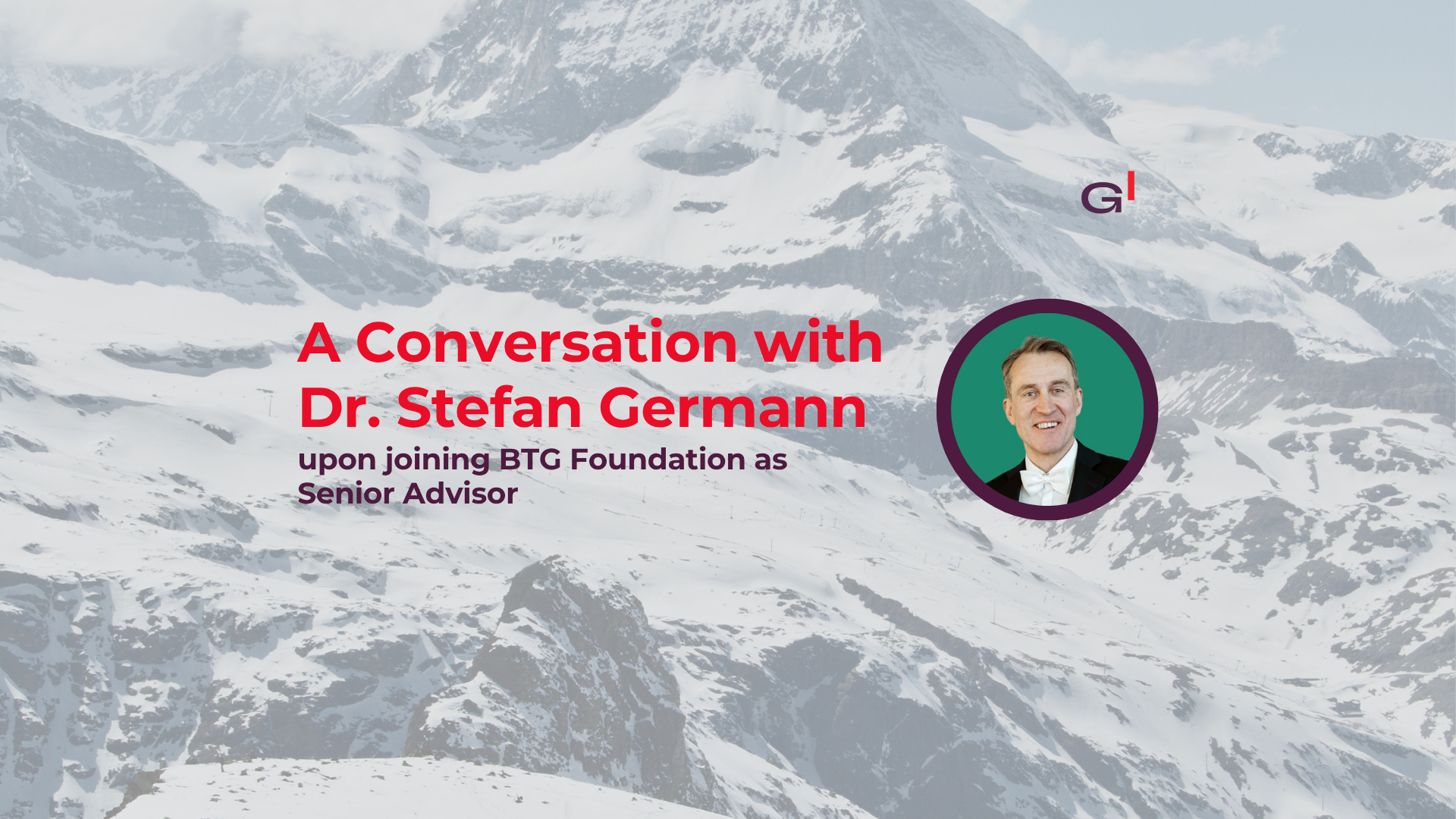
Zürich, 1/10/2026 - Dr. Stefan Germann has spent more than three decades working across community development, philanthropy, impact investing and systems change, with extensive experience in Southern Africa, Southeast Asia and Europe. Now joining BTG Foundation as Senior Advisor, he brings a perspective shaped by a consistent focus on sustainability, scale, agency and what he calls an “owner’s mindset.”
In this conversation, Stefan reflects on the transition from “learning to earning,” the importance of investing in young women, the role of the Pathway Centre, and the need for philanthropy to think beyond grants alone. He also speaks about compassionate leadership, relational wellbeing and the idea that increasingly guides his work and life: “courageous kindness.”
1. Personal journey and connection to BTG
Luca from BTG: First of all, welcome to Be That Girl! Looking back over more than thirty years - from community health programmes in Southern Africa and Asia, particularly the Mekong region, to leading major European philanthropic organisations - what has remained constant in the way you think about creating change?
Stefan Germann: Thank you Luca. I learned very early on that if we want to sustain and scale transformative efforts at the community level, for most contexts and topics we need to understand what a sustainable, scalable business model looks like.
When I was managing Tshelanyemba clinic in the south of Zimbabwe, and transforming it into a full-fledged hospital, and later working on programmes related to children with HIV and AIDS, health and nutrition, water and sanitation, and food programming, I saw that the entrepreneurial mindset within that space was often lacking.
I think that is one of the failures of development work over the last forty or fifty years. It became quite transactional, and people were not thinking through what could be a scalable, sustainable business model.
And I am not talking just about a corporation, or a business where we need to have a product or a service that gets paid for. There are many blended financing structures where different actors within the ecosystem contribute so that a programme or intervention becomes scalable and sustainable.
I say that everyone involved should have skin in the game and make a contribution, in a way that is not dependent for the long term on a few individual dollars.
Luca from BTG: After Fondation Botnar and now leading the Ursimone Wietlisbach Foundation, what drew you to take on the additional role of Senior Advisor at BTG Foundation?
Stefan Germann: There are basically three aspects that resonated very well with me about joining Be That Girl.
First of all, I am a very strong believer that the transition from education - what we call “learning to earning” - from finishing school into a job is a very critical transition, especially for young women, but for young men too.
I do think that, particularly for young women, it is a critical period of time, and the topic has interested me for a very long time.
Secondly, the vision resonated with me very well in terms of being very transformative, but also scalable and sustainable.
And the third is that philanthropy is very much driven by an entrepreneurial mindset. It looks at working with partners that strive to be very cost-effective and focuses on driving change in a way that can be scaled and sustained through good business models.
Luca from BTG: BTG’s mission is to help women lead self-determined lives. What does this concept mean to you personally, and how does it resonate with your experience?
Stefan Germann: I think it is a lot about agency.
Agency, for me, is the ability to understand the context you are in, where you are coming from, and how you can influence the present to shape your future.
I think Be That Girl, with its different programmes, is really creating that space.
It is about creating an enabling environment for young women to grow the power that they have within themselves, in the context of their own agency, to positively influence their lives - not just for themselves as individuals, but also for the community they are in and the environment.
I have a deep belief in the importance, in our society, of understanding the concept of relational wellbeing. That does not apply just to Be That Girl. It is a collective, big challenge of our time.
Wellbeing is not something that you can buy off the shelf. It is an emerging property that is happening every moment in our lives.
It is the relationship between me and myself in terms of my own agency, my capacity to reflect, my capacity to know what is good for me at this point in time, and my ability to take responsibility for that.
Relational wellbeing also emerges when I am in relationship with other people and with the environment.
If the environment is not well, it is difficult for me to be well. If the environment is not well, it is difficult for the society and community where I live to be well. And if I am not well, it negatively influences my peers and my community.
So it is important that we develop that sense of agency. And that is what Be That Girl does: enabling young women to take care of themselves and their own needs, but in relationship to others and the environment.
If we do that well, we create a much more sustainable, much happier and much kinder society.
2. BTG’s distinctive purpose
Luca from BTG: Why does investing in adolescent girls and young women represent such an important opportunity for lasting social change?
Stefan Germann: I think, in general, investing in young people - but particularly investing in young women - is where scalability and sustainability come in.
I am very proud to see that Be That Girl is able to enable young women. Through the support they get, they start to mentor other young women and their siblings, brothers and sisters.
They take leading roles in the community as part of that journey through mentoring. Through that, you have a sustainable, scalable ecosystem.
Whilst the number of individuals directly involved in, let us say, the Pathway Centres or other programmes has a certain limitation, if you look at the influence they have over a ten-year period - in their family, in their community, in their school, at their university - they have a systemic influence.
What that means for society in the long term is not to be underestimated.
I have been strongly encouraging Be That Girl to invest in an alumni network.
I have seen that with one of our partners of the Ursimone Wietlisbach Foundation in the Mekong region, Child’s Dream. For twenty years, they have been doing similar work with young people.
Now they have alumni who are thirty-five or forty years old and quite influential in government and in business, and they continue that transformation because they have managed to keep the network and keep these people engaged as alumni.
Luca from BTG: BTG’s approach focuses on holistic support that goes beyond financial aid, such as scholarships, to include mentoring, life and future skills, wellbeing and community engagement. Why is this holistic model essential to achieving lasting outcomes for young women?
Stefan Germann: I think the holistic approach is absolutely critical. I have been criticising approaches that are too narrow and sectorial.
I wrote my doctorate in literature and philosophy and development studies on the topic of resilience around young people in urban contexts in Southern Africa.
What I learned there, and through my many years of work in the field and in communities, is that young people’s problems are not in boxes.
It is not: here is an education box, here is a nutrition box, here is a health box, here is a mental health box, here is an employment box.
People’s lives are integrated. Our own lives are fully integrated.
If I have a problem in my extended family, it impacts me at work. If I am not nourishing myself well, it impacts my health. If I am afraid of something, I cannot study that well because my mind is not on my books.
Be That Girl understands that growth and development are a multi-layered system.
If you just focus on education but you do not provide mentoring, or you do not understand that maybe somebody has just lost their mother and might need psychosocial care and support, you need to have that integrated, holistic approach.
I think Be That Girl is doing that quite well.
Luca from BTG: Why do you think there are organisations that still focus on specific boxes and do not have this holistic view?
Stefan Germann: It is mainly donor-driven, because donors often have a very sectorial, narrow focus.
And it is easier to measure. Measurement becomes a bit complex when you have multiple integrated interventions. It is very easy if you just do vaccines or bed-net distribution.
Unfortunately, it is often donor-driven. I really encourage foundations and donors to have much more integrated approaches because, from a systems and long-term perspective, they have a much greater impact.
3. Post-secondary pathways and the Pathway Centre
Luca from BTG: A central point of focus for BTG is the transition from secondary education into higher education, employment or entrepreneurship. Why is this such a pivotal - and often overlooked - moment in a young woman’s journey?
Stefan Germann: I think there are a couple of reasons.
One reason is that employment pathways in low-income or middle-income emerging markets are not so easily discernible and not so easy to follow.
Quite often, they are also very relational. And, of course, the big challenge is that there are many more young people than available jobs.
It is also an age group that sometimes falls through the cracks.
If you look at government interventions or donor interventions, you have quite a bit in early childhood education. You have less at primary level, even less at secondary level, and almost none in the post-secondary transition into workplaces.
You have a bit of vocational training, but it is often patchy.
I have seen programmes for an age group that is preparing for that transition, a bit like the Pathway Centres. They give young people confidence to be in an interview and help them differentiate themselves from the large number of others applying for jobs.
I do think that kind of ability is absolutely critical, especially for young women coming out of more vulnerable contexts and communities who did not have the nurturing from parents or relatives, or a good school where they learned these kinds of skills.
These are life skills in that transition from learning to earning.
We see it in Switzerland.
We support a young coaches programme, a coaches-mentor programme. They learn discipline, reliability and punctuality. A study showed that those who are part of that programme perform much better than their peers in apprenticeships within the Swiss system.
I think that with the young women who go through the Pathway Centres, you will see that they are more reliable and have much more ownership.
I encourage them to really cultivate an owner’s mindset.
If you have an owner’s mindset, you get to work to make a real contribution.
That means you are functional. It means you think beyond just what your role is.
You become a very valuable person in your community, in your organisation, in your company, wherever you are.
That personal leadership is transformative.
Luca from BTG: As part of this commitment, BTG is launching its first Pathway Centre in Lusaka, Zambia, to help young women who completed secondary school with BTG support successfully transition to higher education, employment or entrepreneurship. Why do you think this initiative fills a gap in the existing ecosystem?
Stefan Germann: Particularly in the context of Malawi, where Be That Girl currently has a strong focus, that kind of approach is definitely a gap.
During my time when I was more in the field, specifically across Southern Africa, I used to go and visit rural secondary schools and ask young people: “What job would you like to do?”
It was quite amazing, quite disturbing, that the understanding of available pathways was very narrow and limited.
Most young people think: “The only jobs I have are farmer, nurse, police, teacher,” in many of these communities.
And the idea that you could do biology or become a chemist or a pharmacist or a photographer - of course, you always need to see what is in the market.
I think the Pathway Centre is so critical.
You know those torches where you can twist the lens to focus the beam? When it is focused, the light is sharp, but it only falls on one small spot, and everything around it is dark. Sometimes I feel young people see their career options that way, through a very narrow beam. What the Pathway Centre does is widen that beam, so the light falls across much more of what is around them and they can see: "I might not be able to do that, but I have ten other opportunities I can look into. That is a pathway I can choose, and it fits my interests, my skills, my understanding." Always matched, of course, with market realities.
Luca from BTG: The strategy recognises that every young woman’s pathway will be different. How should BTG combine clear ambition with the flexibility to respond to individual aspirations and local realities?
Stefan Germann: That is actually why I agreed as well to be involved with Be That Girl.
I do not believe that transferring models particularly works well.
You can learn from any context, but you definitely need to adapt it.
I think Be That Girl does that well. You look at what works within the Zambian context, the Southern African context, and what is maybe available in other parts of the world. Then you adapt it, you learn, and you reflect.
I do think the key here is that there are some foundational skills that every young person should learn that are not dependent on the thematic focus of the career they pursue.
I think the Pathway Centre is contributing very critically to these foundational skills.
It is what I mentioned before: an owner’s mindset.
You think: “How could I advance what is in the best interest of the organisation I work with?”, not just because something is in my job description or is not in my job description.
When something goes wrong, do I just deny that it went wrong or blame somebody else? Or do I take accountability, learn from it and do it better next time?
There are a number of these foundational blocks that every young person needs in order to have a successful trajectory.
And then on top you stack the more thematic professional area.
That, of course, needs a little bit of a reality check with the local market, and I think that is where the Pathway Centre, with the mentors, can help.
A lot of young people these days want to be TikTokers and make millions with TikTok, or become musicians. But it is really hard and it is not for the faint-hearted.
So it is about making people aware.
If you are so passionate about making a living with music in Zambia, be aware.
We do not want to say, “Don’t do it,” but these are the consequences.
You have to work really hard. You have to market yourself. You need to have all the skills of an entrepreneur to do that well.
Luca from BTG: Launching the Pathway Centre will mark a shift in BTG’s trajectory, from being mostly a grantmaker to being also an implementer. How do you think the organisation can navigate this successfully?
Stefan Germann: I think it is by understanding the landscape, understanding what kind of key actors we bring in, and being humble and learning and listening.
I do think it is important - and it is not always easy - to bring in the relevant actors from the government early on.
I think this is a critical aspect for most emerging countries in terms of career guidance and equipping young people in that transition more successfully, but there is quite a big gap.
We really want to have an impact at scale in Zambia and Malawi.
Eventually, some adaptation of the Pathway Centre model should be financed with government funding.
That means policy engagement with the relevant stakeholders and involving them - whether local government, provincial government or central government.
Keep them informed. Keep them in the loop. Get them excited. And remember: it takes ten years, not three years.
4. BTG’s wider influence and philanthropy
Luca from BTG: BTG’s strategy combines direct support for adolescent girls and young women with investment in local partners, strategic partnerships and knowledge and influence. Why is this integrated approach essential to creating lasting change?
Stefan Germann: I think there is a third piece that I would like to add.
That third piece is really the private sector.
I think it is very important to establish links for the Pathway Centres.
It could be a chamber of commerce, or it could be a women-in-business network.
Start to see how these Pathway Centres can really be linked to employers - not just in the capital city, but across the whole country, in different sectors.
Through that, you can start to have internships where young people gain tremendous practical experience, and they might be mentored by someone who is part of a women-in-business network.
So we need to expand that private-sector ecosystem as well, alongside all the other actors.
Luca from BTG: As Senior Advisor, where do you hope to challenge BTG’s thinking - and where could BTG challenge the wider philanthropic sector?
Stefan Germann: One is that I am really pushing on scaling and sustaining.
I was involved with negotiations around income-share agreements, which of course we need to be quite careful with in terms of more marginalised population groups.
But what I like about income-share agreements is that they create incentives for young people to be successful and then, as part of solidarity, to give back so that other young people can benefit in the future through part of their future earnings.
It lends itself to long-term, patient-capital investors, where we as foundations can take a sort of first loss and bring in other investors - hopefully local investors.
My vision would be that a successful income-share agreement in Zambia would lead, in a few years, to Zambian pension funds starting to invest into pathways.
It becomes a revenue model that, from a fiduciary point of view, could be sufficient for a pension fund to invest into the future of a country in a meaningful way whilst creating revenue.
It is an impact-investing lens, eventually leveraging domestic capital.
That is where I really see the challenge.
It may take fifteen years to get there, but it is the direction we should move in.
We need to move away from this idea that we have one dollar as a grant and we burn that one dollar as a grant.
The question for Be That Girl is: how can we, with that one dollar, create ten dollars within the ecosystem?
Luca from BTG: Are there success cases of local pension funds investing in a Pathway Centre?
Stefan Germann: Not to my knowledge.
But it does not necessarily have to be pension funds. It can be local banks.
We had an example in Namibia where a bank was involved in investing in a scalable early-childhood-education franchise model. So there is interest.
I know even in Nigeria there are local funds looking at impact investing within their own countries, focusing not just on generating financial returns but also on long-term societal, transformative impact.
I do think that if we get the Pathway Centres right in terms of the business model, linking them to income-share agreements, that then becomes an investable solution.
Luca from BTG: When you look at the evolution of philanthropy over the past twenty years, what has fundamentally changed - and what has not?
Stefan Germann: I think what has fundamentally changed fairly recently is probably two things.
One is unfortunate, although there is an upside as well. The kind of solidarity across regions and countries has declined.
Especially among bilateral donors, it has become much more part of foreign policy than it was ever before.
It is much harder to have collaborative spaces that are driven more by solidarity, and most engagements are very driven by interests.
That has changed. It is not always positive.
The upside is that with the change in the funding landscape and this dependency on donor money, there has been a little wake-up call.
Many organisations are starting to look at more sustainable business models that are scalable.
As I mentioned at the beginning, not every topic lends itself to a business model.
Protecting young children from sexual abuse is quite difficult to turn into some sort of business model. For people with severe cognitive disabilities, it is quite difficult to have a sustainable business model in terms of the care and support they need.
So I do think there are areas where continuous charitable or government support is needed.
But there are so many other areas - most areas - that lend themselves to having a much better sustainable, scalable business model.
I am very much in favour of impact businesses where it is not about the shortest-term maximum return, but where patient capital is possible, with blended financing, with government putting in its share and with local users contributing appropriately to their purchasing power.
Then you can have blended business models that can be much more sustainable.
That, for me, is a positive change.
We have different conversations than twenty years ago.
Luca from BTG: A shift from a grant-first to a sustainability-first approach?
Stefan Germann: Yes. One of the things still missing in foundations - and this is an area I am very passionate about - is that too many foundations are not aligning their assets and their endowments with the impact they are trying to generate on the grant side.
Some are actually working against it.
You have large foundations doing climate activism, but on the asset side they are still financing and investing in businesses that are the very problem the grants are trying to address.
You have foundations trying to support young people’s mental health while, at the same time, their endowment is invested in addiction-based social-media companies that create the very problem of mental health in young people that their grants are trying to address.
There is a lack of intellectual coherence among many foundations between where their assets that generate the revenue are sitting and where the grants are sitting.
We need to challenge philanthropy to do what we call “total impact”.
Every asset is creating an impact.
The question is: does it move your mission on the grant side forward, or does it pull it back?
Luca from BTG: How has the profile of people that the philanthropy sector should attract changed over the years? What do you think are essential skills to look for in this sector?
Stefan Germann: I see at the moment a lot of people interested in moving into more impact-related businesses and philanthropy.
What unfortunately many of them lack is really good contextual rooting and lived experience within some of the contexts where people are trying to make a difference.
I always say I feel very glad that I had many years living in rural areas in Africa - almost ten years. I worked around fifteen years in Southern Africa and around ten years in Southeast Asia.
It gives you a contextual understanding of very dynamic, fast-evolving contexts.
I think a lot of people who have predominantly been educated here in Europe and worked in Europe underestimate how fast and profoundly some of those contexts are changing, and the challenges that change brings.
There are a lot of well-intended, well-educated people with good track records in businesses here in Europe who want to make a difference.
But you cannot just shift across and then think you can really make a difference if you have not done the work of being in the context and understanding the context.
In terms of the most important mindsets and skills, it is probably to be humble, to be able to listen and to try to really understand.
We are so often very quick to think we know the solution.
I am very much encouraging solution-focused approaches, but rooted in that deep listening mode - really trying to understand.
The second is what I have mentioned several times: the owner’s mindset.
An entrepreneur’s mindset and an owner’s mindset, for me, are kind of interchangeable.
It is continuously questioning: with the limited resources you have, how do I deploy these resources that are very scarce, and how can I contribute to getting the best out of them with the different actors and stakeholders I am working with?
5. Leadership, future and legacy
Luca from BTG: You have often spoken about compassionate leadership. How has your understanding of it evolved since your early years in humanitarian and community development work?
Stefan Germann: When I was quite young, I was managing the Tshelanyemba clinic that was transformed into a hospital.
I had some tough times where I had to fire people.
You can say firing a person is not compassionate leadership, and I would completely disagree with you.
Firing a person, if you do it respectfully and if you really consider the whole person and the implications it has for that person, can be a gift to that person if you do it well and with respect.
For me, compassionate leadership is not about trying to avoid confrontation.
It is about bringing yourself into it, acknowledging your own vulnerabilities and shortcomings, but also the strengths that you bring in and the need to confront the situation, and doing it in a respectful, kind way.
Civilisation has the word “civil” in it.
And civil means kind, respectful behaviour.
I fear a little bit that in management and leadership practice, and especially in politics, we have really lost the civil part of it.
For me, compassionate leadership is not about thinking in terms of power and hierarchy, but asking: how can I serve and bring in my experience and capabilities to move not only the company’s or the organisation’s best interests forward, but also make a contribution to the wider society and the communities we are in?
That comes back to relational wellbeing.
A strong economy is about creating wealth for nations. It is about creating wealth for society so that people can have better wellbeing.
It is not an end in itself.
That is why I am very passionate about impact investing.
There are four capitals: financial capital, nature capital, societal capital and people’s capital.
We should have profit-and-loss statements on all four of these capitals in the balance sheet of a company.
That is compassionate leadership. If I am compassionate about people in my company and in the community where my operation is, if I am compassionate about a society that gives us a licence to operate, if I am compassionate about nature that sustains all our collective lives, and if I am compassionate about driving profits, then I can scale, sustain and do well.
Luca from BTG: Financial capital is clear to me. People’s capital is clear to me. What do you mean by nature capital and societal capital?
Stefan Germann: Nature capital is basically about recognising that our economic model is still very much extractive in nature and not regenerative.
If I burn the capital and I am not renewing it in a way that deprives future generations, or deprives others through externalities, then I create a loss.
If I manufacture the cheapest T-shirt in Bangladesh because the toxic colour goes downstream into the river, destroys all the fish downstream and people get sick from the water, that is a problem I create for others.
There is nature capital being undermined.
I create a loss on nature capital.
We need to start reporting that in terms of the carbon footprint created through products and services, water waste, perhaps soil erosion - these are all losses to nature as a capital.
I should have that represented in a profit-and-loss statement so that an investor can make a real decision about the value of my company.
And societal capital - I take Meta as a good example.
Meta might look good on the balance sheet and in the profit-and-loss statement, but its algorithms have destroyed the foundations of democracy and thinking and undermined society more than any other company probably has in the last one hundred years.
Luca from BTG: Throughout your career, you have worked across humanitarian action, philanthropy, impact investing and systems change. What gives you the greatest sense of hope today?
Stefan Germann: It is actually the young people. I have not had a chance yet to go to the Pathway Centre. I hope to do that in the coming years.
In my work, we focus as a foundation on the Mekong region.
When I go and meet young people in similar programmes, it is part of our learning journey.
I remember being in Mae Sot, the border town between Myanmar and Thailand, where you have a lot of young people who had to flee because of the coup and the civil war, and the destruction and bombing of schools in ethnic-controlled areas.
It is a really difficult situation.
I met a group of young people who were in that transition after school and before going to university, upskilling a bit like in the Pathway Centre - mentoring, English skills, presentation skills, and getting themselves ready to apply for university degrees.
I met this group of ten young students and I was just so inspired.
They faced huge challenges back home, but the questions they asked, the challenges to my generation they raised, and the ambition and hope they have to contribute to the future - it just blows me away.
Even here in Switzerland, I really like engaging with young people, fifteen- to thirty-year-olds.
It is very positive to see how many want to contribute.
Luca from BTG: Looking ahead to 2030, what would meaningful success for BTG look like - for young women, local partners and the wider ecosystem?
Stefan Germann: 2030 is soon.
I think success for Be That Girl would be if those young women who are now part of the programme evolve and become alumni, and take an active role in their communities mentoring others, encouraging others and giving back what, through Be That Girl, they have felt has benefited them.
They really are fired up in solidarity to enable as many other young women in Zambia and in other countries as possible to experience the same.
Luca from BTG: Finally, when you look back on your life’s work, what legacy would matter most to you?
Stefan Germann: A couple of years ago, I did a deep dive on this.
I feel that in life it is good to have a North Star, a kind of guiding star.
I do that every ten years or so, to re-examine what that North Star is, because sometimes life changes.
For a long time, my North Star was contributing towards children’s rights and enabling environments for children.
A few years ago, I adapted that North Star.
It is now my life’s commitment to bring courageous kindness to myself, my loved ones, all people and the planet Earth.
In terms of legacy, I would like to really contribute to that growth of courageous kindness within myself, but also within my workplace, the teams I work with, the organisations I influence, the community that I live in, wider society and, of course, the environment.
I like courageous kindness very much because kindness on its own can be a little bit fuzzy and fluffy.
But courage is a very powerful driver of change.
Luca from BTG: Thank you, Stefan. It has been great. And welcome again to BTG!
Stefan Germann: Thank you. My pleasure.