
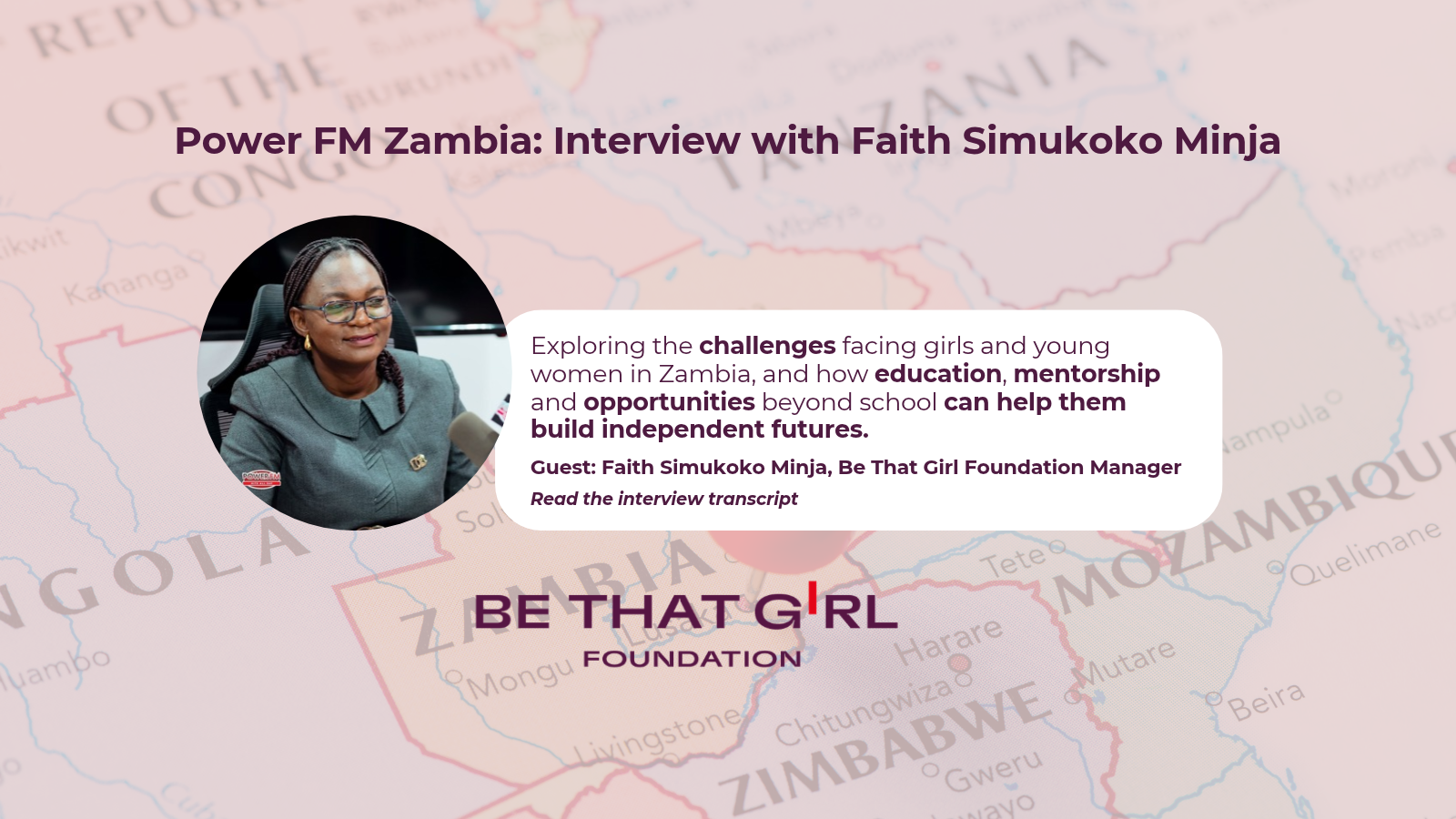
Broadcast: Power FM Zambia - Voice of the People
Guest: Faith Simukoko Minja, Be That Girl Foundation Manager
In a recent interview on Power FM Zambia’s Voice of the People, Faith Simukoko Minja, Be That Girl Foundation Manager, discussed the challenges facing girls and young women in Zambia, from barriers to education and teenage pregnancy to limited opportunities after completing secondary school.
The conversation explored how Be That Girl Foundation supports girls through scholarships, mentorship and coaching, as well as its plans for the Pathway Center in Lusaka, an initiative designed to help young women transition from secondary education to further studies, employment and entrepreneurship. Faith also highlighted the important role of families, communities and businesses in helping girls build independent futures.
Below is the edited interview transcript.
Power FM presenter: Now, today we are talking about foundations, and we have Be That Girl Foundation. Be That Girl Foundation is working to help girls and young women from low-income backgrounds pursue education, develop essential life skills and access opportunities that can help them build independent futures. Through scholarships, mentorship, coaching and other forms of support, the foundation seeks to help girls navigate the challenges of adolescence and the transition into further education and economic independence.
Today, we turn our attention to the dreams, challenges and opportunities facing adolescent girls and young women in Zambia. Completing school should open doors to a brighter future, but for many young women, the journey becomes even more difficult after Grade 12. The cost of tertiary education, limited career guidance, early pregnancies, child marriage and gender-based violence can stand between a young woman and her ambitions.
So, what happens to the girl who completes secondary school but cannot afford university? Who helps her discover her talents, develop practical skills and find a path towards financial independence?
Joining us in the studio today is Faith Simukoko Minja of Be That Girl Foundation, a development practitioner with more than 23 years of experience in education and gender equality. We’ll discuss the foundation’s work supporting girls through scholarships, mentorship, life skills development and its Emerging Pathways Center initiative in Lusaka. We’ll explore how the organization is helping young women move beyond secondary education into further studies, vocational training, employment and entrepreneurship skills.
Madam Faith, welcome.
Faith Simukoko Minja: Thank you so much.
Power FM presenter: You’re welcome to Power FM.
Faith: Thank you for having me.
Power FM presenter: Now, to start with, help us understand the foundation and what it is about.
Faith: Thank you so much. Be That Girl Foundation was established in 2021. From 2021 up to 2025, we’ve mainly been working as a funder, providing sub-grants to other organizations working in education.
Our main mandate as an institution is to empower girls, ensuring they are able to live self-determined lives. We believe that once a girl is supported in all areas of need, education remains key. We understand that education is indeed an equalizer, regardless of someone’s background or where they come from.
In Zambia, this will be the first time we are directly implementing a program. But we already have two organizations in Zambia that we work with. Since 2022, we have been providing them with funding to support girls in education: Mothers Without Borders and CAMFED.
We have been supporting these two institutions, especially Mothers Without Borders, which I think has been our main partner. Through our funding, they have been able to provide scholarships to secondary school girls and young women. So, basically, that is what we do in Zambia.
Power FM presenter: Many adolescent girls face challenges that threaten their education and future opportunities. What are some of the biggest challenges affecting the girls you work with, and how is the foundation helping to address them?
Faith: Thank you so much. We know that in Zambia, when you look at statistics from the Ministry of Education, every year we record quite a large number of teenage pregnancies. For example, in 2024–2025, we recorded more than 12,000 pregnancies in the country. That already shows there is a very big challenge that continues to hinder girls from continuing with education.
Teenage pregnancies are very rampant in Zambia, as are child marriages. That is why we have the National Network on Ending Child Marriages, where civil society organizations have partnered with the government to ensure we can curb some of these issues of child marriage and teenage pregnancy.
As an organization, we feel these issues also raise the question of how we can ensure that traditional and cultural practices do not continue to hinder girls’ access to education.
Teenage pregnancy and child marriage are among the challenges, but high poverty levels have also continued to affect girls’ ability to complete education. Poverty at household level can hinder parents from supporting their children to continue with school. As you mentioned in your introduction, the cost of education is very high for some parents to afford.
When you look at university, for example, families may be unable to manage the costs. Even though we have loans, it is quite demanding. Not everyone has access to the opportunities provided through the Loans Board.
Some of these challenges that girls and young women face are also faced by boys. But when you compare the two, you find there is a higher chance of girls dropping out of school as a result of some of the challenges we have mentioned.
I’ll give an example from a classroom. When I was working with FAWEZA, we went to one of the rural schools. A teacher told us that in Grade 1, there were 50 learners in a particular class, with gender parity: 25 girls and 25 boys. But by the time they progressed beyond Grade 5 and reached the Grade 7 examinations, almost 50% of the girls had dropped out.
That already shows that there are certain challenges we face that affect girls differently from boys. I am saying this because there have been a lot of questions about why we support more girls than boys. This does not mean we are sidelining the boy child. There are a number of programs coming on board for boys as well.
But we are looking at the bigger picture: what might happen 20 years from now if we do not concentrate on addressing all the barriers that hinder girls from accessing education?
For example, when you look at leadership in Parliament, or even in management roles, we still have very few women representatives. Even in our current Parliament, where a number of seats were created through changes to the Constitution, we have still not reached 30% or 40% women’s representation.
That shows that society continues to experience gender inequality between men and women. That is why we are always pushing to ensure that every barrier that can hinder a girl from completing education is eliminated. That is exactly what we are doing together with other stakeholders.
Another challenge I see facing girls and young women is access to sexual and reproductive health and rights services. When you look at the 12,000 reported teenage pregnancies, that shows there is a lot of information these young people require. For me, 12,000 getting pregnant means they have been having unprotected sex, which means the risk of contracting HIV and other sexually transmitted infections is also very high. This also has implications for the fight against HIV and AIDS.
You see that every challenge a girl faces, when you look at the outcome, reflects difficulties in other sectors. There are health issues, poverty and the ways culture can exacerbate some of these things. All of that calls upon us, as citizens, to look at the main problems we face as a country so that we can address some of the challenges girls are facing.
Power FM presenter: Thank you Madam Minja. We have discussed what the foundation is about and some of the challenges affecting girls. Now, turning our focus to Be That Girl Foundation, which we know operates in several countries, including Zambia: What are some of the specific programs Be That Girl Foundation is implementing locally? Which communities are you reaching, and how can girls access your support?
Faith: Thank you so much. As I mentioned earlier, as a foundation in Zambia we have been working through Mothers Without Borders and CAMFED. Mothers Without Borders has operations across Zambia, in all the provinces, and CAMFED works across six provinces of Zambia.
The services we mainly provide are mentorship, coaching and scholarships. Our scholarships run from secondary school, Grade 8, all the way through Grade 12. When a girl completes Grade 12, we continue with the scholarship up to university until she completes her education.
We have had a number of girls supported by Be That Girl Foundation who started in Grade 8, continued through university and completed their education. For us as a foundation, support for girls needs to be holistic rather than partial.
You find that certain institutions will sponsor a girl from Grade 8 to Grade 9, or perhaps up to the end of secondary school, and then the support ends there. They do not have further support through tertiary education. For us, we really want to see holistic support given to these girls.
Mentorship also plays a very key role. In our five years of operation as an institution, we have seen how important mentorship is in a girl’s life. When girls are mentored, whether at school or at home, they are able to make informed decisions about which pathway they want to undertake.
That is exactly what we are doing as an institution: ensuring mentorship is a day-to-day part of a girl’s life, alongside coaching and the necessary support they require to continue their education.
I must mention that, as a foundation, our primary beneficiaries are those from vulnerable backgrounds. We work mainly with vulnerable girls.
When you look at the selection criteria used by Mothers Without Borders, our partner handling the secondary level, they assess the girls to ensure they come from vulnerable families. Vulnerability at household level also affects girls, because parents may be unable to continue supporting their children.
Some of the children come from single-parent families, or both parents have passed away and there is no one able to support their education. We also focus on child-headed households, where children are taking care of one another. They cannot manage the school fees or the educational costs they are required to pay from time to time.
I know education in Zambia is free, but it is not entirely free when you look at Grades 8 to 12. There are other school requisites needed to enable a girl, or any learner, to continue with education. So costs are still there, regardless of education being free.
We also appreciate the government’s free education policy, because it has given many more children the chance to access education. Even if you have only one uniform, you can continue attending school.
We know there are other services, such as the Constituency Development Fund (CDF), which I think need to be looked into closely. We need to consider how vulnerable children are accessing this fund. There is a lot of discussion about whether girls and boys are able to access the CDF, because it has an education component.
Are people really aware that they can apply? And are the application procedures easy enough for someone in a rural community to access the funding? These are issues we need to look at when considering the government services available to community members.
Power FM presenter: Very interesting, for sure. You touched on scholarships, which are one of the foundation’s key interventions. How does the scholarship program work, and what criteria must a girl meet to benefit from this support?
Faith: Thank you so much. Overall, it is vulnerability. Nothing else. We do not look at academic performance, because one thing we believe is that everyone is intelligent. But the circumstances surrounding a person can affect their performance.
We know that some scholarships have requirements such as six points or 15 points. But in our case, we believe everyone is intelligent; it may just be the circumstances surrounding them.
So we do not look at academic performance when enrolling a learner. We only look at vulnerability. Once someone is vulnerable, they can reach out.
For secondary education, they have to reach out through Mothers Without Borders. At the moment, we are not recruiting girls and young women directly for support. Recruitment is through our partner organization, Mothers Without Borders. We continue to provide sub-grants to them so they can select vulnerable children, who can then transition into the Pathway Center that we will discuss later.
Our main focus is supporting vulnerable girls in Lusaka, including those living in its compounds, who can reach out to Mothers Without Borders. The organization also runs programs outside Lusaka.
For example, next year they will be recruiting 100 girls entering Grade 8. As Be That Girl Foundation, we will continue supporting those 100 girls until they complete Grade 12, and then facilitate their progression to university until they complete their education.
We have a long-term plan as a foundation to reach as many girls as possible. Of course, funding can be a limiting factor. But we are doing our best to ensure that whoever is enrolled in secondary school under a Be That Girl Foundation scholarship can continue all the way through university.
Power FM presenter: Now, let’s speak about protecting girls from abuse. The foundation’s strategy includes holistic support and protection from gender-based violence. How does the organization help girls who experience abuse or unsafe conditions? And what roles do families and communities play in protecting girls?
Faith: Thank you so much. We have interventions aimed at protecting girls. In working with our participants, as we call them, we have a safeguarding policy in place. The safeguarding policy is meant to ensure that whoever comes into contact with our girls understands safeguarding and the need to protect them from abuse.
It is not only about institutionalizing safeguarding. It is also about providing girls with information, so that they are aware of gender-based violence. Through the mentorship they undergo with Mothers Without Borders, they are taught about the various forms of gender-based violence and where they can report such cases.
When we come to the Pathway Center, which we will be starting in January, we have interventions planned with the Zambia Police to ensure there is a reporting mechanism where a girl who experiences gender-based violence can report directly to the police.
We will also have talks at the center. Zambia Police officers will come to provide information to our girls, to ensure they understand their rights, the forms of gender-based violence and where they can report when they experience abuse. Some of the things that lead to gender-based violence are not being aware of your rights, not being aware of the forms of gender-based violence and not knowing where to report it.
This is a holistic approach: providing information, ensuring prevention and making sure we are able to handle certain cases of gender-based violence if they are reported.
As a foundation, we are also going to be part of key networks of civil society organizations in Zambia. For example, the National Committee on Ending Child Marriages that I mentioned earlier provides a platform where we can advocate for greater protection of girls.
We also plan to participate in national commemorations such as the 16 Days of Activism Against Gender-Based Violence. These activities are mainly intended to raise awareness in communities.
For me, communities play a very key role in fighting gender-based violence, because it is within communities that these issues are happening. In the past, we used to believe that when you see a child, that child is everyone’s child. You have to be concerned.
When you see a girl, perhaps a five-year-old child, who has been left alone at home and is just wandering around, you as a neighbor must take an interest. Who is this child with? Because such children can be abused by anyone.
I am always concerned when I visit communities where mothers have to spend the whole day at the market earning a living. My concern is: Who is looking after their children while they are away? If children are left without proper supervision, they become vulnerable to abuse. That is why we need to ensure they are protected.
As neighbors, we also need to be concerned. If my neighbor has gone to the market and the children are just playing outside, who is watching over them?
As communities, we all have a role to play in the fight against gender-based violence. Schools are also a good platform for fighting it. What are we teaching our children in schools? What are they learning about gender-based violence? And what are teachers doing to ensure we protect girls from abuse?
Holistic support is required from communities, the government and ourselves as civil society organizations. All of us working together will be able to fight gender-based violence and protect girls in our country.
Power FM presenter: Now, let’s speak about beyond education. How is the foundation preparing young girls to become economically independent, secure employment and develop practical skills to contribute to their families and communities?
Faith: Thank you so much. Through the Pathway Center initiative, we are looking at coaching these girls once they complete their education. We want to empower them to understand which pathway they would like to take.
Sometimes it is interesting when children finish Grade 12 and you ask, “Now that you are done with Grade 12, what do you want to become?” And the child says, “For now, I don’t know.”
So this is a child who completes Grade 12 without knowing which direction to take. Some of these children then go to university. Today they are in the School of Engineering, and the next year they drop out and go into another school. It is because they were not sure.
Then their parents become frustrated and say, “You are just changing courses.” The child may be changing courses because they were not sure what they wanted to do while they were still at school.
So the mentorship program gives girls and young people an opportunity, while still in school, to have a clear picture of which direction they want to take. With the resources provided, they are able to realize their dreams.
Ultimately, we know they are going to be economically empowered if they continue with that mentorship and know which direction they are taking.
The coaching at the Pathway Center will help girls sharpen their vision and follow the pathway they choose, whether that is entrepreneurship, employment or further education.
Power FM presenter: Well said and well articulated. You’ve mentioned the Pathway Center throughout our conversation. What exactly is this initiative?
Faith: Thank you so much. The Pathway Center initiative is aimed at bridging a gap we identified in our work supporting girls. Since 2022, we have seen girls continue their education and complete Grade 12, but after finishing secondary school, they often face a waiting period before going to university.
That one-year gap, when they are waiting for results or waiting to go to university, was found to be a very risky period for young girls. It is a time when they feel they have completed their education and become excited about having more freedom. For some, that period might disrupt their bright future. They might end up getting pregnant, getting married or becoming involved in other harmful situations because they have so much idle time.
They feel, “I have the time now. I can do whatever I want, since I have completed Grade 12.”
When we realized this, we conducted research in which the girls themselves were involved through focus group discussions. We asked them what they did during that period. The majority said, “I just sit at home, helping my parents,” and similar things. This showed us that the year after completing secondary education can be an idle year for a girl.
The Pathway Center comes in to bridge that gap, because it is a risky period for young people, especially young girls. At the end of it all, we do not want to lose them after educating them for the five years they were in secondary school.
The Pathway Center will mainly provide coaching, as well as ICT and entrepreneurship training. The idea is to ensure that within that one year when the girl is waiting to go to university, she is empowered and equipped with the necessary skills to help her move into her next stage of education.
Our aim is to ensure that whoever passes through the center can go to university equipped with ICT skills. We have been to universities and seen first- and second-year students who do not even know how to use a computer. They have to take their assignments to a café to have them typed, because they do not know how to use a laptop.
All these skills will be taught to girls at the Pathway Center. We will have a fully equipped ICT lab and an ICT trainer. We have an entrepreneurship trainer, a senior coach and another coach focusing on career guidance and internships.
We will also provide internship opportunities through the center. These opportunities are not employment as such. They are internships, or what we might call job shadowing, aimed at exposing girls to the real world of work.
For example, a girl who wants to be a journalist could come to Power FM and spend four weeks here, to get a feel for what it means to be a journalist. With your support, that experience could give her the motivation to study journalism because she already understands something about the profession.
If you go to study without being sure what careers are available in a particular field, it can be difficult to develop that passion. We hope the internship program will ignite that passion so that when the girls go to university, they might say, “Yes, because I saw Francine on television or heard her on the radio, I want to do the same.”
The internship exposure is aimed at equipping them with practical experience so they can better understand what they are going to study when they enter university.
In terms of entrepreneurship, it is not mainly about saying they must go and start a business immediately. It is about a mindset shift. Most of the time, I think entrepreneurship has been seen as something for people who have not completed school. But we want to change that mindset and say everyone can be an entrepreneur.
Financial literacy is also required for every person, because even when they start working, they need to manage their finances. Often, we find people unable to manage their household finances, not necessarily because their income is small, but because they do not have the financial discipline to manage their resources adequately.
So girls will also receive financial literacy training. Some will use those skills in their future. Our training will be practical rather than mainly theoretical.
In entrepreneurship, they will also be involved in projects to help them acquire practical skills. Even when they complete university and are waiting to be employed, they may be able to venture into some form of entrepreneurship, perhaps by selling products or using skills they have learned, such as baking or ICT. They can use those skills to become entrepreneurs in their own way.
Power FM presenter: Let’s now look at Vision 2030. It used to seem far away, but it is approaching quite quickly. You have a strategy outlining your plans from 2026 to 2030 to support girls. Walk us through this. What are your main priorities, especially within Zambia over the next four years, and what changes do you hope to see by 2030?
Faith: Thank you so much. In terms of the Be That Girl Pathway Center, the work we are starting in January will have its first year, 2027, as more of a pilot. There will be a lot of learning. We will look at the strategies we have put in place, what is working and what is not, and document the best practices so that we can learn and improve what we are doing at the Pathway Center.
Over the next four or five years, we want to look at how we can ensure that every girl who passes through the center is positively impacted. We also want to see how, in five years, the first cohort of girls we support can come back and provide a service to those who follow them.
I think one thing we are learning in Zambia, or in Africa in general, is that when someone benefits from a resource, it can be rare for them to look back and give back through a service or a contribution. We want to instill this value in the first cohort.
Five years after they finish school, when they are working, we want them to be able to look back and say, “Yes, there was an organization that supported me. How can I go back and provide a service?” We expect some of them to become senior mentors to their younger sisters.
That is mainly what we are looking at over the next five years: how the girls we empower can come back as alumni and support other girls in different ways. Some will be working in big companies. How can they open doors to internship opportunities for those coming behind them?
For us, these are important priorities, but we are also looking at how we can contribute to government efforts, particularly in promoting inclusive education.
We participated in the drafting of the National Development Plan, focusing mainly on the skills and education sectors. Through our work as a foundation, we are contributing to these national efforts. For example, if we reach 100 learners each year, we will also be contributing to the attainment of Zambia’s Vision 2030. These are some of the priorities we are focusing on.
Above all, we want to ensure that the support we provide to girls is meaningful and impactful. That is why we are also committed to employing the best staff, who can help these girls achieve greater things in their lives.
Power FM presenter: You mentioned teenage pregnancies earlier. When a girl becomes pregnant while she is still in school, her education and ambitions can be disrupted.
What support systems are needed to ensure teenage mothers are not permanently excluded from education, skills training and employment?
Faith:Thank you so much. I think Zambia has been proactive in this area because we have a re-entry policy that allows girls to continue their education even if they become pregnant.
Our role as an institution is to raise awareness about the existence of this policy, which was recently revised.We must also ensure that girls understand the risks and consequences of teenage pregnancy and early marriage while they are still in school.
The mentorship provided through Mothers Without Borders, together with the coaching we will offer at the Pathway Center, will help girls make informed decisions.
We will also continue working with other civil society organizations in Zambia, such as the National Network on Ending Child Marriages, to address these challenges. These platforms provide opportunities for civil society organizations to contribute meaningfully to advocacy around teenage pregnancy and child marriage.
I also think the scholarships we provide can help girls focus on school rather than becoming involved in these other situations. Some girls explain that they were looking for money to meet their needs and ended up in situations that led to pregnancy. This shows how poverty can play a significant role in contributing to teenage pregnancies.
As a foundation operating here in Zambia, I should also mention that our headquarters are in Switzerland. That is where our founder, Madam Cornelia, is based. Although we work in six other countries, Zambia is the first where we are implementing this kind of intervention directly. In other countries, we are supporting work for girls and women through partners. We are grateful that the foundation chose to start direct implementation in Zambia.
Power FM presenter: Speaking of supporting girls and women, men and boys are often left out of these conversations. How can they become active allies in preventing gender-based violence, challenging harmful gender norms and promoting equal opportunities?
Faith: Thank you so much. Through our partner, Mothers Without Borders, there are other programs focusing mainly on boys. I think there are also many other NGOs working on issues affecting boys.
Regarding men and boys as allies in fighting gender-based violence, I am aware of men’s networks and boys’ networks that are already doing a lot of work. For me, once we have males partnering in the fight against gender-based violence, we will be able to win that fight.
So, boys and men, we call upon you to be at the forefront of fighting gender-based violence. Statistics from the Zambia Police have shown that the majority of victims of gender-based violence are female and that the majority of perpetrators, unfortunately, are male.
That shows the need to bring more men on board in the fight against gender-based violence and to continue raising boys to see girls as their sisters, whom they can protect.
I am aware of a program under Oxfam that involved boys’ forums established in schools in collaboration with FAWEZA at the time. Through these forums, boys were trained to use their masculinity positively and encouraged to protect their sisters.
This led to the “I Care About Her” campaign, which encouraged men to take a leading role in addressing gender-based violence. By working with musicians, the campaign was able to reach communities and encourage more men to join the fight.
As civil society organizations, we continue to engage boys and men as allies in the fight against gender-based violence.
Power FM presenter: We have received a message from a listener in Chongwe District, who emphasizes the importance of educating and training girls, addressing child marriage, and supporting girls living in poverty.
Do you have any comments on that? And what can families do when they prioritize educating boys over girls, particularly when resources are limited, because they believe that investing in a boy’s education will bring financial returns?
What can communities do to encourage families to invest equally in their daughters’ education and future?
Faith: Thank you so much. Regarding the comment from the man from Chongwe, yes, we need to continue our interventions around educating girls and curbing child marriage.
In areas like Chongwe, where I think he is coming from, child marriage is indeed one of the worrying issues. Such things are happening in many rural communities. We want to keep working with other institutions to ensure that girls are left to be girls. Let them go to school, because their future is just as important as that of a boy.
Coming to your question, we need to ensure that girls are given the right platform to continue with education.
It is a myth when parents say, “If I send a boy to school, the money will come back.” What guarantee do you have? And what happens when you leave the girl out of school?
For me, parents must provide an equal platform for both girls and boys, with the support they need so that all of them can continue their education.
If resources are not adequate for you to send all your children to school, it is important to reach out to government institutions. I was just talking about the Constituency Development Fund. The CDF is an opportunity available to community members. Vulnerable children can apply for support through the fund so they can continue their education. We also have the Loans Board, where people can apply for education loans to continue their education.
We are calling upon community members to ensure there is equality in how resources are distributed to educate both girls and boys, because you do not know which child may support you tomorrow. You might think it is the boy. There are parents who regret prioritizing a boy’s education over a girl’s. Some parents have said they wish they had sent their daughter to school, after sending their son as far as India only for him to return as a Rastafarian who is not doing anything.
He has come back with long hair, all the way from India.
So it is a gamble. You cannot say that because you have supported a boy, money will come back.
At the end of the day, what I am saying is that there must be equality in how we treat boys and girls.
That also brings me to the need for an equal distribution of household chores between boys and girls. Often, in households with both girls and boys, we expect the girl child to wake up very early and do chores before going to school, while the boy is allowed to sleep, wake up, bathe and go to school.
These inequalities mean the girl arrives at school already tired. Why can we not have households where both the girl and the boy John are given certain chores, so that both contribute before school, if they have to do chores?
I know that in some areas, like Lusaka, many households nowadays have domestic workers. But it is still important for children to learn skills at home. Otherwise, they can become vulnerable when they cannot cook for themselves or wash their own clothes.
A boy can be 18 years old and still unable to survive on his own because he has not been taught these skills at home. At 18, someone is still washing his clothes. Such values must be instilled at household level.
These are children who may go to boarding school and fail to cope because they have been spoon-fed. Everything is done by the maid. Let us raise children who can stand on their own in whatever environment they find themselves.
Power FM presenter: As we wrap up, businesses need skilled, motivated employees, while many young women need work experience and a first opportunity. What would you say to Zambian companies that could offer internships, mentorship, apprenticeships or entry-level jobs but have not yet partnered with organizations supporting girls?
Faith: Companies are focused on running their businesses and generating revenue, so naturally, they want qualified staff in their various departments. However, it is important that they also provide opportunities for the younger generation.
Young people who have completed Grade 12 or graduated from university are looking for opportunities to gain work experience. We therefore call upon companies, organizations and institutions to open their doors to these young people because, in doing so, they are helping to build the future.
Through the Pathway Center, we will also be looking for opportunities for girls who have completed Grade 12. These girls will already have received training and acquired basic skills. Of course, we cannot expect someone who has just completed secondary school and is preparing to enter university to have extensive professional experience.
That is why our focus is on job shadowing, which will allow girls to experience different working environments and develop an interest in the fields they wish to study.
We are therefore calling on companies and organizations to partner with Be That Girl Foundation by providing these opportunities. In 2027, we expect to have 50 girls at the Pathway Center, and our goal is to secure 50 internship or job-shadowing placements so that each girl can gain practical exposure to the professional field she hopes to pursue.
Power FM presenter: Madam Faith, thank you so much. It has been a pleasure. Before we let you go, how can those who have been listening and would like to partner with the organization or get in touch with you do so?
Faith: Thank you so much. Be That Girl Foundation is in Jesmondine, Plot Number 50, just opposite the University of Zambia.
You can call us on 0974-85-8064. If you require any services, we will be able to show you how we can work together.
For anyone interested in partnering with us, particularly by offering internship opportunities or career talks, we encourage you to get in touch. If you are in a leadership position, have experience as a mentor or feel you have something valuable to share with the girls, please reach out so we can explore how to work together.
Power FM presenter: Thank you very much for joining us for this insightful conversation. It has been a pleasure. We have learned a lot, been inspired and, I think, been challenged to do better, both individually and as a community.
Faith: Thank you so much for having me.
Power FM presenter: And if you’ve just tuned in, you’ve caught the end of our conversation with Faith Simukoko Minja, Be That Girl Foundation Manager. We’ve discussed what happens after girls complete Grade 12 and the opportunities available to them, as well as the role that business owners, individuals, community leaders and communities themselves can play in supporting girls and contributing to Zambia’s development.