
Women’s Self-Determination and Agency: A Conversation with Faith S. Minja, Be The Girl Foundation’s New Pathway Centre Manager
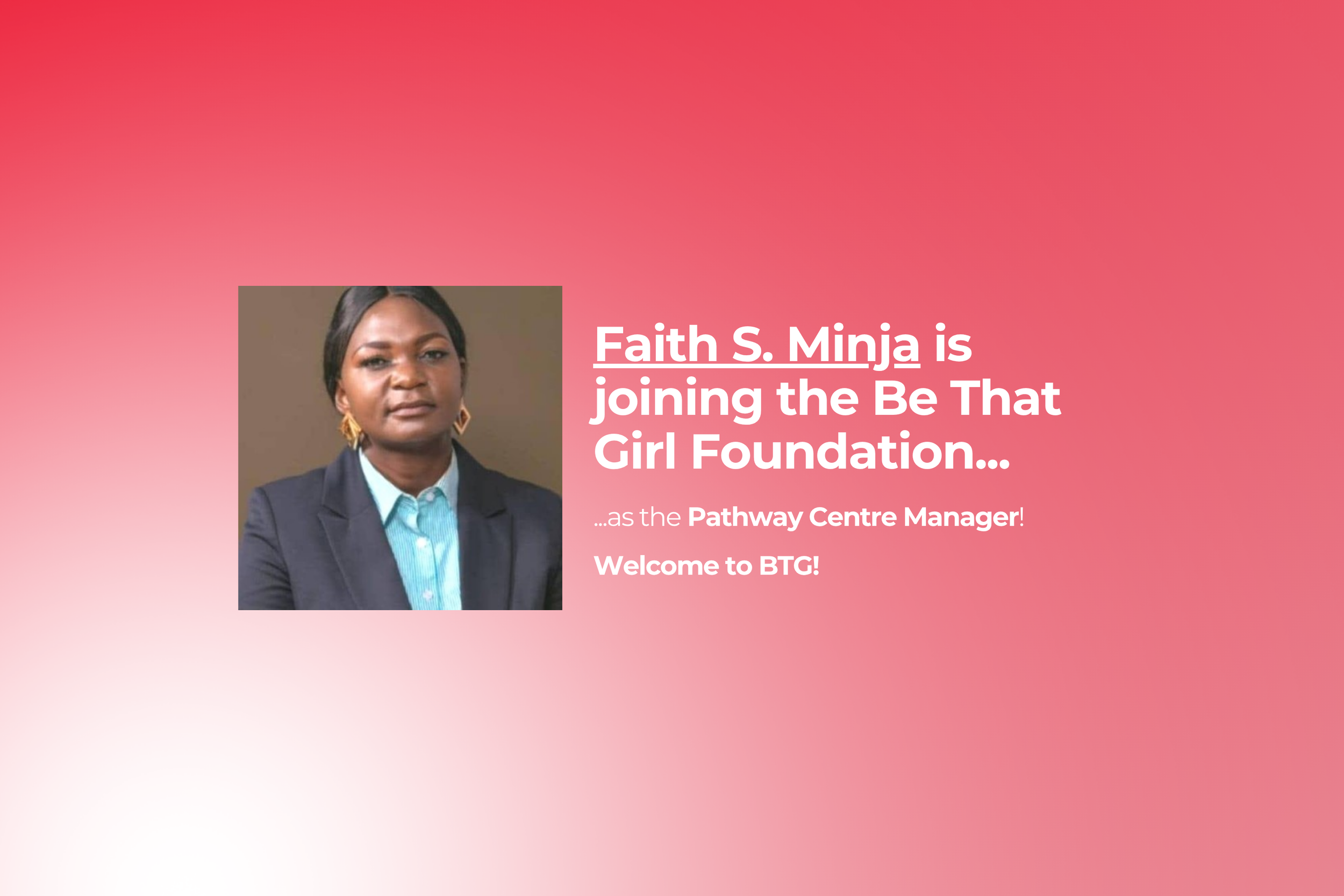
Lusaka, 27 April 2026 – For Faith, education is not an abstract idea. It is the opportunity that allowed her to move from a rural community in Zambia’s Eastern Province to Lusaka, continue her studies, and build a career dedicated to education, gender, and young women’s empowerment.
Now joining the Be The Girl Foundation as the Pathway Centre Manager, based in Lusaka, she brings more than 23 years of experience in the education and gender sectors, as well as a personal understanding of one of the most fragile transitions in a girl’s life: the period after secondary school. The Centre is a pilot initiative that BTG is working on to provide career orientation, training and networking services to women transition from secondary school into post-secondary opportunities
The time after secondary school graduation is a moment filled with possibility. But for many girls in Zambia, it can also become a moment of waiting, uncertainty, pressure, and risk. Without support, guidance, or access to further education and skills, the years after Grade 12 can determine whether a young woman continues pursuing her dreams - or whether those dreams stop there.
In this conversation, Faith reflects on her own journey, the realities facing young women after secondary school, and why the Pathways Centre can become a critical space for girls to build skills, confidence, leadership, and direction.
Faith, could you start by telling us who you are?
I am a development practitioner with a focus on education and gender. I have over 23 years of experience in the education and gender sector.
I am very passionate about issues of gender, especially education for young women and girls. For me, once you educate a woman, the entire household benefits from that education.
Where did you grow up, and how did that experience shape your understanding of education?
I have lived in Zambia all my life. I grew up in a rural part of Eastern Province, where I completed both my primary and secondary education.
Growing up there was not an easy journey. There were many challenges, including access to education and walking long distances to school.
For me, education became an opportunity. It allowed me to move from the rural setup where I grew up to Lusaka, where I am now.
That is why joining an organization focused on girls’ self-determination is exciting for me. I can see how my own journey connects directly with what the organization is focusing on.
When did you move to Lusaka, and what made that possible?
I moved to Lusaka after completing my secondary education: after finishing school, I came to stay with my uncle so that I could continue with tertiary education.
Not every girl has that kind of opportunity. Not every girl has a relative in Lusaka who can support her and help her continue with education.
What did you go on to study?
I first completed a diploma in journalism. Then I completed a bachelor’s degree in development studies, followed by a master’s degree in development studies. I am currently pursuing a PhD in development studies.
Thanks for sharing it. There is often an expectation that when young women complete school, opportunity will naturally follow. From your experience, what does that period actually look like for many girls in Zambia?
After completing school in Zambia, it does not automatically mean that opportunities will follow. That is where the gap mainly is.
After completing Grade 12, if a girl is not assisted by someone who can come on board and support her, she may end up doing nothing. Tertiary education in Zambia is very expensive, and vulnerable children from vulnerable families are often unable to afford it.
Even going to the University of Zambia, or any other university, is costly. Many families cannot manage.
So opportunities do not just happen.
There are organizations that support the girl child, and I think they are really helping those who are in need. The government also provides scholarships, but those scholarships are very competitive because the demand is high.
A young woman can complete secondary education and sit at home for four or five years without doing anything. That is the period when many girls end up getting married. Someone may have completed secondary education, but because she cannot further her education for different reasons, she ends up getting married. Then that becomes the end of the dream she had for her life.
That is the situation in Zambia.
For those who are lucky enough to get scholarships, they continue with their education and complete tertiary education. Once they complete tertiary education, many can at least find something to do. Some may not be formally employed immediately, but they can go into business or take up internships. At the end of the day, some are employed by the companies or organizations where they did their internship programmes.
But for many girls, marriage becomes the point where the dream stops. They do not go into employment. They become married women, and they are no longer able to pursue their dreams.
Is this especially visible in rural communities?
Yes. Most girls will end up in that scenario, especially in rural communities.
In my own story, I had to leave the place where my parents were and come to Lusaka to stay with a relative who was willing to keep me so that I could further my education.
Now imagine girls in rural communities who have no relatives in Lusaka, for example, and no one to support them to access tertiary education. What do they do?
Even if there is a college, university, or tertiary institution where they can get a skill, they may still have no one to support them. So they end up getting married.
For most girls, once they complete Grade 12, if there is nothing else to do, they may opt to get married because that is the only solution they can think of. They may think it is better to be married and have a man take care of them.
That is the scenario we want to change.
As a country, we need to help as many girls as possible - and also young boys and young men - to access different skills. Even if they do not go further into university or tertiary-level education, if they have a skill, they can start their own business and do something meaningful within the localities where they are staying.
Not everyone will be as lucky as I was to have an uncle in Lusaka and continue with education.
Why does the period after school carry both heightened risk and possibility for girls?
It is a very critical period.
On the risk side, it is the period when a girl can end up getting married because she thinks there is no one to support her to continue her education.
It is also a period when, if young women are not well guided and given the right information on sexual and reproductive health rights, they may end up having unwanted pregnancies they did not plan for. They may also engage in risky behaviours.
Those are some of the risks during that period.
But the “gap year” time after secondary school graduation also presents an opportunity, because this is a free period when they are not yet engaged. For those coming from schools that offer skills-focused subjects, opportunities can present themselves. They are able to engage in entrepreneurship activities and raise funds for what they want to do. For example, some may start small businesses, selling things here and there, so they can raise money to go into tertiary education or support themselves in one way or another.
This is a period that requires a lot of mentorship for a young person to remain focused on their dreams.
Beyond the cost of education, what other pressures or constraints do girls face as they try to move toward independence?
One major constraint is poverty.
High poverty levels affect households and their ability to continue educating children beyond secondary level.
Another constraint is inadequate career guidance and counselling in schools. There is very little being done in the current education system to mentor young people so that they are ready to leave school, become independent, and take the career pathway they want after secondary education.
Another constraint is inadequate access to sexual and reproductive health rights information and services. This is a period when young people may become reckless with their lives. Without proper information and services, they may end up having unwanted pregnancies that prevent them from continuing their education, or contracting STIs. Negative social norms that continue to perpetuate issues of gender-based violence also aggravate the risk of teen pregnancies in Zambia.
Another constraint is the lack of facilities that can mentor girls and give them guidance after they have completed Grade 12 or secondary education.
That waiting period can be very risky if a girl is not mentored and not kept busy with other things she needs to focus on.
You have spent years working closely with communities. How has that shaped the way you think about support, agency, and choice for young women?
The community plays a very significant role in shaping the choices that young women and adolescents make.
It is in communities that we have the social norms we have grown up with, especially in rural communities. These social norms continue to shape the way young people make decisions and the choices they make.
There are negative social norms, and there are also positive ones. They influence decisions around sexuality, career pathways, and even the type of life a young person wants to lead.
The way someone is brought up in the community plays a significant role. That is why there is a need for continued community engagement around the importance of education.
When a girl has completed Grade 12 or secondary education, she needs community support. It is only then that she will be able to continue with her education.
This is especially important for girls who, along their education pathway, experience unwanted pregnancies. They need family and community support to progress with their education. They should not be discriminated against or made to feel like failures because they became pregnant.
The community plays a very significant role because it shapes the decisions young people ultimately make about their lives.
The Pathway Centre is designed to support young women in that in-between moment after secondary school. When you first encountered the idea, what felt most necessary to you?
When I first encountered the idea, I really loved it.
I looked at the period when someone has finished Grade 12 and needs to go through a centre where she can be mentored and supported.
Even if she is not going to university or tertiary education, the centre can provide the necessary skills she needs to thrive in her own right. She may not be able to go and do formal learning at the University of Zambia, for example, but she can still gain skills and support that help her move forward.
The centre bridges the gap between those who finish secondary school and those who want to further their education or develop a skill.
The Pathway Centre provides a very good opportunity for young women. Instead of someone opting to get married or just staying at home, she can acquire a skill through the centre. That can be very empowering for her life.
From what you have seen working with young people, do you believe the Pathway Centre addresses a real gap for girls?
Yes, the centre provides a very good opportunity to bridge the gap for young women.
I think of a young girl who has completed Grade 12 and is waiting to enter tertiary education, or waiting to do something else. If she passes through the centre, I think the centre will empower her with the necessary skills and also the passion to continue pursuing her dreams.
For example, if a young woman comes to the centre and finds mentors there providing different kinds of mentorship, that can make a big difference.
As a country, I do not think we are doing very well when it comes to guidance, career guidance, and counselling at school level.
At the centre, young women will be guided appropriately. They will have coaches who can help them think through the pathway they want to take. Do they want to take the skills pathway? Do they want to go to university?
This role involves building something new for young women in Zambia, rather than stepping into an established programme. How does it feel to take the lead?
It is exciting and interesting for me to take the lead in relation to the Pathway Centre.
Coming from an education and gender background, this is part of my passion: helping young people, especially young women, to be empowered and to make informed decisions about their lives.
I am a firm believer that when a young woman is empowered, she will be able to empower those around her. Her family will also be empowered.
When you picture the Pathway Centre in its earliest days, what feels most important for it to get right?
For us to get it right, we need consultations with key stakeholders.
There are various key stakeholders, including the girls themselves. We need to interact with the girls and find out what they want the Pathway Centre to look like, and what facilities or services they would want to see there.
We also need to engage relevant stakeholders such as the Ministry of Education. This centre may be one of its kind in terms of programming in Lusaka.
Of course, there are other training centres under TEVET institutions, but this centre will be more unique. We can also get guidance from the government on what skills can be provided that are relevant for young girls transitioning from secondary education into the different pathways they want to take.
What do you think young women should notice first when they walk in the Pathway Centre?
They should notice that the centre is meant for them. The environment itself should be youth-friendly. That is the whole picture I have: a youth-friendly space. When they enter the centre, even the mentors should be youth-friendly.
When young women come to the centre, they should not only have access to the skills being offered. They should not only have access to mentorship sessions. The environment should also show that this is a young people’s centre.
For example, they could have access to entertainment or sporting activities right there at the centre.
It should be something attractive that pulls young people to the centre and allows them to say: this is a safe space for us.
How important will mentorship be for the programme?
Mentorship will be very key. Building the capacities of young people requires a lot of mentorship. These are young people just coming out of secondary school, and they are very inexperienced when it comes to the challenges of life.
They need a holistic package of mentorship so that we have a well-rounded, confident young woman who is able to move forward in terms of her passion and the dream she has for her life. They also need mentorship around mental health, gender-based violence, and sexual and reproductive health rights.
At the end of the day, mentorship helps young women make informed decisions in all these areas. Without mentorship, their progression may be limited.
For me, mentorship is critical to this programme.
What has your experience taught you about trying to change systems while staying close to individual lives?
One thing I have learned about changing systems is that you have to carry everyone along.
Consultations and engagement remain very key in system change, because then everyone is brought on board and there is little resistance.
It is also important to have clear guidelines on what is changing. Is the whole system changing, or is only part of the system changing?
That gives clear guidance to those who are supposed to be part of the system change.
If stakeholders are engaged from the start, brought on board, and you work together on the systems being changed, adoption becomes much easier for everyone.
How do you think systemic change can be measured?
Measuring systemic change requires, first and foremost, a very clear theory of change.
That helps us identify the indicators of the change we want to see. Once we have clear indicators of what change should look like, it becomes easier to measure the change.
We also need adaptive tools that help us collect the required information so that we are able to track the change we are seeing.
The documentation process also needs to be very clear. From the start of the change process, we need to document how things were at first, where we are now, and how we are progressing toward the change we want to see.
What is your view on leadership, and how can girls develop leadership skills inside the Pathways Centre?
For me, mentorship sessions must focus on how a girl can become assertive.
Assertiveness and confidence-building are very important for leadership. Mentorship should include confidence, the ability to make decisions, and the ability to lead.
At the end of the day, each girl must make decisions on her own about which career path and which direction of life she wants to take. Once she is able to do that, it means she will be able to make informed decisions.
Capacity-building is very relevant in developing leadership skills.
Practical leadership mentorship sessions are also very important. Girls should be able to interact with other young people who are role models in the community and who have made good decisions.
Peer-to-peer learning is critical in building confidence. When girls see other young people already doing something positive with their lives, it helps them make informed decisions about their own lives.
It is important to identify young people who are already doing something meaningful, who have made good decisions, and who are already working, doing business, or contributing in other ways. That kind of peer learning helps girls build leadership skills.
Years from now, beyond individual success stories, what signs would tell you that this first centre expanded what young women believe is possible for themselves?
Beyond individual success stories, I would look at the number of women who have gone through the centre and are now able to influence processes within their communities.
I would also look at the young women themselves being able to come back and mentor others.
The alumni are important. Those who have passed through the centre should be able to continue staying in contact with the centre and provide their services to help new cohorts coming through.
That would be very significant in terms of looking at the outcomes and results achieved by the centre.
To conclude, what needs to move for girls to truly shape their own lives?
For girls to shape their own lives, it is beyond policy change. It is beyond system change.
It is about the empowerment that each girl receives.
The centre becomes a very critical place for young women. If these services can be replicated in other areas, more young women and adolescents will be empowered, and they will be able to make informed decisions about their lives.
Individual capacity-building gives a girl support. The support given to each girl gives her the power to influence her own life, because she has benefited from the services provided at the centre.
Thank you so much for your time and for sharing your insights with us. We look forward to seeing the Pathway Centre grow!
Thank you! I'm looking forward to it.