
Building Girls’ Agency in Tanzania - BTG Voices of Change Interview with Laina Mwandoloma, Executive Director of SEGA
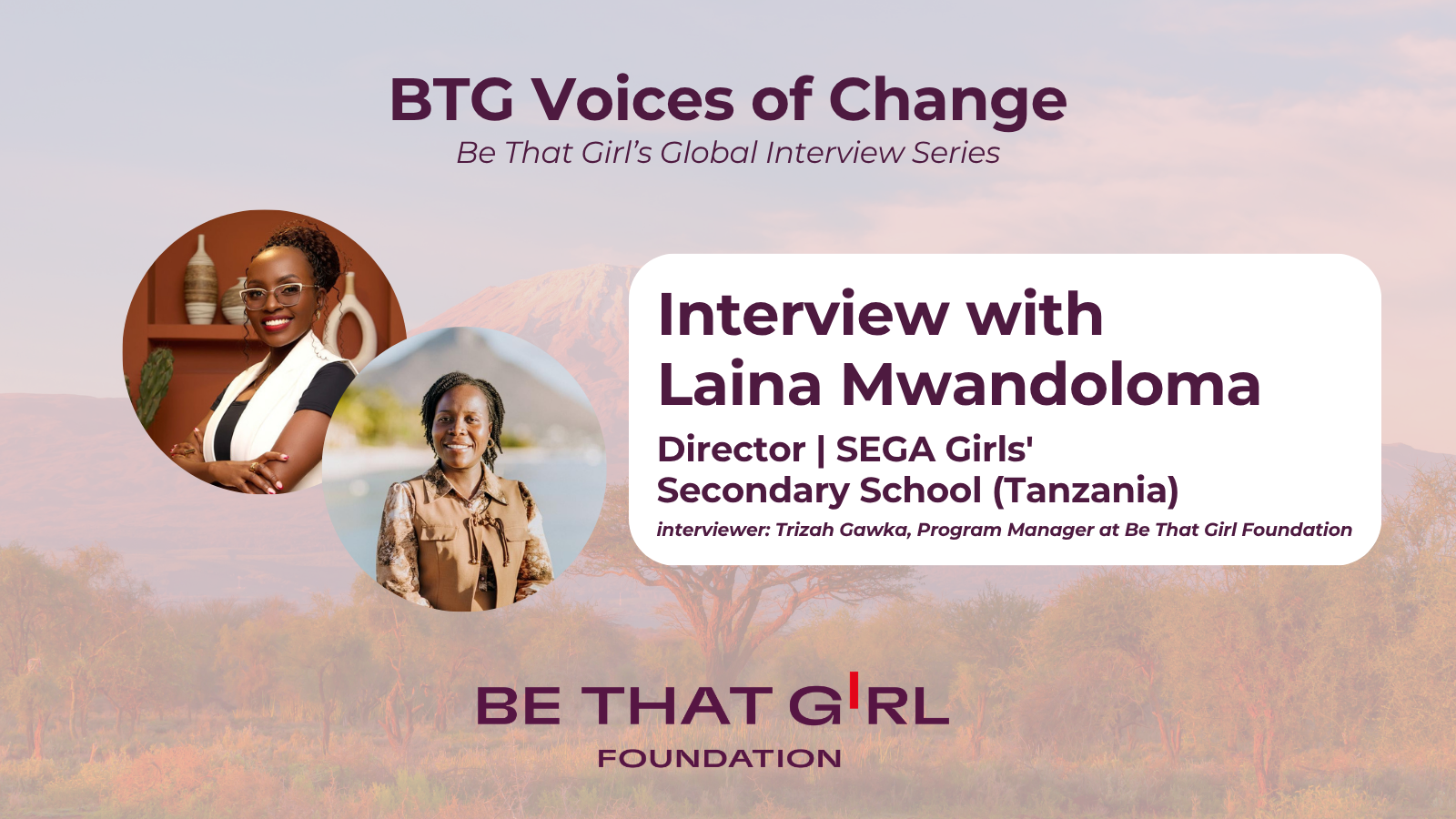
Morogoro, Tanzania | 13.04.2026 - Welcome to the Voices of Change interview series, hosted by the Be That Girl Foundation. This first episode of 2026 features a conversation between Trizah Gakwa, Program Manager at the Foundation, and Laina Mwandoloma, Executive Director of SEGA, a Tanzania-based organization advancing girls’ and women’s empowerment through education, life skills, and community engagement.
The discussion examines self-determination as a foundation for women’s and girls’ empowerment, the role of holistic and relevant education, and the tensions that persist between policy progress and deeply rooted cultural traditions. Drawing on lived experience, research, and program practice, the conversation highlights why empowering girls must extend beyond school environments and into the communities and systems in which they live.
The interview also reflects on SEGA’s long-term, end-to-end approach - from secondary education to higher learning, entrepreneurship, and community mentorship - and considers the importance of evidence, collaboration, and locally grounded solutions in advancing sustainable social change. Read the full interview below.
(The interview has been lightly edited for clarity and readability.)
Triza Gakwa: Hello everybody, and welcome to the first episode of the Voices of Change interview series in 2026. This is our fourth episode since we launched the series last year, and I’m confident that you will enjoy this conversation.
The Voices of Change interview series is hosted by the Be That Girl Foundation, and its aim is to foster collaboration, share knowledge, and amplify bold leadership in women’s empowerment.
My name is Trizah Gakwa, and I am the Program Manager at the Be That Girl Foundation. I have the honor and privilege of hosting this conversation: welcome everyone - and a very special welcome to you, Laina. Thank you so much for making the time to join us. To get us started, could you please introduce yourself and tell us a little more about who you are, what you do, and the work of SEGA - and perhaps share what first inspired you to begin this work?
Laina Mwandoloma: Thanks a lot, Trizah - and thank you to everybody following us today. I’m truly excited and grateful to be part of Voices of Change at the beginning of 2026. This is super exciting.
My name is Laina Mwandoloma, and I am the Executive Director of SEGA, a nonprofit organization in Tanzania focused on empowering girls and women by equipping them with academic education, knowledge, and the life skills they need to thrive and succeed in life.
We carry out our work through four main programs. First, we have a boarding secondary school for girls, primarily from disadvantaged backgrounds, covering Form I to Form IV. There, we provide high-quality, holistic education - supporting their academic growth, life skills development, entrepreneurship skills, and environmental stewardship. Most importantly, we create a friendly and conducive learning environment, which stands in contrast to many other schools in my country.
After secondary school, we support our students’ continuing education through high school, colleges, and universities. I’m sure we’ll talk more about this as the interview goes on.
We also run a community outreach program that serves girls in surrounding communities. Through a one-year curriculum delivered via girls’ clubs, we provide entrepreneurship education, life skills, and human rights education - with the hope of empowering girls to pursue their dreams, avoid exploitation, prevent child pregnancies, stay in school, and attain their education.
In addition, we have a program that supports our graduates in launching and running successful businesses.
Altogether, we reach over 2,500 girls and young women annually across our programs. SEGA has been in existence since 2007, so we are approaching our 20-year anniversary - which is very exciting. We are supported by partners from across the world, and we have a team of 73 full-time staff dedicated to this work. I am a proud and grateful leader to work alongside such an incredible team.
Beyond my professional role, I am also a mother of four - three girls and one boy - which is yet another powerful reason why I remain deeply committed to focusing on girls’ empowerment.
Triza Gakwa: Thank you so much, Laina, for that very comprehensive introduction. You’re doing truly amazing work, so congratulations on everything you and your team are accomplishing.
I love that you mentioned having three daughters as a very compelling reason to work in women’s and girls’ empowerment. But I’m curious to hear more about your personal journey. How did this begin for you? How did this journey start, and how has it evolved over time?
Laina Mwandoloma: When I graduated with my bachelor’s degree in programs management and community development, I went on to work in the field of agriculture for about three years. During that time, I witnessed the challenges that women face. Women are truly at the center of production - if you attend farmer training, you see many women participating, and you see many women working on the farms. But when it comes to harvesting and selling, women are often not part of the equation, especially when you look at ownership of the farms and properties. That was very disturbing for me.
Then, in 2013, I was fortunate to be part of a team that conducted a study in Tanzania on youth education and how that education was impacting their lives and helping them move out of poverty. The research was funded by the Mastercard Foundation and led by the University of Minnesota, I worked as a research assistant.
Through this work, I had the opportunity to follow schools in Tanzania that were participating in a program run by a Latin American organization called Fundación Paraguaya. Their aim was to empower schools to provide affordable but relevant education - education that young people need in order to succeed in life. The SEGA Girls Secondary School was part of that program.
My specific focus was to examine the impact of entrepreneurship education, alongside academic and holistic programs, on girls and boys at that time. I continued this work in 2014 and 2015, and in 2018, I was invited to join the board of SEGA .
Through this journey, I continued to learn how education is such an important tool in empowering women. When you look across sectors - agriculture, mining, and others - education stands out as the most powerful lever for change. Especially when it is relevant: not just academic, but holistic enough to provide the many missing skills women need in order to stand up for themselves.
And that is how I became involved in this work.
Triza Gakwa: Thank you for sharing that experience. I love how you were out in the field researching something that, at first glance, may have seemed quite separate from women’s and girls’ empowerment. Yet through that process, you clearly saw the impact of excluding women and girls - especially at that very critical point of harvesting, when it was time to generate income and make decisions. That’s when women were removed from the conversation.
And I agree with you - education is truly critical in empowering women and girls. That’s very much aligned with the work of the Be That Girl Foundation, which focuses on self-determination.
So, thinking about the work you’ve done so far and your journey, how would you define self-determination? And why do you believe it is so critical for women and girls?
Laina Mwandoloma: For me, self-determination is the ability of women and girls to first define their needs and desires, and then to make choices, make decisions, and take action to achieve what they truly want to achieve.
That is how I define self-determination. And when we talk about women’s and girls’ empowerment, this is central. It is at the heart of all empowerment work, because you have to unleash the potential within women and girls so they can become self-determined and change the many aspects of life that challenge them.
Let me share an example from my lived experience.
When I was in secondary school - quite some time ago - I came from a public primary school. In my country, we have two main languages in the education system. Kiswahili is the main medium of instruction in public primary schools, and when you transition to secondary school, English becomes the main medium of instruction.
So I came from a public school background, while some of my classmates had attended private primary schools because their parents were able to send them there. When I joined secondary school, there was a strict rule: “No English, no service.” For those of us who had come from public schools, this was very intimidating. Most of the time, especially in class, we kept quiet. The only place we could comfortably speak Kiswahili was in the dormitories, where the language rules were not as strict.
At some point, I made a decision: I needed to learn this language. I told myself, I will learn it. That was the beginning of the journey. It’s a long story, but to keep it short, the journey was not easy. Many people laughed at me because of my vernacular accent. In Tanzania, we have many tribes, and I had a strong tribal accent. When I tried to speak English, people would laugh.
I remember that from Form One to Form Four, I participated actively in debates. People would laugh, but I did not care. I had a goal.
Then in A-level - in high school - one of my teachers once told me, “You’re speaking vernacular English.” It was intimidating, yes, but I did not give up. I continued learning the language. By the time I completed Form Six, I could speak English very well.
To show you how it paid off - when I was finishing my university degree, I secured a job two months before graduation. I had a phone interview, and the interviewer was Kenyan. At one point he asked, “Are you Tanzanian?” because of how I was speaking. The interview was conducted fully in English, and he said, “Let’s meet for an in-person interview.”
It paid off. But it was because of self-determination. I refused to let the limiting factors push me back because I had a compelling reason to move forward.
And that is exactly how we approach our work with the girls we serve. We want them to develop self-esteem and confidence so that they can be self-determined and reach their goals. Some of them come from families where they are the first to attend school. They may not have academic support or mentorship at home. But if they are self-determined, they can absolutely achieve their goals.
We tell them that nothing is impossible. As long as you have a dream, put in the effort, believe in God, work hard toward it, and nothing can stop you.
For me, self-determination is essential. Any program focused on women’s empowerment should provide the necessary support for women and girls to become self-determined: you need skills, you need self-esteem, you need confidence. There are certain things you must build within yourself in order to truly be self-determined.
Triza Gakwa: Thank you for sharing that very personal example of what self-determination looks like, and for that comprehensive definition. I really appreciate how you described it - the ability to take decisions about every aspect of one’s life, and having the agency and the resources to act on those decisions. That truly is what self-determination comes down to.
And even going back to your earlier example about the research you conducted, self-determination would have meant those women having the agency to sell their products at prices they themselves determined - leading to real economic empowerment. So thank you for highlighting that. It’s very important.
Now, I’d like us to zoom in a little on the Tanzanian context. Just like here in Kenya, we’ve seen significant progress in women’s and girls’ empowerment over the years. And at the same time, many barriers still remain.
Where do you see - or where have you experienced - tension between progress and tradition within the Tanzanian context?
Laina Mwandoloma: Oh, thank you, Trizah - and for mentioning the situation in Kenya as well. I think this is not just about Tanzania; it applies to many African countries. Our cultures share similarities, and when you hear about certain cultural setbacks across different countries, you often notice common patterns.
In Tanzania, a lot of progress has been made. I would absolutely acknowledge that - especially in the area of girls’ and women’s empowerment. We now have more favorable policies that support this work. For example, the government has advanced a strong back-to-school agenda to ensure that all children - both boys and girls - return to school.
More recently, there was the launch of the re-entry policy, which allows students who dropped out of school due to pregnancy or other reasons to return and continue their education. While it primarily addresses the challenges faced by girls, it applies to both girls and boys. This is a significant and positive step forward.
So yes, there has been meaningful progress.
However, when we talk about tradition, we must recognize that it has existed for decades - even centuries. Culture does not change overnight. And sometimes, tradition can be even stronger than legal frameworks.Sometimes culture is stronger than the legal.
So you will still find tensions. For example, when we talk about child marriage - it is a problem in many parts of the world, including Africa, India, and elsewhere - but in my country specifically, it remains a serious challenge.
Even at the legal level, there are sometimes conflicts. The laws are not always fully aligned. There is the Law of the Child, and then there is the Marriage Act, and at times the defined age of a child under one law does not fully align with what is permitted under the marriage law. The government is working toward reviewing and harmonizing these laws, but these gaps create confusion and leave room for continued challenges.
Beyond the legal framework, there is also the complexity of culture. Tanzania is one of the countries with a large number of ethnic groups and tribes. You can imagine the level of cultural diversity - it is significant. Within some communities, child marriage is still supported as part of tradition. And traditions that have existed for generations do not simply disappear with new policies.
If you look at practices such as female genital mutilation (FGM), it is also deeply rooted in tradition in certain communities. Even with laws in place and strong efforts from the government and various stakeholders to end FGM, you may still find families - mothers, and sometimes even girls themselves - who support the practice because it is seen as part of their cultural identity. As a result, some practices continue in secrecy.
So these are ongoing struggles.
But also GBV - gender-based violence - is a very wide topic. There is still a lot of violence against women and against children. When you talk about sexual abuse, there are things that cannot even be spoken about. Even though there are laws in place, sometimes children who are sexually abused cannot report. They cannot speak out, because families may want to protect their relatives. Oftentimes, these cases happen within the family, and the family may try to shield the perpetrator from the law. And then, when you add the issue of corruption, it can completely undermine justice.
So there are still many struggles, especially within an entrenched patriarchal system - you can imagine how deep this goes. Even when a woman is educated, like I am, challenges remain. When it comes to property inheritance - especially if someone is widowed - the extended family may believe that all the property belongs to their son. Even if you were a working woman, people may still believe the property belongs to the man. Some widows are even forced out. And although there are laws meant to protect women’s rights, the process of claiming those rights can be very long and difficult. So the struggles are still there.
And of course, development partners and civil society organizations must continue supporting the government to work through these tensions between law and tradition. We need to train people. We need to engage communities little by little, bringing ideas in ways that make sense to them and in ways that do not cause harm.
Because I truly believe that within a patriarchal system, both men and women can be victims. We are not putting the blame only on men. In many ways, we are all affected by the system. So we need to find a way to move through this together.
Triza Gakwa: You know, I really love everything you’ve said - and I’ll start with the last point you made. I once had someone say that the only way we will undo patriarchy is when we show men how it harms them. Right now, we put a lot of focus on how it harms women - and rightly so - but you’re absolutely right, it harms men in many ways as well.
The other thing I appreciate, and I’ve seen this in the work we are doing in Kenya, Rwanda, and Zambia - at least in those countries - is the disconnect between the policies governments put in place and how they are operationalized or implemented.
For example, we truly appreciate the initiative by governments to introduce return-to-school policies for girls who are teen moms or who have dropped out for other reasons. That is commendable progress. But when you look at everything that surrounds that policy, there are real challenges. If a girl is a teen mom, childcare becomes a reality. It’s one thing to say, “Go back to school.” It’s another thing to ask, “What do you do with your child?” And there are many other surrounding factors that need to be considered.
So I think there is a real need to move from simply putting policies in place to thinking through implementation and operationalization.
The other thing I really appreciate from what you shared is that laws that are devoid of cultural context or cultural involvement will not have much impact anytime soon. As you said, culture is often more powerful than the law.
For example, in some communities, FGM is considered a rite of passage - a way of moving from being a girl to being recognized as a woman. So it becomes important to engage with culture and ask: what could replace this? What other rite of passage - one that is not harmful - could take its place, while still honoring the cultural importance of marking that transition?
So I really value what you’re saying. And I am deeply passionate about moving the needle from policy to implementation. One of the ways we can do that, I believe, is through data. Evidence-based progress is important. These issues will shift when we can demonstrate that there are alternatives that work.
So I’m curious to hear - given your background in monitoring and evaluation - how do you measure change and transformational impact in the lives of the girls? And how does that evidence inform your programs and potentially contribute to policy as well?
Laina Mwandoloma: Thanks, Trizah. That’s a long question.
So how do we measure change and progress with our programs? We have different approaches to evaluation. Of course, we have our monitoring information that we collect regularly.
But when it comes to evaluation - because we have different programs - I’ll start with the school, for example. At the school, we conduct a beginning-of-the-year survey for the Form One students, focusing on agency. We have a robust life skills curriculum where agency is a major component, and we are fortunate to be part of the Amplify Girls Network, which has launched an Adolescent Girls Agency Survey that measures different aspects of girls’ agency.
So we administer that at the beginning of the year, which we call the baseline. Then we conduct an endline evaluation at the end of the year. That comparison tells us what has changed.
Then we also have a long-term evaluation that we conduct every five years to measure long-term indicators. For example, one of our indicators is delayed pregnancy. We have raised our benchmark to age 22. We would like our program graduates to have their first child at the age of 22, because that gives them ample time to study and fulfill their dreams before entering motherhood.
We also look at income generation - income earned through paid employment or through running successful businesses. So there are indicators we measure in the long term, and there are indicators we measure annually.
Both levels of evaluation have been very helpful. The annual evaluation and monitoring data inform our Annual Development Plan, which we prepare every year and follow through on. The long-term evaluation, which happens every five years, is very helpful in informing our strategic planning - and even in designing new programs and strengthening current ones.
For example, we started with the girls’ secondary boarding school as our main program. The other programs are growth programs that came out of evaluation findings. From feedback we received from graduates and other stakeholders, we identified a need to continue providing support after secondary school. So we expanded to include high school support, and then university support. Currently, we are supporting over 300 girls annually in universities and colleges.
Another evaluation informed the creation of our Graduate Business Fund. We realized that although girls were graduating, there were still limited job opportunities in the market due to high unemployment rates in the country. We had invested a lot in educating one girl - and then she did not have a job. So we had to ask: what is the other path?
While they were still in school, we trained them in entrepreneurship. But the evaluation findings showed that girls needed startup capital, training, and mentorship. That led us to establish a business fund that provides revolving loans, business support, and mentorship.
So you see, those findings are really helpful. You cannot run programs without evaluating yourself. You need periodic evaluations, and those evaluations must be relevant - they must inform your work, your programs, and any adaptations and changes you need to make.
Triza Gakwa: Thank you. You know, I’m very excited about SEGA’s involvement and utilization of the Adolescent Girls Agency Survey. The Be That Girl Foundation also worked with Amplify Girls in the development of this tool. It took seven years - and that’s because there were fifty-four locally led organizations and over eight thousand young adolescent girls and young women who contributed to it.
My hope is that as many organizations like SEGA continue sharing their feedback through this tool, in the coming years we will have such strong evidence that it moves beyond contributing to program design and begins influencing policy in the region.
I was having a conversation with Lucy from Amplify Girls, and she mentioned something very powerful. When girls are within the safety of the program they are part of - for example, when girls are at SEGA - they report a very high sense of agency because they are in a safe environment where there is uniformity of values and strong support. But when that same girl goes back to a community where practices like FGM, early marriage, and other harmful norms are still present, her agency can be compromised. She may begin to feel like there is not much she can do.
So my hope is that as we continue collecting this data, we will make a very strong case for why it is important to have that wraparound support - support that sustains and protects girls’ agency beyond the program space.
Thank you so much, Laina, for sharing your program model. It sounds very, very comprehensive. I really appreciate how you walk with a girl from the beginning to the point where she can - in our language - be self-determined.
Maybe in summary, could you share what is unique about the SEGA model?
Laina Mwandoloma: I would say our model is really unique. Oftentimes, organizations implement a specific short-term project in a community and then they leave. For us, first, we have a secondary boarding school that provides a very safe environment for girls from disadvantaged backgrounds - a safe place where they can pursue their dreams.
As I mentioned, in addition to the academic curriculum, we provide other holistic approaches. We offer a lot of skills and knowledge to the girls, and they also have access to four meals a day. Some of them would have only one or two meals at home, but at school they have a proper diet. We do not use corporal punishment. Instead, we use positive discipline approaches, which is a very different experience from the schools they are coming from.
From the school itself, we have many programs that support the holistic growth of the girl - from mentorship to sexual and reproductive health knowledge, which is often not attained at home. In some communities, norms forbid parents from talking about sexual and reproductive health with their daughters. But at school, the girls have that space and that opportunity.
After they finish school and have gained these skills, when they go back home, we want them to mentor other girls in their communities. So we form girls’ clubs and provide support. We have field officers working in the communities where the girls come from. During the waiting period before they transition to the next level, the girls serve as mentors. They receive a stipend during that period so they have some support for their needs, and at the same time they share the experience they gained from school with other girls.
After that, they continue to A-levels. For those who do not get the pass mark to go to high school, they go to vocational training. We are very happy that now about seventy percent of our school graduates go on to high school and university.
At all levels, we provide not just academic support, but scholarships, sexual and reproductive health training, alumni meetings, and other trainings. We support them in pursuing their university degrees. We have career counselors who guide them in their career choices. We invite inspirational speakers. We hold career days at school to inspire the girls while they are still young so they can choose wisely.
When they graduate from university, we are still connected. We link them with internship opportunities. We call them back to SEGA for job readiness and preparedness training. We train them on resume preparation, how to present themselves in interviews, and we conduct mock interviews to make sure they are ready for the job market.
We cultivate partnerships with companies, corporates, and organizations to secure internship opportunities because many of our graduates cannot access these opportunities on their own, especially given the backgrounds they come from. We also provide transport and meals allowances so they can attend their internships.
So there is a lot that we do with them. We do not leave them. As of now, we have 546 graduates from the SEGA School, and we know where all of them are. We are very connected to them. They come back to SEGA. We invite them for extracurricular programs, STEM programs, robotics: they come to share their experiences and inspire their younger sisters here.
We follow the girls throughout their journey. Out of the 73 full-time staff that I have, 8 are SEGA graduates - they are our alumni. In the Modern Girl program, alumni also become mentors. And for those running businesses, we continue supporting them through the business fund.
So always, we remain very connected with them.
Triza Gakwa: Yeah, that is so holistic. I really love the end-to-end commitment to the girl - ensuring that she is independent and self-determined. I didn’t even realize that your model had so many components. I’m very impressed.
One of the things that is coming through from everything you’ve shared is the importance of peer-to-peer mentorship - either through the alumni network or through the girls who go back to mentor others in their homes and communities.
What is the greatest benefit you have seen from peer-to-peer mentorship?
Laina Mwandoloma: Thank you for that question, Trizah. So we do peer-to-peer mentorship throughout our programs. To begin with the school - yes, there is a lot of peer-to-peer mentorship, but we also have an intentional mentorship program. For example, when the girls are in Form Three, they mentor the girls in Form One and Form Two.
Usually, they form what we call “form families”. Within each family, there are mentors and mentees. They support each other in everything around school life and around their personal challenges. . Although we have a professional counselor who handles counseling and psychosocial support, the mentorship structure also strongly supports the growth and well-being of the students. Sometimes the girls trust their peers more than adults. There are things they can easily share with their peers that they may not share with adults.
If someone in the family is not doing well in class, the mentors will sit with her to identify the challenges and then connect her with the right support - whether that means talking to a teacher or to the counselor. So for the school program, it has been really helpful.
Even with the alumni, we invite graduates to inspire their younger sisters. For example, when the Form Four students are deciding which subject combination to pursue in high school and which schools to choose, we invite their sisters to talk about their experiences in their new schools, colleges, and careers. The girls ask many questions and receive direct responses: it has been working very well.
With the Community Outreach Program as well, it is peer-to-peer. The girls from the school go back to mentor girls in their communities who are of similar age. Even graduates of the community program itself become mentors - and they are still peers.
This creates a lot of safe space, because the girls can confide in them. They understand the challenges within their communities. They have gained tools to navigate or avoid certain forms of exploitation and challenges. Because they share similar experiences, they know how to connect these problems with the right people.
For us, it has been very helpful. Sometimes there are cases that children will not report to adults, but they will report to their peers - the peers they trust. And those peers have helped in some cases to report to the village authorities, to our teachers, or to mentors.
I believe peer-to-peer mentorship is very important.
Triza Gakwa: Absolutely, I love that - and I agree with you. There is safety when you’re talking to somebody you see as your peer.
What’s interesting is, as you were speaking, I remembered my own experience. I went to a Catholic high school here in Kenya, and when I joined Form One, I had a Form Three mentor. The school had that structure as well. And when I was in Form Three, I also had someone that I mentored. The way they designed it - because we had bunk beds - your mentee would actually sleep in the upper bed, and you would support them with everything that had to do with onboarding into the school and settling in. So I really love that model, and I think every organization working with girls should try it.
Now, you mentioned that as the girls mentor, they sometimes report certain issues. And I’m wondering, how do you center the voices of the girls - every girl who is benefiting from the work of SEGA? How do you center their voices in designing your programs? At the same time, how do you get input from - or include the voices of - the community, the ecosystem within which the girl exists?
Laina Mwandoloma: Yeah, thank you for your question. I’ll begin with the voices of the girls. For us, the voices of the girls - especially the 2,500 we reach every year through our programs - are very important.
Through our daily monitoring, regular evaluations, and other feedback mechanisms, we intentionally capture their suggestions, opinions, and views, and we use that input to develop and strengthen our programs.
For example, at the school, about a year ago, we reviewed our entrepreneurship curriculum. Before doing so, we designed a survey to gather feedback from our alumni who had gone through the program. We asked them: What felt missing? What would you have loved to learn? Now that you are out there in real life, what do you wish you had been taught? They gave us very constructive feedback.
At the same time, we gathered opinions from the students who are currently in school. From those combined insights, we identified key areas to improve in the curriculum. We were also fortunate to partner with Babson College, one of the leading entrepreneurship colleges in the United States, and we integrated aspects of the entrepreneurial mindset into our curriculum. But the feedback from our girls and graduates was instrumental in shaping those revisions.
Even with other programs we are scaling up or adding on, we involve them. For example, we are currently finalizing our new strategic plan for the next five-year period, and we involved all stakeholders in the design process - including students in the school and our graduates.
Recently, we were facing some challenges around how best to support our girls in A-levels. There were concerns about the quality of some schools and the support systems available. We discussed this with our funding partners, staff, teachers, and non-teaching staff. But interestingly, the issue was quickly clarified through an alumni workshop. We shared a survey with our graduates, asked for their honest input and ideas, and their responses helped us move forward. We are now finalizing those plans.
It is very important to involve the girls. We should never assume that because they are young, they do not know, or that we must design everything for them. When they are involved, the programs become stronger - and honestly, it makes the work easier as well.
Triza Gakwa: Yeah, absolutely. I love that the alumni already knew what was needed.
And what about the community, where they come from? We spoke earlier about the barriers that exist within the community for the girls. How do you engage them and get their buy-in?
Laina Mwandoloma: For us at SEGA, what we do with the communities is very important.
For the school, we hold parents’ meetings. We have a parents’ committee at the school, and we also organize parents’ meetings each year. We have one parents’ meeting for each class - so for the four classes, we have four different parents’ meetings. In those meetings, we involve parents in discussions about the areas where we need their support for their children.
Oftentimes, parents are very busy with work and other responsibilities, and they may forget to closely follow up with their children. So sometimes the girls are safe at school but not necessarily safe at home. We use these meetings to remind parents of their role.
Recently, the agenda of child protection has not been very common in Tanzania. In the beginning, we even received backlash. Some people would ask, “What are you talking about with child protection?” Some did not believe that education without a stick - without corporal punishment - could be successful.
So we had to really explain the importance of child protection - that it is not just a SEGA agenda, but also a UN agenda, a national agenda, and a broader global concern. We also talk to parents about topics they may feel uncomfortable discussing with their children, and we encourage them to be more open.
With the Modern Girl Program, at the inception of the program in each village or community, we hold community meetings. We introduce the program during village meetings. We go door to door to meet with all parents. It is hectic, but we do it - we meet as many parents as possible.
We also go to churches and sometimes mosques to talk about the program - why it is important for girls to participate, why girls’ education matters, and why communities should address and stop child abuse. We use those platforms to speak about these issues openly.
But we also feel we have not done enough. We need to do more. Because as much as we empower the girls, if the systems and the communities do not change their perspectives, it becomes very hard for the girls to thrive on their own.
At some point, we have even organized debates with boys in the communities. We involve boys in our life skills seminars - both at the school and in the community. It is ongoing work, and we still need to strengthen it. If systems change, then the girls will truly thrive.
Triza Gakwa: Absolutely. And I just want to say thank you for the work you are already doing. As you’ve said, it is not easy - doing home visits, engaging parents, and explaining sensitive issues, especially when you’re asking families to rethink practices they have followed their entire lives. That is very important work.
I also know that many international partners sometimes misunderstand or misread local contexts.
What would you say is often misunderstood about Tanzanian girls and their realities?
Laina Mwandoloma: Yeah, so I think from my perspective, what is often misunderstood - or maybe not fully looked at or considered - is what really happens in the community.
We do all this empowerment work, but many organizations do not look closely at what happens beyond the program. As you said, the girls are very safe when they are here in our programs. But what happens when they go back home, back into their communities?
For example, if a girl is educated, is education alone enough to empower her to thrive in a community where there are still many underlying cultural and other factors affecting girls’ and women’s progress?
Sometimes there is this assumption: if Laina is educated, then she will be successful. But we do not look at the family, the husband, the parents-in-law, the community around her. How do they define her success? How is she affected by that definition?
So as much as we are empowering women, there is still a lot that needs to be communicated with the communities and with the culture. As I said earlier, culture is difficult to change. It takes time. But little by little, it can change.
Also, if you are seated there as a donor and you hear one individual success story - this girl moved from A to Z, now she is doing this - those are very powerful stories. But when we talk about girls’ empowerment, one story is not enough. We need approaches that can push a group of girls. We need those stories for many more girls, because one story alone is not enough to support change in a community where so many girls are still at risk.
So as much as we are happy with one success story, we need to think about how to foster development at the community level. How do we involve boys, for example? Of course, I love girls’ empowerment - this is my field - but I get many questions in the community: What are you doing with men? Boys are also at risk of sexual abuse. If the girl is empowered and educated, and then she marries a man who is not empowered, what happens? So we have to think about these balances.
Another aspect that needs to be understood more is entrepreneurship - supporting entrepreneurship initiatives for girls and women. Oftentimes, many models favor girls in urban areas because they are tech-savvy or connected. They are not really including girls in rural areas.
For rural girls, entrepreneurship may simply mean running a small retail business, making and selling something, or earning income through agricultural produce. But we do not always define that as entrepreneurship.
So I think there is a need to tailor definitions according to the local context. For example, if you talk about an improved bathroom in Europe, it will be very different from an improved bathroom in Tanzania - in urban areas and in villages. Community members understand their own problems and what improvement means for them. It cannot always be compared to a global definition.
Trizah Gakwa: Laina, thank you. That’s profoundly powerful.
And what I’m hearing you say is that, yes, the issues that affect women and girls may be similar, but they are not homogeneous. They’re not even homogeneous within the same country. What a girl in Dar es Salaam needs could be quite different from what a girl in Morogoro needs.
Laina Mwandoloma: Definitely.
Trizah Gakwa: And whatever solution we come up with needs to appreciate and be cognizant of that reality. That’s a really powerful message - one that I think we need to put out there.
The other thing I’m hearing you say is that this girl, this woman, exists within an ecosystem. It would not work to think that you are changing her life as an individual if there is no systemic change - if you are not addressing everything that surrounds her.
And I think that is a very strong message to philanthropy. It’s easy for philanthropy to want to focus on just the one story of impact. But that can only be sustainable - and we can only truly win this fight of women’s empowerment - if we think about the system within which these girls exist.
Now, we have a few more minutes to go, and I want to invite you to share what your vision is for Tanzanian girls ten years from now. And if that vision were to come to life, what ripple effects would we see in society?
Laina Mwandoloma: So if I imagine ten years from now, I will tell you our vision. SEGA’s vision is confident Tanzanian girls and women thriving and leading social change.
So if I think of our girls ten years from now, I see a generation of girls who are empowered - confident in themselves. They have self-esteem. They can dream. They wish to reach their dreams. They have important goals to attain.
They are digitally skilled. In this AI world, they are competent in AI. They are enrolled in higher learning.
Then as a result of this, we will see women earning decent incomes. They will have decent jobs, decent businesses. They will be running successful businesses. We will be seeing women in STEM, in technology, in male-dominated industries.
There will also be many women in those fields who are great leaders. And in the end, we will have women leading social change in their families, at family level, in their communities, and in the country at large.
So I think the future is bright. A lot of work still needs to be done collaboratively - not just by one actor. But the future is bright.
Trizah Gakwa: Absolutely. Thank you, I appreciate that. And I think having listened to the work you’re doing at SEGA, I can see that happening. You’re already talking about 546 young women who have graduated from your school program and are doing amazing work. As that number grows, and as more people contribute to this work, that vision is attainable. It really is attainable. And I pray that I live to see it and to celebrate it.
Now, you mentioned collaboration and that we need to all contribute. I want you to share your final message, and I want you to share it to two audiences.
One audience is the next generation of women leaders who are stepping into spaces where their voices are still not fully heard. Think of the SEGA alumna who is stepping into the world - what is your message to her?
And the second is a quick message to leaders in the philanthropy space. How can we meaningfully contribute to this work of women and girls’ empowerment?
Laina Mwandoloma: Thank you, Trizah. I really want to appreciate all the philanthropies, funders, and donors, because they are doing a lot to support the work that grassroots organizations like us are doing. And I believe collaboration is really vital.
I will give you an example. In 2016, the Population Council shared their research with us, and they even sent us a staff person because we wanted to start a community outreach program. Our Modern Girl Program is borrowed from the Population Council model. They gave us the research and the staff support, and we were able to start the program. Over the past seven years, we have reached over ten thousand girls and young women - because every year we reach about two thousand through that program.
We are also part of the Obama Foundation Girls Opportunity Alliance Network, which has become like a global village where we share girls’ education work - the challenges, best practices, and lessons learned. So collaboration is really important.
To philanthropies, I want to call upon them to continue supporting this work. Currently, there has been a huge reduction in foreign aid - not just in Tanzania, but across many countries. Organizations are struggling. And if philanthropy also stops, then this work risks going to waste.
We really need them to stand with us - to build resilient and sustainable investments that will foster the sustainability of all the empowerment work we are doing. They should be flexible: with funding, we really wish to receive unrestricted financing that allows organizations to plan, adapt, and implement programs sustainably.
We are in the position where we truly understand our problems. Some of us are founders, some are not, but we have been trusted to lead these organizations. We are at the center of the vision. If we receive unrestricted funding, we are better able to decide, plan, and adapt to different situations - like the current reality where foreign aid has reduced.
We also need investment in sustainability mechanisms - for example, endowments. These are the kinds of investments we need for long-term sustainability. Otherwise, this work will go to waste.
Now, to the girls and young women stepping into this space - the message I would send them is what we share throughout our programs: believe in yourself, be confident, and stand up for yourself.
We have now included negotiation skills in our life skills curriculum, and we are partnering with the Harvard Law School Mediation Clinic, which is very exciting. We want girls to be able to stand up for themselves - even within challenging families and communities - and negotiate better outcomes for themselves.
You are not alone. If you are struggling, remember that many other girls around the world - not just in Tanzania - are also struggling. But we must stand up for ourselves. Raise your voice. Do it your way. Kenyan women and Tanzanian women are different. American women and Tanzanian women are different. So let us do it our way.
Let us learn the best ways to ensure our voices are heard. Invest in learning. Keep learning. The world is changing. Technology is improving every day. We need to update ourselves so that we can remain competitive.
Learn from people who have succeeded and shown the way. Look for role models. Connect with people who share a similar vision and learn from them.
And we should support each other. It is often said that women do not support each other - but we should change that. Support your fellow woman. If someone is struggling, give her a helping hand. That is how we grow and thrive together - not just one woman out of ten thousand, but many women rising together.
We want that narrative to change.
Trizah Gakwa: Wow, Laina. That was very profound. Thank you for your time, and thank you for your insights.
I think we’ve learned a lot about holistic programming for women and girls - programming that centers their voices, takes into account the contexts they live in, and includes their communities. And we’ve also learned how different players, including government and philanthropy, can contribute to this movement of women and girls’ empowerment.
I’m deeply grateful for your time and for the impactful work you’re doing at SEGA. We’re cheering you on, and I look forward to celebrating all your successes - for every individual girl and for the community at large.
Laina Mwandoloma: Thank you so much. You’re welcome to visit us in Tanzania, in Morogoro. I welcome the listeners and viewers to visit our school.
We have volunteer opportunities - in STEM, in English fluency programs, in robotics. We have many opportunities for people to work with us at the school and within our community programs. And also at the university level, we have many opportunities for volunteers.
Trizah Gakwa:
Perfect! Thanks a lot Laina, it has been a true pleasure interviewing you.