
What It Takes for girls in Zambia to succeed - Interview with Gift Musenga
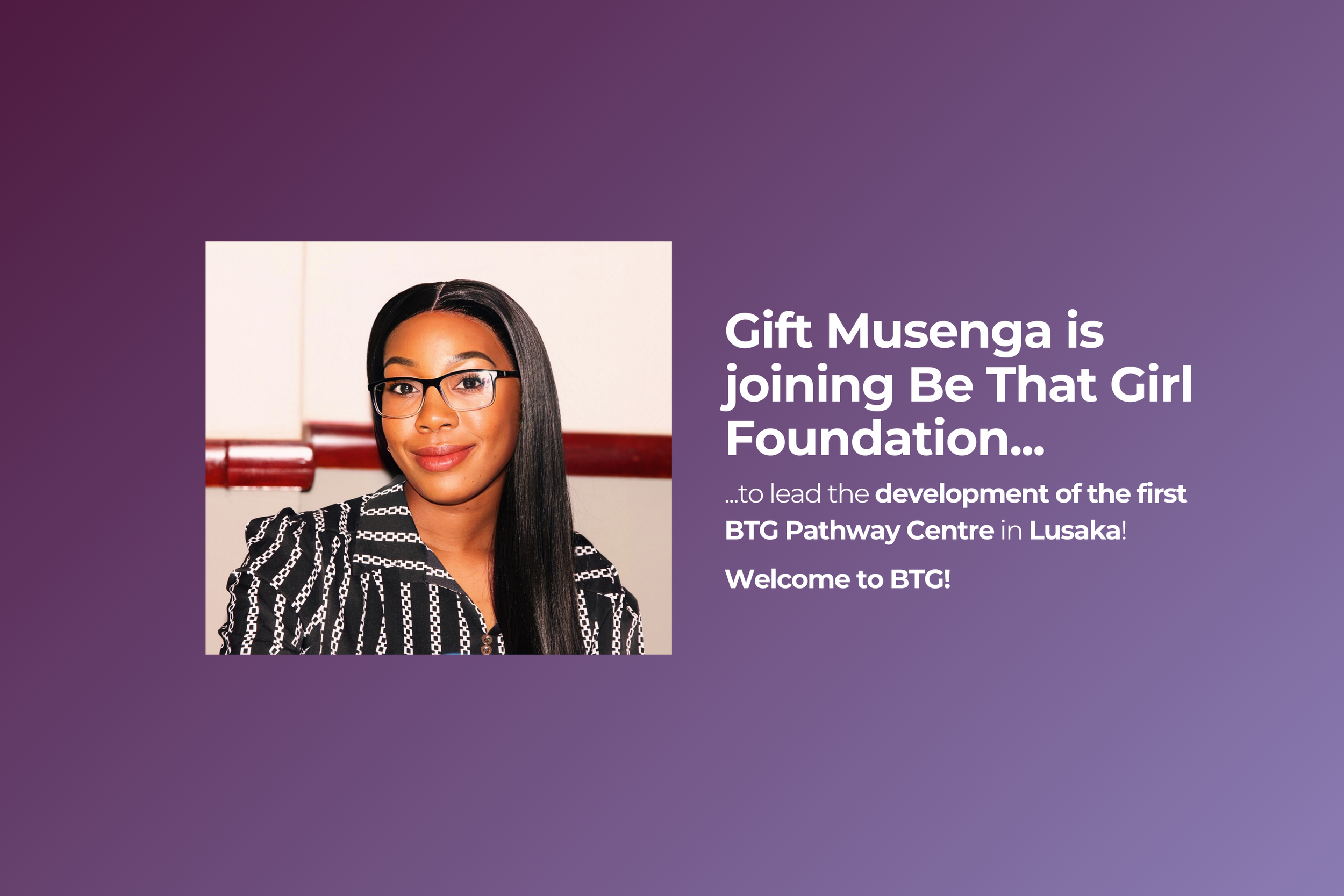
Lusaka, 19/01/2026 For many girls in Zambia, finishing secondary school does not open a clear next chapter. Instead, it marks the beginning of a period shaped by uncertainty, pressure, and limited choice. Access to information is uneven, financial strain is common, and expectations around marriage and adulthood often land before real opportunity does.
Gift Musenga knows this delicate transition well. She is joining the Be That Girl Foundation after more than a decade working in youth-focused programmes across Zambia, in both urban and rural contexts. Her perspective is shaped not only by her professional experience, but by her own journey - growing up in a mining town near the border with the Democratic Republic of Congo, navigating life after school with little guidance, and later carving out a path for herself through higher education and leadership in the NGO sector.
At Be That Girl, Gift will lead the development of the first BTG Pathway Centre in Lusaka. The Centre will help girls successfully transition from secondary school to higher Education, Entrepreneurship or Employment (the 3 Es), while avoiding early marriage and pregnancy. It will provide targeted support to girls - through coaching, work readiness skills, connections to work experiences and networking, among other systems - particularly during their gap year period, when the girls are waiting to receive their final secondary school exam results. This is a period when many girls are left without support and pushed toward choices driven by survival rather than aspiration. The Centre will be designed to provide what is often missing for girls during this period in a one-stop shop: clear information, practical guidance, job-market relevant skills and a space where girls can make decisions without judgment or pressure.
In the interview below, Gift reflects on the forces that shape girls’ lives long before choices are made - from knowledge gaps and economic vulnerability to social norms that quietly narrow what feels possible, and on the possibilities she sees through the Pathway centre initiative. She speaks candidly about early marriage, financial dependence, and why real change begins with listening to girls and taking their realities seriously.
Meet Gift in this interview!
Gift on Choices, Pressure, and the Paths Open to Girls
Luca from BTG:
Gift, it’s a pleasure to meet you - and welcome to Be That Girl Foundation. Before we talk about the Pathway Centre, I’d like to start with you. Can you take us back to your own journey?
Gift Musenga:
Thank you, Luca - it’s a pleasure to meet you as well. I’m based in Lusaka, Zambia. I’ve been working in the NGO sector for the past 11 years, with the last eight focused largely on youth-centered programs. My work has involved designing and implementing initiatives, mentoring young people, and supporting the development of monitoring and evaluation frameworks.
I grew up in a small town called Chililabombwe, a border town between Zambia and the Democratic Republic of Congo. It’s a heavily mining-centered community, and mining is a male-dominated field. After school, most boys could find work and start earning a living. For girls, that option didn’t exist. Many of us stayed at home, unsure of` what to do next.
Growing up there made me aware, from a very young age, that gender strongly influences how your future is seen - and what opportunities are considered possible for you. That awareness stayed with me. It continues to guide the advice I give, the mentorship I offer, and the way I think about creating spaces where young women can navigate this in-between moment with information, support, and real choice.
Luca from BTG:
Thank you for sharing that. And what shaped your own attitude?
Gift Musenga:
For me, it begins with how I grew up. I was raised by a single mother, and my mother was - and still is - an educated woman. She’s a teacher.
She herself came from a very rural, remote area and built a life in an urban setting. That journey was largely shaped by her father, who refused to accept the idea that girls should simply get married and stop there. He wanted every child - girls included - to be able to earn an income and stand on their own.
Because my mother had made that journey, she was very intentional with me. She gave us a good life - a comfortable life - but more importantly, she constantly reinforced the idea that I had choices. She would always tell me, “You’re not going to rush into marriage. You will go to college first. You will graduate. Only then can you think about marriage.”
She supported my ambitions and took a real interest in what I wanted to do. When it came to career choices, she guided me - explaining what different fields could lead to, and what studying one subject might open up later. She also made sure my school fees were paid. Even after I graduated, she would give me money every day to buy a newspaper so I could look for job opportunities and apply.
She wasn’t just a parent - she was a role model. I saw her financial independence, and I wanted that for myself. I wanted to make her proud - to show that the dream she had for me was possible.
Of course, there were temptations. I saw friends choose easier paths and, on the surface, appear to be doing well. But my mother always reminded me that those choices come with consequences. She told me to be patient - that my time would come.
That patience shaped my path. I found work. I went back to school to upgrade my studies. I completed my master’s degree last year. And my mother is still there - now asking me when I plan to start a PhD.
I also married later, when I felt ready. And over time, I realised something I hadn’t expected: my journey was quietly influencing other girls in my family. My younger cousins began asking what they should study, how they could follow a similar path. I didn’t set out to be an example - but simply living differently became one.
Luca from BTG:
When you were a student, what did you imagine for yourself?
Gift Musenga:
At that time, my dream was very simple. I wanted a stable, comfortable life - to earn an income, go to work, come home. Nothing extravagant.
But as opportunities opened up, I realised something important: once you’re informed, once you’re exposed to possibilities, your sense of what’s achievable expands. I met new people, built networks, learned more - and I understood that I could make better decisions for myself.
Luca from BTG:
And today - what does your ambition look like now?
Gift Musenga:
Professionally, I want to continue growing within the organisation. I’ve spent several years in management, and I’m ready to take on more senior leadership.
What excites me about this role is the room to grow - especially as the Pathway Centre moves beyond its pilot phase. I’m motivated by the possibility of helping build and scale this work across the country, province by province, and growing alongside it.
Luca from BTG:
Listening to your story, it’s clear how much context matters - family, place, and access to opportunity. In Global North countries, there’s an assumption that once you finish school, opportunity will naturally follow, whether through university or employment. From your experience, what does that same period actually look like for many girls in Zambia?
Gift Musenga:
It’s not always like that. For many girls, finishing school is the moment when hardships truly begin. The daily structure of school - waking up, attending classes, coming home - suddenly disappears, and with it having a sense of direction.
We do have guidance and career teachers in our schools, but in reality, they are not very effective. What follows is often a long, dry period of waiting - waiting for the unknown. Some girls wait for their parents to raise money for college. Others wait for acceptance letters from universities, especially government institutions, which are affordable but extremely competitive.
Many begin looking for work, but the jobs may not exist - or, as in the town where I grew up, the available jobs are shaped by male-dominated industries. Certain kinds of work are simply not considered appropriate for women, which limits options even further.
At the same time, pressure builds from families and society. Girls are told there is no money for further education, that they should start contributing financially, or that since they are grown, they should get married. Others are told they must find money quickly to take care of their own basic needs - or simply “figure it out.”
Very quickly, the excitement of finishing school fades.
Because there are so few programs, safe spaces, or mentorship opportunities to support girls during this transition, this period can stretch on for years. And when opportunities don’t appear, many young women end up getting married - not because they planned to, but because there seems to be no alternative.
Luca from BTG:
Is it really that common - to get married because there are no opportunities?
Gift Musenga:
Yes. It is very common. When there are no opportunities, marriage becomes a financial escape. For girls from very poor families, it can feel like the only way out of poverty - marrying a man who can provide.
As a result, we see high numbers of early marriages and teenage pregnancies. Some girls marry; others become pregnant without wanting it.
It’s heartbreaking - and it’s far more normal than many people realize.
Building the Pathway Centre
Luca from BTG:
It shouldn’t be normal. The Pathway Centre aims to become a gateway to help more young women in Zambia build a solid future, where self-determination is at the center. How does it feel for you personally to take the lead in creating the Centre?
Gift Musenga:
I find it very exciting. I’ll be building something from scratch - something that, years from now, I can look back on and clearly see where we started, and how far we’ve come, how many girls we have helped. Perhaps already five years down the line.
This role also gives me a responsibility: to connect with the girls, to listen to them, to listen to their experiences, not rushing to make decisions, and always being accountable to the young women the centre exists to serve.
These programs must also be shaped by the voices, the needs, and the realities of young women themselves. So yes - I’m very excited to build something from scratch and watch it grow.
Luca from BTG:
Super. What does it mean to you to be accountable to girls?
Gift Musenga:
First of all, to provide that safe space. For example, when we talk about safeguarding, I have to ensure that the centre staff is truly providing a safe environment and safeguarding the girls’ interests.
It also means being accountable in everything that we’re doing at the centre. I cannot be preaching or mentoring and then go ahead and live in a way that contradicts that. Because once you start having these sessions, you become a role model to these girls. They look up to you, and they pay attention to everything that you do.
So accountability has to start with me - my behavior, the way I dress, the things that I do. That’s what accountability means to me.
Luca from BTG:
Moving forward into understanding the transition to adulthood - the period is full of uncertainty for young women. From your experience, what are the biggest pressures and constraints a girl faces as she tries to move toward independence?
Gift Musenga:
I feel like girls face many pressures as they try to navigate adulthood and move toward independence. But the biggest pressure is financial challenges - because that’s what pushes them to make uninformed decisions.
Many families are unable to support further education or further training, even skills-based training. On top of that, girls often don’t have information about where opportunities are being provided. For example, right now the government is offering many opportunities - but in our communities, there’s very little awareness. Girls don’t even know where this information exists.
As a result, they end up being pushed into risky situations. One of the most common is entering relationships with older men who have financial power - often referred to locally as “sugar daddies”. For girls who lack money even for basic necessities, these relationships can seem like a solution, but they often come with serious consequences. They expose young women to unwanted pregnancies, health risks, and social stigma, and can narrow their options even further at a moment when their futures are already fragile.
Family expectations also play a huge role. In our society, a girl child is often not seen as someone who can become something big in the future. They’re told, “You’re done with school now. You can easily get married. Don’t be too educated. No man is going to marry you. Men don’t like educated women.”
Over time, this changes how a girl sees life. It becomes normalized.
Many girls also lack access to reliable information - including guidance that challenges early marriage - and existing laws are weakly enforced, with few policies that actually criminalize these practices. In that gap, advocacy becomes necessary.
That’s why, at the Pathway Centre, we also want to encourage parents and caregivers to be involved. If we give information to girls but leave out the adults around them, we’re not really solving the problem. So we plan to have caregiver sessions as well - so parents understand what we’re doing, what opportunities are available, and why it’s important for girls to have information and be able to make their own informed decisions.
Luca from BTG:
Great to know. Even with skills and a job, how realistic is financial independence for young women in Zambia today?
Gift Musenga:
The first and most important step is education. One of the things we’ll be doing at the Pathway Centre is focusing on job-readiness skills, including linking young women with companies where they can gain practical experience.
That said, independence is possible. Even at an early stage, a girl can begin to earn an income and make decisions for herself. She doesn’t have to rely on a sugar daddy or a provider, because she is building skills, gaining experience, and accessing the right information to guide her choices. What matters is that a career has begun, even if it starts modestly.
Alongside this, we’ll run mentorship sessions that bring in women who have succeeded in different fields. I’m also planning an annual conference, in collaboration with partners doing similar work, where women from a wide range of sectors can come together.
Mining, for example, is widely seen as a male-dominated industry, yet there are female engineers working in that space. We bring in those engineers. We bring in bankers. Girls will be able to see women who have done it - and to imagine themselves doing it too.
A young woman might say, “I’ve just started working, but I’m aiming to be like Mizinga Melu, the CEO of Absa Bank. I can follow that path as well if I work hard enough”. That shift in focus matters. When girls can see a future they’re working toward, there is far less pull toward risky relationships, dropping out, or unplanned pregnancies.
For the success of the Pathway Centre it will be extremely important to build trust - trust in the program and trust in what we are doing. Many girls don’t trust easily, and they don’t open up easily, especially in programs like this.
So it’s essential to build trust not only between us and the girls, but also between us and their parents. The Pathway Centre needs to feel genuinely safe. That means respecting the girls and respecting one another, and making sure they feel truly welcome from the moment they walk through the door.
Once that sense of safety and trust is there, everything else can follow - learning, guidance, personal growth, and the programs we’re offering. Without trust, none of that works.
And you’re right to point out the economic reality. Salaries are low, and many girls - even when they are working - still maintain relationships with sugar daddies. That’s why one part of the curriculum we’ll introduce at the Pathway Centre focuses on social behavior change. We want to address this directly, across all our programs and mentorship sessions, so we can bridge that gap and reduce the risk - even for girls who are already employed.
Luca from BTG:
Great. For girls navigating economic pressure and real risks - including exploitative relationships or early pregnancy - the first encounter with the Pathway Centre matters. When they walk in for the first time, what do you want them to feel, and how will you begin building that environment?
Gift Musenga:
From my own experience - even as an adolescent - I learned how powerful it is to enter a space where you feel you can trust someone. Knowing that what you share will remain confidential makes it easier to open up. That sense of safety changes everything.
So when girls walk into the centre, the first thing we focus on is how they’re received. They need to feel genuinely welcomed. Our staff will be trained not just in programs, but in how to listen - without judgment - and how to build real relationships. The space itself must feel calm and safe. Girls need to know that their presence matters, that they’re not simply being tolerated.
We want the Pathway Centre to feel like it belongs to them - like a place they can call home. A space where they can talk openly about things that, in many homes, are difficult or even forbidden to discuss. Questions about relationships, curiosity about sex, fears about their future - these are conversations that often have no safe outlet. At the centre, they can ask those questions, receive accurate information, and make choices based on understanding rather than fear or pressure.
It won’t be a judgmental space. Even if a girl has made mistakes in the past, she will be welcomed. The centre is about helping her move forward - about giving her the chance to rewrite her story.
Those first impressions matter. They shape whether a girl comes back, whether she feels safe enough to speak honestly, and whether she trusts the support being offered. That foundation is what makes everything else possible.
Luca from BTG:
You’ve spoken about how trust is built one girl at a time - through safety, listening, and lived experience. But you also work alongside institutions and policies. What has that taught you about trying to change systems while staying grounded in real lives?
Gift Musenga:
Working across different communities - both rural and urban - and alongside institutions has shown me that real change only happens when individual lives are taken seriously.
Policies and programs matter. Many of them exist on paper, and in some places they are implemented. But too often they are designed far from the realities of the girls they are meant to support. When programs are enforced without being shaped by lived experience, they miss the mark.
That’s why I believe programs must start with listening. We have to ask: What challenges are young women actually facing? What has led this girl into a relationship with an older man? What pressure pushed another toward early marriage? When we understand those experiences, we can design programs that respond to reality - not assumptions.
The same applies to policy. Many of Zambia’s laws are outdated and don’t reflect the world young women are navigating today - a world shaped by economic precarity, digital exposure, and shifting social norms. Advocacy, then, isn’t abstract. It’s about pushing for policies to change in ways that reflect what girls are actually living through.
Luca from BTG:
So that work also involves engaging directly with the government.
Gift Musenga:
Yes - it has to.
Luca from BTG:
To move forward: it’s often easier to see individual progress - a girl finding work, earning an income, gaining stability. But the Pathway Centre is also meant to contribute to something broader than individual outcomes.
How do you think about measuring whether this work is creating lasting change beyond the girls who pass through the centre?
Gift Musenga:
Most programs measure success through individual stories and numbers. And those things matter - they tell you that life has shifted in a real way. But sometimes we stop there and miss the bigger picture.
We celebrate resilience without asking what made that resilience necessary in the first place. We don’t always look closely enough at the structural barriers that shape girls’ choices long before they reach a program like this.
For me, success has to be understood on two levels. One is the individual girl - whether her life looks different, whether she has more agency, more options, more confidence. But the other level is the system around her. What about the policies that are outdated or unevenly applied? What about the structures that continue to limit opportunity?
Real success means changing individual lives and challenging the conditions that make those lives so difficult to begin with. That’s where advocacy comes in - pushing for policies to evolve in ways that reflect what young women are actually living through today.
I’ll consider this work successful if opportunity expands not only for the girls who come to the Pathway Centre, but also for young women beyond it - including those who may never walk through our doors. Zambia is a large country. Lasting change has to reach further than one place.
For me, success is measured through individual stories, yes - but also through visible shifts in the systems that shape women’s participation in society.
Luca from BTG:
Zambia is a large country, and the Pathway Centre is based in Lusaka. How are you thinking about reaching girls beyond the capital - especially those who may never have easy access to a centre like this?
Gift Musenga:
Zambia is geographically large - we have ten provinces - so this is something we have to approach carefully. We can’t rush it. If we move too fast, we risk not managing the work properly.
We’re starting with a pilot in Lusaka, learning from it, and then expanding gradually. And the truth is, the way the programme works in Lusaka won’t look the same everywhere else.
In many rural areas, early marriage and unplanned pregnancy are far more common than in the capital. In some places, girls don’t even complete secondary school because the gap is already so wide. So the first step there is often simply closing that gap.
That also means working closely with local leadership - including traditional leaders and chiefs - to address the cultural pressures that make girls feel marriage is their only option, especially when there’s financial strain and no clear alternatives.
In urban areas, the approach is different. Some programmes already exist, which makes partnerships essential. By working alongside organisations that are already trusted in those communities, we can combine resources and reach more girls than we could on our own.
For example, in the Copperbelt Province, organisations like the Young Women Christian Association are already doing related work. Partnering with groups like that allows us to strengthen what’s already there, rather than duplicating efforts - and to reach girls well beyond our initial targets.
Luca from BTG:
Thank you for your insights. This work clearly requires strong leadership. How did you develop that leadership - and what does leadership mean to you in practice?
Gift Musenga:
For me, leadership means taking responsibility - for the programme, for the people involved, and for the choices we make along the way.
Work like this can be emotionally demanding, so leadership isn’t just about direction; it’s about creating a shared sense of purpose and space for reflection. It means having regular moments where we talk openly about what’s working, what isn’t, and what we’ve learned - both from past programmes and from one another.
It also means knowing when to pause. We rest when we need to, we support one another, we protect our energy - because sustaining this work requires care. Leadership, to me, is about making sure the team is able to continue offering high-quality support without burning out.
Luca from BTG:
That emotional weight is real - this work is about changing people’s lives. How do you plan to manage that side of it?
Gift Musenga:
By recognising that the Pathway Centre needs to be safe not only for the girls, but for the staff as well.
We’re very intentional about creating policies that support mental well-being. If someone isn’t emotionally okay, they need to feel able to say so. That might mean taking time off, or having access to counselling and a space where they can talk openly and be supported.
If we don’t care for the people doing the work, we can’t expect them to provide consistent, thoughtful care to others. So managing emotional well-being means supporting both the girls and the team - ensuring everyone has the space they need to stay grounded and present.
Luca from BTG:
Looking further ahead - beyond individual success stories - what would tell you that this first centre has truly expanded what young women believe is possible for themselves?
Gift Musenga:
I’ll know it’s made a difference when girls come back - not just to visit, but to support others who are walking the same path.
When they speak confidently about the choices they’ve made. When they take time before making decisions, because they know they’re allowed to. When they’ve built businesses, found employment, or created stability - and then return to share that journey with others.
You see it in confidence. In financial independence. In their ability to challenge the limitations that were once placed on them. And in the way they support one another through peer-to-peer mentorship.
That’s when you know something has shifted.
Luca from BTG:
What needs to change for girls to truly shape their own lives and move toward self-determination?
Gift Musenga:
Both practical and cultural change are needed. Practically, we need far more investment in spaces and programmes that support the transition after school. Right now, there are very few, and the gap is huge.
Culturally, we have to work with the reality that culture matters - especially in African societies - but that doesn’t mean using culture to limit girls’ choices. It means designing programmes that are culturally respectful while still trusting girls to make their own decisions.
Girls need guidance, information, and freedom - not pressure to step into roles that others have already decided for them. That, to me, is what it means for girls to truly shape their own lives.
Education, Power, and Choice
Luca from BTG:
Moving into a broader topic: when we look at why so many girls end up making survival-driven choices, it often comes back to gaps in education - not just schooling, but access to information and guidance.
What do you think is really missing? And what kind of education would genuinely help girls shape their own futures?
Gift Musenga:
At the moment, I think the most important gaps are the knowledge gaps.
Because we do have programs now that are improving access -free education, for example, from grade one all the way up to the last grade of secondary school.
And we also have the government financing higher education -I talked about the Teveta and CDF scholarships- where you can apply for these programs and get 100% scholarship for tertiary education.
But a lot of people don’t know how to go about it-or have never even heard about these opportunities -because the information gap is very wide.
And the other thing has to do with social behavior change, because we’re an African country and we’re ruled by culture. There are certain things that are not discussed in our homes-even as we are growing up. Even in my case, there were limitations.
So if we start addressing that and giving the correct information to the girls and shaping them into that social behavior change, we’ll definitely avoid the issue of sugar daddies.
And also our policies and our laws exist, but are not enforced strongly enough. For example, relationships between girls under 18 and much older men - in their thirties, forties, or fifties - are illegal under Zambian law. Yet in practice, these cases are rarely treated as crimes. You’ll find that they will impregnate a young girl and the parents of the girls will be saying: marry her.
But when you come and look at the laws of Zambia, they’re supposed to be imprisoned because that’s someone below 18. They’re not able to make their own informed decisions - especially in rural areas, this is very common.
So we need to advocate for these laws to actually start being put into use so that we can actually ensure that people should know: I cannot date a young girl below 18. We cannot work on social behavior change for the young girls while leaving the adults to go unpunished.
Luca from BTG:
And why do you think it is considered normal?
Gift Musenga:
Zambia does have laws in place, but enforcement remains a serious challenge. Corruption plays a role, but so do economic realities at the family level. Many cases are underreported, and even when they are reported, families are often pressured to withdraw them. In some situations, the offender offers a small amount of money, and because of financial insecurity, parents or guardians feel they have no choice but to accept it and let the case go.
This isn’t rare. Organisations working closely on these issues have documented it consistently. In cases involving young women, the number of withdrawn cases is often higher than the number that are fully pursued. That tells us something important: legal frameworks alone are not enough if the conditions around families remain unchanged.
So while advocacy for stronger enforcement is necessary, it has to go hand in hand with broader systemic change. Corruption needs to be addressed, but so does poverty. Families need alternatives - real support - so they’re not forced into decisions that protect short-term survival at the expense of a girl’s future.
That’s why partnerships matter. At the Pathway Centre, we plan to work alongside organisations already active in this space, including those training officers within victim support units - often the first point of contact when cases of abuse or safeguarding concerns are reported. Strengthening these systems helps ensure cases are handled properly and that families receive guidance and support instead of pressure.
At the same time, social behaviour change cannot focus only on girls. Parents and caregivers are central to these decisions. When adults are supported - financially and socially - they are far less likely to withdraw cases or accept harmful compromises.
This is also where partnerships with organisations that work directly with families become critical. Groups that support caregivers to become financially independent help reduce the economic pressure that leads to these outcomes. When parents have options, they don’t feel forced to trade justice for survival.
Ultimately, protecting girls requires more than laws. It requires changing the conditions that make those laws difficult to uphold in the first place.
Luca from BTG:
Thank you Gift. If you had to summarise it - after everything we’ve discussed - where do you think the real leverage point is? If we want fewer girls pushed into early marriage, exploitative relationships, or unplanned pregnancy, what has to shift first?
Gift Musenga:
For me, it starts with closing the knowledge gap - because a lot of opportunities already exist, but many girls and families don’t even know they’re there or how to access them. We have free education, scholarships, bursaries - but information doesn’t reach people, especially outside urban areas.
At the same time, information alone is not enough. We also have to address social behaviour change, because culture shapes what is discussed at home and what is considered “normal.” There are things girls don’t feel they can talk about with parents or guardians - relationships, sex, pressure - and when there’s no trusted space to ask questions, they get their answers in unsafe ways.
And then there’s the system side. We do have laws, especially around girls under 18, but enforcement is weak. Cases are under-reported, and sometimes families withdraw them because of money - and corruption makes that easier. That’s why this work has to involve advocacy and partnerships, including working with organisations already doing this and supporting the structures that respond when abuse is reported.
So it’s not one thing. It’s information, social behaviour change, and real accountability - with parents and caregivers included - because if the adults around the girl don’t shift, the pressure doesn’t shift.
Luca from BTG:
Thank you, Gift. It has been a pleasure interviewing you. I am looking forward to seeing the Pathway Centre develop.
Gift Musenga:
Thank you, Luca. It’s been good to reflect on this journey, and I’m hopeful about what we will build.