
How can MEL guide philanthropy and support female self-determination - Interview with Esther Wambui
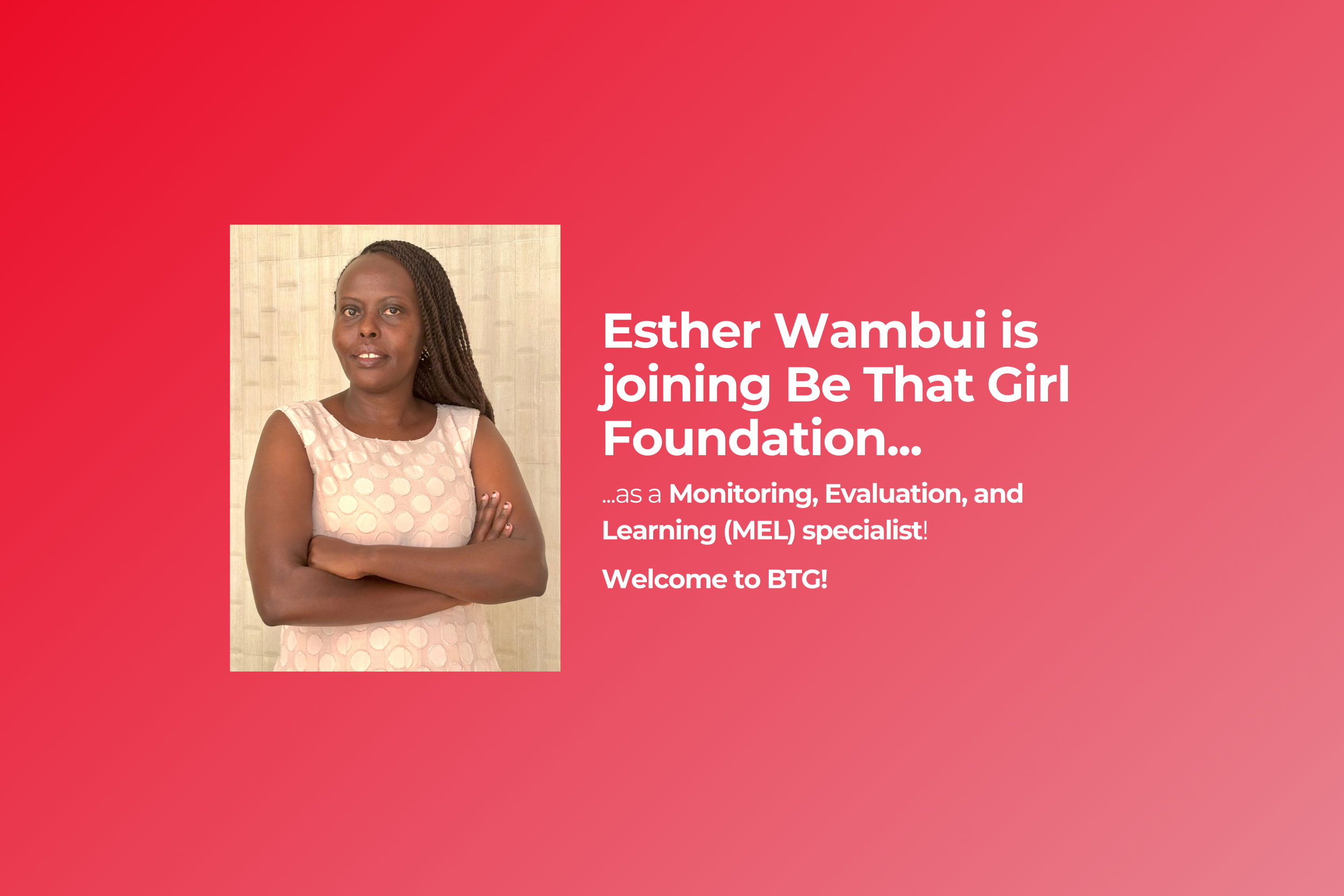
Nairobi, 19/01/2026 In this interview, we speak with Esther Wambui, who is joining Be That Girl Foundation as a Monitoring, Evaluation, and Learning (MEL) specialist. Based in Nairobi, Esther brings more than a decade of experience working across women’s empowerment, development, and learning-focused programmes in Kenya and beyond.
Her perspective is grounded in lived experience. Growing up between Nairobi and her family’s rural home in Murang’a County, she witnessed both the strength of community life and the quiet limits placed on girls’ choices. Those early experiences continue to shape how she thinks about self-determination, evidence, and the role of MEL in reflecting real lives rather than abstract targets.
The conversation begins with her personal foundations - and expands into how listening, reflection, and learning can help widen the paths available to girls today.
Esther - Personal Foundations
Luca from BTG:
Esther, it’s a pleasure to welcome you to Be The Girl. To begin, where did you grow up, where do you live now, and what did those places feel like to you?
Esther:
I was born and raised in Nairobi, Kenya, and I’ve spent most of my life there, including my schooling. Nairobi was home in every sense.
When I was growing up, the city was much smaller than it is today. There were fewer buildings, fewer houses scattered across the landscape. Alongside city life, I regularly visited my family’s rural home in Murang’a County, and those visits became an important part of my upbringing.
As opposed to the city life in Nairobi, Life in Muranga was simple. In the evenings, people would gather around a bonfire, talking openly about family matters, community concerns, and everyday challenges. It was a deeply communal way of living - one centered on conversation, connection, and shared responsibility.
Luca from BTG:
And professionally, your work has expanded beyond Kenya in recent years.
Esther:
Yes. Most of my career has been based in Kenya, but more recently I’ve had the opportunity to work across different countries. I was involved in a program funded by the USAID Regional MEL Manager, supporting private sector organizations on trade and investment between Africa and the United States, as well as intra-African trade.
Through that work, I traveled to several countries within Africa and the U.S. Those experiences broadened my perspective - seeing how people live, how they work, and how they relate to one another in different contexts. It shifted the way I think about women’s empowerment and girls’ empowerment more globally.
Luca from BTG:
You mentioned earlier those evenings around the bonfire in Murang’a. When you think back now - on Nairobi, on Murang’a - do you feel most strongly? What do you miss, if anything?
Esther:
I feel a mix of pride and nostalgia. I’ve watched Nairobi grow into a modern city, with high-rise buildings and improved infrastructure. There’s pride in seeing how far we’ve come as a country - not only economically, but also in how we’re able to engage with issues more openly and democratically.
When I think about Murang’a, I see a similar transformation. People have moved from traditional homes to more modern housing. Development is visible there too.
In Muranga, I miss the simpler days where we bonded closely as a family and community and were content with the simpler way of life.I miss the sense of shared ownership when it came to raising children. When I was growing up, child-rearing was a collective effort. Today, that responsibility has narrowed almost entirely to parents. Something important has been lost in that shift.
So when I look back, it’s both pride - we’ve grown, we’ve modernized - and nostalgia for a way of life that valued closeness, patience, and collective care.
Luca from BTG:
Thank you for sharing this. One of the central pillars of Be The Girl is women’s self-determination. As a man, it took me some time to fully understand what that really means, particularly in an African context. How does the idea of self-determination resonate with you personally?
Esther:
It’s deeply personal for me. I’ve seen, both growing up and throughout my career, how gender shapes opportunity.
I come from a family of six siblings - four boys and two girls. From an early age, roles were clearly defined. Girls were expected to take on household responsibilities, while boys accompanied our father and were exposed to business and decision-making.
I also witnessed girls being married off at a young age, often because they lacked the space or support to decide what they wanted for themselves or what they hoped to achieve. That absence of choice stays with you.
Today, I’m a mother to a daughter. For her - and for other girls - I want something different. I want girls to realize their full potential. To decide how they want to live their lives, when - or whether - they want children, and how far they want to go in their education.
Women’s self-determination, to me, means having the freedom to make those decisions for yourself. That is what I want for my daughter, and that is what I want for other girls as well.
Luca from BTG:
You’re also doing this work in your personal life.
Esther:
Yes, in a small way. I currently support two girls with their education. It’s not large-scale, I help them by buying books and contributing toward their school fees when I can. It matters to me. I’ve also been fortunate to have support from my husband, which makes this possible.
Women’s self-determination is something I care about deeply, not only in theory but in everyday life. I want my daughter, her friends, and other girls to understand that they can become anything they want to be.
Luca from BTG:
How old is your daughter?
Esther:
She’s ten.
Luca from BTG:
At that age, does she already understand what self-determination means?
Esther:
In a small way, yes. I try not to frame it in abstract terms. Instead, I use examples from her everyday life - especially school.
She’s in Grade Five now, and since the school year recently began, we talk often. I ask her what she enjoys, what excites her, what she imagines doing in the future. I know those answers will change over time, and that’s part of the process. What matters most to me is that she believes in herself.
I also make a point of telling her that whatever boys can do, girls can do too - sometimes even better. When those ideas are introduced early, you can already begin to see their effect.
Luca from BTG:
When you think back to the people or moments that shaped you early on, what lessons continue to guide how you move through the world?
Esther:
The people and moments that shaped me early taught me the value of humility, hard work and listening to others.
Living both in Nairobi and Murang’a also showed me that people’s experiences differ widely. I try to approach others with that understanding. Often, people behave the way they do because of missed opportunities, not because of a lack of ability.
These lessons guide how I move through the world today-they have shaped me into listening more, staying grounded and approaching people with empathy and respect.
Can girls dream in Kenya today?
Luca from BTG:
Dreams are powerful. And often in interviews, a single word opens up something larger. Let me ask you directly: can girls in Kenya dream?
Esther:
Yes, absolutely. Girls in Kenya do dream. Over the years, there have been many girls’ and women’s empowerment programs that intentionally address the barriers girls face. Kenya’s Constitution, for example, mandates that no more than two-thirds of members in public elective or appointive bodies can be of the same gender. As a result, we have increasingly seen women in top decision-making positions in government. This visibility matters-it creates space for girls to imagine themselves as leaders and to believe that leadership is possible for them too.
We are seeing more girls enroll in secondary and post-secondary education, and that progress matters deeply. Education opens space for imagination as much as it builds skills-it allows girls to see possibilities beyond their immediate circumstances and to believe in futures they may not have thought were within reach. Through education, many girls are not only dreaming, but beginning to realize their full potential. We’re now seeing more girls studying engineering, medicine, and other technical disciplines that were earlier male dominated. Government policy has played an important role in making that possible.
Beyond government efforts, development partners have also played a critical role in ensuring that girls can dream, particularly in communities where gender stereotypes are deeply rooted. In some areas, girls were traditionally expected to marry at a young age, sometimes in exchange for livestock-a pathway that was once seen as a way for households to escape poverty. That mindset, while still present in some places, is slowly but meaningfully changing.
Communities are beginning to see that a girl child deserves the same opportunities as a boy child. More families are supporting girls to stay in school and pursue their aspirations.
While we are not fully there as a country, it is a struggle we hope to overcome in the near future.
Luca from BTG:
Much of the work of BTG looks not only at outcomes, but at aspiration - how young women imagine their futures. What do you think about evidence when change is gradual, internal, or not immediately visible?
Esther:
In my experience, evidence goes far beyond numbers or quick results - especially in programs focused on social and behavioral change.
When programs aim to shift how communities perceive the girl child-such as moving away from early marriage toward continued education, change is often gradual and internal. Early evidence may appear in subtle ways, like shifts in attitudes, conversations, and aspirations, long before it shows up in formal indicators.
In those cases, qualitative information becomes essential. Storytelling is one powerful tool. You listen to a girl describe her experience from the beginning of a program to the point where change becomes visible in her thinking or her choices.
Numbers can tell you what happened - perhaps that a certain percentage of girls completed school - but qualitative insights help you understand why and how that change occurred.
I also pay close attention to stories, reflection and context.They help us understand the invisible shifts -the ones that don’t show up immediately in data, but shape lives over time.
In addition, there are approaches that can help capture gradual change. For example, outcome harvesting involves identifying a change first and then working backward to understand what contributed to it. This approach helps determine whether an initiative promoted by Be That Girl contributed to that outcome.
Luca from BTG:
So what you’re describing is a broader way of thinking about monitoring and evaluation - one that goes beyond numbers.
Esther:
Exactly. Monitoring and evaluation isn’t only about data. Numbers are important, but they don’t stand on their own. We need to give meaning to the numbers we report.
That’s why qualitative information matters so much. It allows girls to tell their own stories, and it helps us capture significant change - especially the kind of change that unfolds over time and isn’t immediately visible.
In addition to that, we conduct impact assessments, usually about five years after the program implementation. These assessments help us understand what happens beyond the program period. It helps us understand what lasting changes have occurred from Be That Girl Engagement.
They also help us identify what BTG interventions can be replicated or scaled. . Focusing only on short-term KPIs can be shortsighted. Without enough time, KPIs can become a way to lose sight of real impact rather than a way to measure success.
Beyond Monitoring: Building a Culture of Learning
Luca from BTG:
Let’s move to monitoring and evaluation more broadly. What do you find most challenging about helping learning take root in real-world settings?
Esther:
That’s a very important question. Monitoring, evaluation, and learning - what we often call MEL - really consists of three parts.
First is monitoring: routine data collection to inform decision-making and track whether a program is on course. Second is evaluation, which assesses relevance, outcomes, and results. Finally, there is learning, which focuses on reflecting, adapting, and improving future programming.
In my ten years working in this field, I’ve seen monitoring and evaluation improve significantly. Many organizations now embrace them. But learning is still lagging behind.
The challenge isn’t that organizations don’t collect data. It’s that they struggle to use it meaningfully. Learning often isn’t embedded across the entire program cycle - from grant design, to implementation, to closure.
What’s missing is a culture of learning. And that culture has to start with leadership and extend to the teams implementing the work.
Too often, learning is associated with failure or blame. Instead, the question should be: Why didn’t we achieve what we hoped? What can we do differently? What’s working well, and how can we scale it?
Learning shouldn’t penalize projects. It should strengthen them. But many organizations haven’t fully embraced that mindset yet.
Luca from BTG:
So learning is less a technical gap and more a cultural one.
Esther:
Exactly. When organizations develop a clear learning agenda and define their learning questions upfront, it becomes easier to see which interventions work and how to adapt them across contexts. Learning questions are crucial because they focus evidence collection and ensure insights lead to meaningful improvements.
Luca from BTG:
Across different settings, what makes it easier - or harder - for learning to become part of everyday practice?
Esther:
Learning becomes easier when people are given space to pause and reflect. When teams have time to ask: What worked? What didn’t? What should we do differently next time?
It becomes harder when data is collected purely for reporting. I’ve seen this often - data gathered to fill templates or meet donor requirements, without any effort to understand what it’s actually saying.
For me, learning is about reflection. It’s about sitting with the data and asking real questions. What is this telling us? Where are we falling short? Where can we improve?
Those moments of pause - reflection sessions with teams and partners - are where learning actually happens.
Luca from BTG:
And when information is gathered but not used, why do you think that happens so often?
Esther:
Usually, it’s because there’s a disconnect between the data being collected and the decisions being made.
Information only matters to the extent that it’s used. When the people collecting data aren’t connected to the people making decisions, the data loses relevance.
When that connection is intentional - when data directly informs choices - then evidence becomes meaningful, not just accumulated.
Luca from BTG: You’ve spoken about the gap between collecting information and actually using it. How do you think about audiences when you’re working with data?
Esther: We have very different audiences for data, and that matters. When it comes to decision-making, my role is not to share raw data, but to highlight what decision-makers actually need to see.
Once data is analyzed, it has to be translated into a form people can absorb and act on. That means pulling out the key messages - what matters most - and presenting those clearly. When decision-makers understand the story the data is telling, they’re much more likely to use it.
Another reason data often goes unused is the lack of reflection. Teams may collect it, but without pausing to ask what the data is really telling us?What's working well?What lessons can we draw? What should be scaled?
Without that collective reflection, data accumulates but doesn’t inform action and we risk missing the opportunity to turn information into meaningful change.
Luca from BTG:
So when insights are shared with people making big decisions, for example at board level, what makes those insights feel usable rather than overwhelming?
Esther:
Usability comes from clarity and focus. Different audiences need different levels of detail.
For senior decision-makers, I often prepare a one-page fact sheet. These are busy people. They need to understand key results quickly - what the programs are producing and where things are heading.
Beyond that, I try to highlight patterns and key takeaways. When people can see trends emerging from the data, it helps them make decisions and anticipate future outcomes.
Context is also critical. A number alone doesn’t tell the full story unless you understand why it looks the way it does. Linking data to stories and lived experiences makes it actionable rather than intimidating. That’s how we answer the questions of why and how, not just what.
Luca from BTG:
When learnings are distilled or summarized, what’s most important not to lose?
Esther:
Context and voice.
Change happens within a specific context. What works in Zambia may not necessarily apply in Kenya. If you remove context, you risk misinterpreting the data.
And you should never lose the voice behind the numbers. The voices of girls and communities give meaning to the data. Without them, numbers are empty. Those two things - context and voice - are essential.
Luca from BTG:
As Be The Girl grows, monitoring and evaluation will shape not only how impact is understood, but also how decisions are made. As you prepare to step into this role, what needs to be established early so that learning grows alongside the organization?
Esther:
One of my priorities in the first three months would be developing a MEL plan.
This plan becomes the roadmap for how information is collected, how learning happens, and how data flows through the organization. It’s not something I would develop alone. It needs to be collaborative.
That collaboration helps standardize processes and ensures that partners understand how MEL works within Be The Girl - from data collection at the partner level all the way to decision-making by leadership and stakeholders.
Embedding learning also means defining clear learning questions. What do we want to understand by the end of a program? What lessons do we want to carry forward?
For MEL professionals, the plan is our reference point - almost like a guidebook. It ensures consistency across programs and allows data to be collected and reported in a standardized way.
I am aware that BTG partners have varying capacities when it comes to MEL. Some programs are already doing this well, while others face challenges. My goal would be to strengthen capacity where it’s needed, ensuring that both reporting and learning are aligned across the organization.
Luca from BTG:
Looking ahead, when you reflect on Be The Girl, what will tell you that the work has expanded what young women believe is possible for themselves?
Esther:
For me, it’s the before-and-after story.
I want to understand who a girl was before she joined Be The Girl - her confidence, her choices, her sense of possibility - and then see how that changes over time. Interviewing a girl when she enters a program and again when she leaves reveals that transformation.
Years from now, I’ll feel proud if I see girls who are confident in their decisions, who pursue opportunities deliberately, and who feel ownership over their lives.
That kind of change - self-awareness, confidence, the ability to make informed choices - matters to me more than any single metric.
Luca from BTG:
Finally, what do you think society needs to change - or let go of - for girls to truly live self-determined lives?
Esther:
Gender stereotypes. They limit girls before they even have the chance to imagine their futures.
I want to see a society where early marriage is no longer something girls are pushed into, and where education is fully supported as a path to realizing their dreams.
Girls also need freedom - the freedom to make choices about their personal lives. That freedom is central to self-determination. Without it, opportunity remains theoretical.
Looking Ahead
Luca from BTG:
You’ve witnessed Kenya change significantly over time, especially in its cities. As society evolves, how do you see Kenya developing into a place where women are truly self-determined - where they don’t have to rely on men to build lives of purpose, and where their dreams can genuinely take shape?
Esther:
I think the government has played a critical role in this progress.
First, there is the Kenyan Constitution, which establishes the two-thirds gender principle. In practice, this creates a constitutional mandate to increase women’s representation in leadership and decision-making, at both the national and county levels.
That recognition matters. It shapes policy, guides public appointments, and signals - at the highest legal level - that women’s leadership is not optional, but central to the country’s development.
Second, women elected into leadership positions have access to government funding designed to support women’s economic empowerment. There are specific budget allocations meant to create opportunities for women to grow economically and participate more fully in leadership at the community level.
There are also bursary funds that support children - especially girls - from marginalized communities, helping them stay in school and continue their education. These interventions make a real difference.
So when I look at Kenya, I see that many of the right policies are already in place. The Constitution provides guidance on women’s participation and funding priorities, and that framework helps ensure girls are supported and able to pursue their dreams.
Beyond government efforts, development partners have also played a significant role. Organizations like UNICEF continue to work in marginalized communities to ensure girls remain in school, complete their education, and envision futures beyond secondary education.
A lot has been done. There’s still work ahead, but meaningful progress has been made.
Luca from BTG:
Esther, thank you so much for your time. This conversation has been incredibly valuable, and I appreciate the clarity and thought you brought to questions of monitoring, evaluation, and learning. It was a real pleasure getting to know you and hearing your perspective. Welcome again to Be The Girl.
Esther:
Thank you. I’m really looking forward to working together.