
BTG Voices of Change — Interview with Sumitra Mishra, CEO of Mobile Crèches
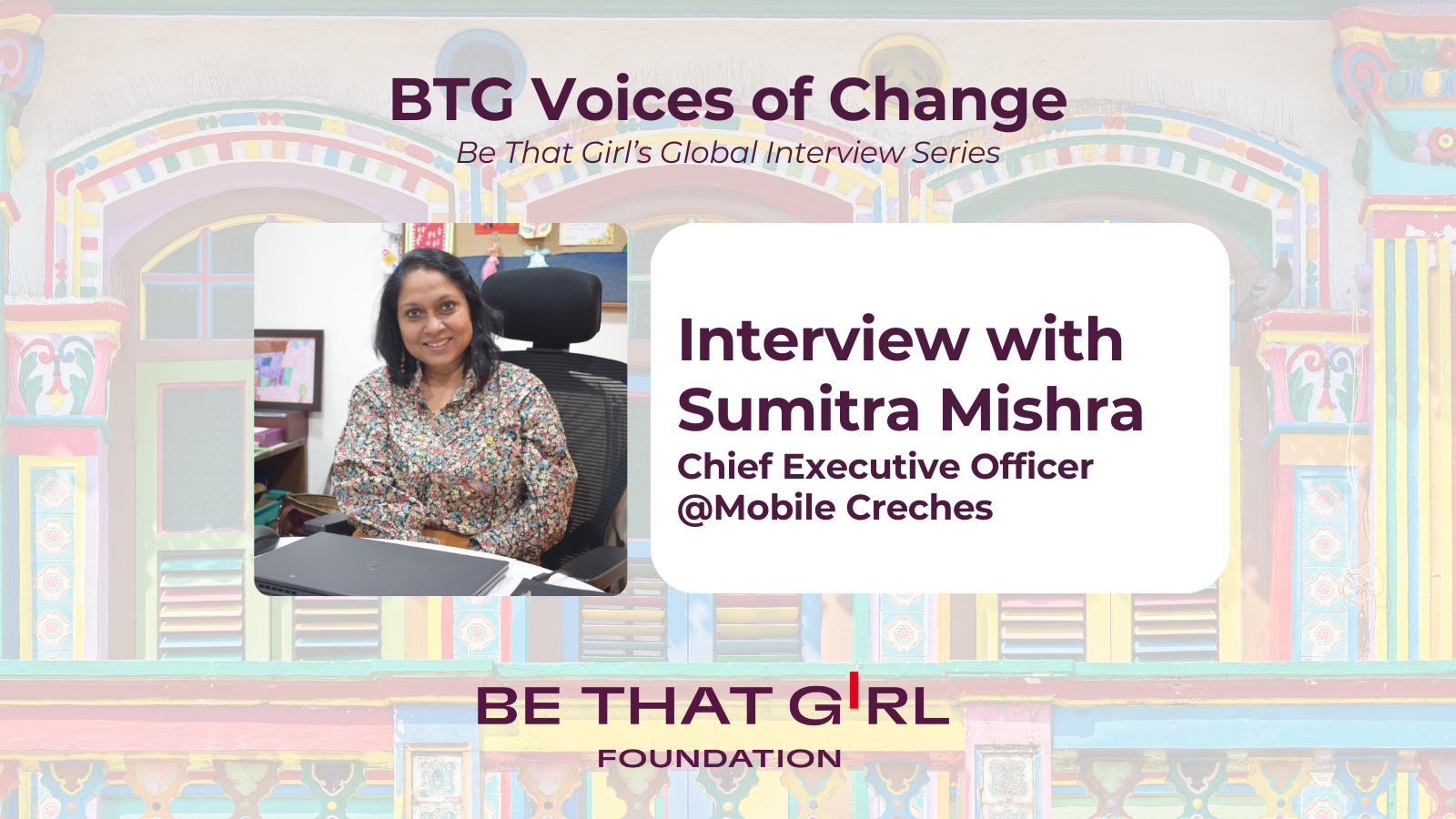
In this powerful episode of Voices of Change, we sit down with Sumitra Mishra, CEO of Mobile Crèches, a pioneering organization that has spent more than five decades transforming early childhood development, gender equity, and labor rights in India. Hosted by Trizah Gawka, Program Manager at Be That Girl Foundation, this conversation explores what it truly means to care — for children, for women, and for communities living at the margins.
Through personal reflection and deep professional insight, Sumitra shares how lived experience, persistence, and partnership have shaped her leadership journey and Mobile Crèches’ enduring impact. From redefining caregiving as connection, to advocating for childcare as essential economic infrastructure, this dialogue illuminates how investing in the youngest children can unlock systemic change for generations to come.
This is a conversation about care, courage, and collective responsibility — and a reminder that when we center children and women, we build the foundations for a more just and equitable world.
Trizah - Hello everybody, and welcome back to the Voices of Change interview series. My name is Trizah Gawka, and I am the Program Manager at Be That Girl Foundation. We’re always really excited and honored to host these conversations with amazing, phenomenal female leaders who are changing the world in different ways.
Today I am deeply honored to host a phenomenal leader who I am also really looking forward to learning from in today’s conversation. So, welcome, Sumitra. It’s such an honor. Thank you for making time to be with us today. I want to invite you to introduce yourself, and then we will get right into it.
Sumitra - Thank you, Trizah. It’s an equal honor for me to be here as part of the wider Be That Girl Foundation community. I’m Sumitra Mishra, and I am the CEO of Mobile Crèches, based in India.
Trizah - Thank you so much, Sumitra. Now, many people may not know this, but you have spent so much of your time advocating for women and children in India. Please tell us: where and when did this commitment begin?
Sumitra - Well, I think as a young girl born into a large conservative family from Eastern India, the experience of being a girl – and therefore having different expectations from me – was very formative. I grew up with what I call the “burden of no expectations” on me other than being a good girl. And a “good girl” was equal to being an obedient girl who did not challenge norms or create trouble.
So in some sense, even with all the privileges I was born into, simply being a girl shaped my life choices — it pushed me to break the norms placed on me, and to use my access to education, opportunities, and family support to widen possibilities for other women and girls.
Trizah - That’s very interesting – that just being born a girl in itself is enough fuel for this work because of the inequalities that exist in the world. Thank you for sharing that, Sumitra.
And Mobile Crèches itself has pioneered early childhood development programs since 1969. That’s a long time. How does such a long history of work inform and shape the work of the organization today?
Sumitra - So at fifty-seven years of age, Mobile Crèches is clearly a legacy organization in the field of early childhood development. I would say there are four “P’s” that make us relevant even today.
The first P is the people that we serve – we are rooted in our communities.
The second P would be persistence. We show up every day to do the hard work: from the days when even “crèches” was not understood as a concept, to now, when childcare is seen as an economic infrastructure investment for progress.
The third P for me would be precision. Precision here means a laser-sharp focus on our mission: quality childcare that sits at the intersection of early childhood development for children, gender equity for women’s workforce participation, and labor rights so that markets can benefit from a more diverse workforce where women are included in their ecosystem.
The fourth P would be partnerships, because we believe we cannot do this alone – we always work with others. And I think these four P’s form the cornerstone and the North Star for being relevant after more than five decades of our work in India.
Trizah - Wow, that is profound. I love that. I will sit with those four P’s a little more after this. And I love how you explained that you’re working at the intersection of early childhood development, gender equity, and labor rights. It’s an entire ecosystem.
I want to zero in a little on the P of persistence. Mobile Crèches, in the last couple of years, has received several awards – the latest just yesterday. Congratulations. What I’m curious to hear is: first, tell us a little bit about the award – what it is – and then, why do you remain this persistent in keeping the bar so high? What motivates you?
Sumitra - Thank you very much. On behalf of the entire Mobile Crèches community, I accept with deep gratitude this acknowledgement as “Social Leader of the Year” by a highly prestigious organisation called Sabera.
I think awards are an acknowledgement of the tireless work of our care cadre – our frontline workers – who persist in doing this work day in and day out, through decades now, despite everything that happens in their own personal lives and in the world around them. Frontline care workers carry the burden of building the foundations of the nation by building the future of its youngest citizens.
So awards for Mobile Crèches are really an opportunity to push more of the “fence-sitters” – the unlikely champions – and to use this as a platform to convert them into care champions, into childcare champions.
Trizah - I join you in honoring them, in celebrating them and the work they do and the impact that has on future generations and even current generations. So, thank you to the entire Mobile Crèches team – this is a well-deserved award. Congratulations to you all.
We’ve been talking a bit – everybody hears us talking about Mobile Crèches – but I want us to really understand the work a little more. What services does the organization provide, and perhaps even paint a picture of the communities that you serve and why these services are a lifeline for them?
Sumitra - So first, let’s start with the name Mobile Crèches. “Mobile” here means the moving, migrating population and not a moving bus that runs a childcare service. These are crèches or childcare services for children of migrant, poor, working families, mostly addressing women in the informal work sector.
At the core of our work, we as an organization guarantee quality early childhood development services, and this is derived from the WHO Nurturing Care Framework, which talks about five components: good health, adequate nutrition, early learning opportunities, responsive caregiving between children and adults, and a safe and secure environment.
How do we do this? We do this by running our own demonstration-based crèches at scale, including home-based models delivered through mothers and fathers. But more than that, we work in close collaboration with governments and civil society partners, and we scale up access to quality ECD services through public systems and civil society systems by extending our knowledge and expertise.
We also know that groundwork with communities needs sustained and sustainable scaffolding. That means state-of-the-art training backed by norms and standards and a curricular framework is necessary. So we provide thought leadership to the early childhood development ecosystem in India that is required to deepen the impact of our work on the ground – on actual children’s and women’s life outcomes.
But, Trizah, let me also say that just doing the work or getting the work done through proper training is not going to help us sustain impact, because we’ve seen over the years that research and pedagogy alone cannot sustain the quality of implementation on the ground. We need many more partners – from parents to union leaders, from local political leaders to central ministers, from gender and education groups to business coalitions – to understand, adopt and accelerate the importance of early childhood development and childcare.
So besides the work that we do and the technical expertise that we lend to the ecosystem, we also work with a coalition of partners, through data and evidence, through stories and experiences, to bring joint solidarity on the issue.
Trizah - I see. We’ve got to engage at all the levels of change (individual, community, and systemic) for us to see a tangible difference.
And when I hear that and I think about caregiving, as a mother myself, it feels like such a complex idea. But what I’m really wondering is: if you were to define caregiving in one simple sentence, for yourself as Sumitra, what does care look like to children in one simple sentence?
Sumitra - Care is connection. And connection comes from trust, and trust is formed over consistency. To me, care – which is a universal need, has nothing to do with poor parents or rich parents, because you and I are working parents and we know what care means – care is that connection.
Trizah - And when you define it that way – connection that is built through trust and consistency – it makes it accessible to any of us. It stops being so removed and unattainable. Thank you so much. I’m going to take that definition for myself.
Now, what does a typical day at Mobile Crèches look like, especially for the children and the caregivers?
Sumitra - Our services are closest to the children – in their neighbourhoods or at worksites. They must be close to the family’s natural habitat, whatever that may look like for a moving, migrating population. A care worker is often one of their own, from the same local cultural context, to build that connection. Remember, you have to trust the caregiver. So she comes from the same community.
Our childcare service timings are aligned with the work timings of parents, mostly mothers, so that it is convenient for them to leave their children at the childcare centres when they are at work.
What does the day really look like for the child once they are dropped off at our centre? I would say we follow the “Eat, Play, Love” framework.
“Eat” means balanced diets, good nutrition, and tracking of malnutrition in all our services. “Play” – of course, children will play, children will be naughty. There is a lot of free play and structured play laid out by our play-based pedagogy, and that is what builds connection through social-emotional bonding, because children experience a sense of security in that space through the Play-Way methodology. And “Love”, as I said, is the care through feeding, putting children to sleep, washing them, giving special attention to a new crying child, or acknowledging that siblings may want to sit together and eat together even if they are split into two different age groups within the childcare centre.
All of this sounds simple, but it’s actually quite technical, and it’s all codified as part of our standard operating procedures. That’s what determines our training, our measurements, and our monitoring systems.
Trizah - Yeah, wow. I love “Eat, Play, Love” because I’m a fan of the “Eat Play Love” movie – that really clicked for me.
Earlier, Sumitra, you mentioned that the name Mobile Crèches is not because it’s a vehicle that is moving. It is because of the transient nature of the families and the communities that you serve. And you’ve also mentioned that care is really about connection and trust.
So how do you build a sense of continuity, a sense of connection and trust, with these communities and families that may be moving from place to place?
Sumitra - It doesn’t need a very complex theory. It’s about showing up every day. It’s about listening to the people in the community that we serve.
We have worked with migrant populations in urban settings. When you work with migrant populations, it is astounding to see and experience the level of exclusion they experience when they move away from their families. They are excluded physically in a new setup. They are excluded socially because they’ve left behind the social fabric of their own family and ethnicity. They are excluded emotionally because they don’t know their neighbours and it’s a strange place with a strange language. They are, of course, excluded economically because they are on the margins of large cities seeking work.
They are excluded legally because sometimes even basic citizenship documents are not valid when they move from state to state. And let’s not forget that they are uprooted environmentally because they come from a different geographical context to a new one. In a country as large and diverse as India, geographies change every hundred kilometres or so.
So what helps to keep the connection is to really show up every day, to represent their experiences, but never try to replace their identities. And I think that’s a code that we would like to continue to hold as we move further and further across the country in scaling up our services.
Trizah - So, holding on to identity even throughout different experiences – that’s very supportive, I believe.
Now, traditionally – we know this – women have been assigned the role of caregiving, and not just in India but the world over. I know that Mobile Crèches has been intentional about including fathers in caregiving from the very beginning. How do you do this?
Sumitra - Well, Trizah, let’s be honest, and let me put out a disclaimer straight away: breaking gendered norms about caregiving is a deep-rooted systemic challenge. It’s not going to break away through one intervention by Mobile Crèches or through a few people coming together. It needs an entire worldview shift to break some of these deep-rooted mental models that affect caregiving and place the burden of care on women, not only in India but across the world.
The first step is to recognize that care is highly feminized – whether it is caregiving within our homes or the care workforce across our countries. Preschool teachers, daycare workers – mostly it’s women, because it’s imagined that women are supposed to have this natural nurturing role that they will bring into their professional expertise.
To break some of these patriarchal norms, we of course need role models on the ground and program interventions on the ground, but we also need deeper systemic changes at the policy level and at the level of narratives.
At Mobile Crèches, we try to break this by engaging more fathers throughout all our program interventions in our childcare services. Both mothers and fathers are expected to attend weekly meetings, participate in making crafts out of waste materials. Both parents are invited to join us in picnics, family excursions, sports days, and things like that.
But we’ve also learned the hard way that, to convince fathers to become role models or share the burden of care within their home environments, we needed a tactical shift. We now employ and engage more male care facilitators as champions within the communities. When a man talks about his caregiving experiences through the Dulaar Parenting Program that we run on the ground, it has started to make a difference.
So I think simple techniques on the ground – listening to communities, involving more fathers, being persistent, and showing role models at the local level – are important. But a much larger environment of pushing this narrative of de-feminizing care is also equally important.
Trizah - I think there is a way in which men listen to men more, so I can see how having male caregivers would make more impact.
I remember a situation where I worked in a community where girls would get married early and go through female genital mutilation. It was so hard to shift things until one father brought his girl to the program. Once she got educated, he became the champion. Suddenly the men were listening to him, where we couldn’t get through. And so I really, really love that model where men themselves become advocates for this work.
India generally has made a lot of progress in early childhood programming, and Mobile Crèches has been at the forefront of this work. A lot of progress has been made; gaps still remain. What would you say are the gains that have been made, and what opportunities exist to really further this work within the country?
Sumitra - Well, it’s a country of contradictions. India has one of the world’s largest early childhood development programs – the Anganwadi system – that reaches a very significant population of children under six years, who are from the poorest and most marginalized backgrounds. It is already conceived as a holistic program of health, nutrition, maternal health, adolescent health, and early learning for young children. And yet, as you mentioned, gaps persist.
The uplifting part of India’s socio-economic, intersectional policy view is that the National Education Policy recognizes the continuum of learning from birth to six years. There is a much better focus by the government, both at the central level and across multiple states, on foundational learning for preschool education and bringing that into the country’s structure and systems.
There are also some green shoots emerging around children under three years, where the highest brain development is happening: looking at how children under three and their parents can be supported through home-visiting programs, and how the Anganwadi systems can be expanded to include more children under three in community-based platforms. These platforms enable better intervention, better developmental progress, and also help children with disabilities and other at-risk children get picked up faster and become part of the system.
Trizah - Wow. What do you think – maybe this is just a follow-up question – what drives the political goodwill? Because I think a gap I have seen in many places is the disconnect between policy on paper and the goodwill to actually ensure that things are happening. And even though you’re naming the gaps, it sounds to me like there is a lot of goodwill at different levels of government.
And this is really an invitation for you to speak to other governments – that’s the opportunity here. What would it take, from the government’s side, to actually make this change happen?
Sumitra - If governments can look at inclusive economic prosperity through the lens of human capital development, and therefore put their investments in the highest-priority areas where they will get the best returns, then there is enough science and enough economic modeling available around the world that says that investing in early childhood development gives more than four times the return in adult life outcomes.
What has changed in India is that there is political leadership that recognizes that India is one of the fastest-growing economies in the world. There are ambitions for India to be a developed nation in its hundredth year of independence in 2047. The Government of India has put together a vision paper called Viksit Bharat 2047, meaning “developed India” by 2047, and therefore it is looking at investments in preschool education and early childhood development programs as foundational.
At the same time, organisations like Mobile Crèches, along with many partners, are working to surface the intersectionality of early childhood development – how ECD and childcare can unlock greater women’s workforce participation, and how having more women in the workforce ultimately strengthens India’s growth story.
In order to increase access to better ECD services and childcare services that will enable more women to work, it also means creating more care jobs and therefore training more and more women – and, I hope, men too at some point – who will choose early childhood development and childcare as an aspirational career of choice.
So there are really three strands of investment for governments to look at: invest in ECD because it is future human capital; invest in ECD and childcare because it will unlock more women to join the workforce and contribute to economic prosperity; and invest in ECD to increase and expand quality services across the country, because this is one job that AI and technology cannot take over. We are creating more jobs for more men and women from local communities to enter the formal care-economy workforce.
Trizah - Wow, that is profound. And I do believe that if we did this, if this happened, if our governments did this, then childcare would become a universal service, something accessible to every child – which really is the goal.
In many ways, I know Mobile Crèches has been leading this work. You talked about thought leadership at the beginning as a key priority for the organization. How do you fuel this patient work of advocacy, which may take a long time to actually see its fruit? And how do you centre the lived experiences of the communities that you serve? How do they inform the advocacy?
Sumitra - Three simple ways to keep doing this patient work. One is to listen to our communities, as I mentioned.
We do not leave the ground. I think that is one of the strengths of Mobile Crèches – that we walk the talk. We demonstrate what we advocate for. And therefore we build our credibility through the moral authority of having done something and speaking from practitioner-led experience.
But that by itself will only take us so far. So the second piece is that we have to be tactical in our advocacy. Early childhood development is a central priority for us, but over decades different movements have become prominent – food security, maternity benefits, labour rights, and now the care economy. How do we remain true to our work but create evidence to make an intelligent, reasonable and evidence-backed argument to pivot into these movements and political energies, and position early childhood development and the voices of the poorest children and families within these changing political and economic priorities?
The third, and I will repeat myself here, is to know and recognize that we are one good organization for sure, but we are still only one. Big systemic change is never led by one. It has to be led by many. So we must always have the humility to learn from others, always reach out to others to join them, and have the patience to know that in large systemic change you sometimes have to give up some space in order to gain more space. That is our tactical advocacy strategy.
Trizah - Wow, profound. I’m taking so many notes.
I want to pick up from where you stopped with partnerships and collaboration. Often, that really makes the difference between a pilot project and systemic change. Because as you’re rightly putting it, Mobile Crèches is doing amazing work, but it is one organization in a country with so many children and so much need in this sector.
What partnerships would you say have been most effective for Mobile Crèches, and why?
Sumitra - It’s hard, Trizah, for me to call out only one partnership because, as we say, it takes a village to raise a child. Different partnerships have been pivotal at different moments in time.
But if I am going to pin it down, I would say that all our partnerships are meant to strengthen public provision and the right to early childhood development for children, and the right to childcare as a social protection benefit for women, mostly women in the informal sector. From that perspective, our partnerships with the government have been the most substantive.
Even within that, we have walked a journey – from being a technical partner informing norms and standards and advocating for legislation, to saying: we understand that you as government have your own challenges, we understand that you have the intent to make things happen, and we understand the limitations of a large, complex system like government. Therefore we will walk this journey with you as a co-traveller and provide technical, end-to-end support and solutions for the system to take up.
From being advocacy partners we have navigated into becoming technical partners of the government. One proof of this is that, from supporting around one hundred childcare centres four years ago, today Mobile Crèches supports around five thousand plus childcare centres, mostly through government partnerships. And within that five-thousand-odd universe, fewer than five hundred are actually run by Mobile Crèches or other civil society partners – which is also important. But that shows the scale and possibility of working with the government, and we work with many players to make that happen.
That’s been our experience with the government sector. But I must also dwell a little bit on our partnerships with the private sector. Remember when I started, I spoke about the intersection of early childhood development, gender and labour – and labour is dominated by the private sector. Manufacturing units, brickworks, tea plantations, construction, real estate, technology, the service industry – you name it.
Mobile Crèches has, as a legacy over fifty years, always engaged with the private sector. We come across as a facilitator, not a demanding partner. We say to companies: we recognise early childhood and childcare is not your core business priority, but you recognise that some of these services are needed in order for you to fulfil your core business priorities. So here we are, bringing the technical expertise to help you deliver those services.
Some of those relationships have been very fruitful and have led to large private companies, particularly real estate companies, putting childcare as a policy mandate within their ESG frameworks. It’s good to see more and more private sector companies looking at the intersection of getting more women into what I call the “sticky floors”, not just breaking glass ceilings. Getting more women into entry-level jobs means they will need to recognise childcare as one of the enablers of a diverse workforce.
Trizah - I love that. When you spoke about the government, I remembered a conversation I had in July this year with someone about the benefits of engaging with the government – which is hard. Granted, it is so hard; it is easier not to. This person gave me a very vivid example that I’ve never forgotten. He said:
“Think about when there’s no water. There’s a piping system but no water. You have the option of bringing trucks and delivering water to people, or figuring out who owns the pipes and then ensuring that there is water flowing through those pipes, because it will reach more people.”
And he said to me, “That’s what it is. Anywhere you go, it is the government that has the piping system that will allow you to reach way more people than you would if you were just carrying jerry cans and delivering the water.”
And so, to hear that your partnership with the government has allowed you to reach over five thousand centres – that is so profound and commendable.
It also makes me reflect on another key part of this ecosystem: the philanthropic space. Often, philanthropy works in isolation, and many funders support individual projects or organisations. This is not to fault anybody, because meaningful change does happen through those investments.
But thinking about scale, and the kind of reach you’ve achieved, how can partnerships between funders and grassroots organisations better fuel this care work? What can we do differently, from your point of view?
Sumitra - You’ve said it right – funding organizations also have their own boundaries and guardrails. But what has been a beautiful experience for Mobile Crèches is that, through our work over years – by doing this year after year – we have been able to develop long-term partnerships with many of our funding organizations, including Be That Girl Foundation, who have begun to recognize the intersection of gender, education, early childhood, labour, environment, health and nutrition.
Ultimately, social change is not linear. It’s not about what falls neatly under the four boxes of a strategy. It’s the intersectional piece that is hard to measure, difficult to fund, but also the most critical to invest in for long-term, sustainable change. Foundations like Be That Girl have come forward to understand and recognize that intersection. And I see that recognition increasing through multiple other funders who may have started out as “education-focused” or “nutrition-focused”, but are now seeing how it all converges.
Because early childhood development, by its scientific nature, is a holistic, integrated concept, we are able to make multiple, beautiful partnerships.
I must add one more point about the role of the private funding community. Governments, as you said, hold the “plumbing” and the source of the water – and that is where big change can happen. But in that same example you gave, social financing through private philanthropic foundations starts to put the taps and the pipelines in place to show the government the route, the map. Once you have pilots and proven, replicable programs on the ground, then you are able to accelerate much faster.
That’s something we’ve experienced as well. Even today, our outreach and impact is roughly ten times greater through government partnerships, but the investment we receive from the government is less than ten percent of our total funding. More than ninety percent of our funding comes from private philanthropic funds. We are able to unlock this 1:10 ratio because we have that support from private philanthropic funds, which then helps us leverage much more from public partnerships. So let’s not forget that private philanthropic finance holds the power to large-scale public systemic change as well.
Trizah - That is very profound. I think one of the things I hear you inviting us to do is to appreciate that early childhood development is at the intersection of everything.
As you were speaking, I thought about funders that support entrepreneurs and prioritize female entrepreneurs. You cannot separate early childhood development from that. You talk about climate change, you cannot separate it. And so I think that’s a very important call to action or invitation you are making for us to recognize: where does this issue sit? It sits at the core of everything that we are doing. It has the potential to unlock all of it. And we have the opportunity to make investments that can then be scaled through government partnerships.
And I want to zero in a little bit on the intersectionality with gender and, more specifically, the ability of women to really be in the workforce and to contribute to the workforce. That one seems to be clearer, especially for us at Be That Girl, but increasingly it’s becoming clear across different sectors.
You’ve talked about working with the private sector in India. What key learnings or best practices are you seeing in this area that could be replicated elsewhere?
Sumitra - I think I will give full credit to the Government of India’s vision to put women-led development front and centre. The government believes that development for the future is going to be led by women’s power, women’s energy and women’s ability to bring change. We all know the old saying that when you educate a girl, you educate an entire village, because it starts from an educated girl becoming an educated mother, leading to thriving families and prosperous communities.
More and more private sector companies are recognizing the value of making sustained investments in a diverse workforce. Childcare is only one of the solutions to sustain that; there are also welcoming workplace policies, safe mobility, skilling – a whole host of issues.
If I look at one concrete example from our experience, there is an entire manufacturing sector group that is looking at childcare not only as a service for their women workforce, but also as part of their responsibility to the communities around their manufacturing hubs. They are training more and more women as care entrepreneurs, who can then take up care as a livelihood option, and they are creating market opportunities by opening more childcare facilities within their manufacturing units.
You see what they are doing at a policy and industry level: they are trying to retain their own women workforce by providing childcare and supporting their children to grow and develop better. At the same time, within their own communities, they are identifying women and training them as childcare entrepreneurs, thereby supporting the survival and growth of families who may not be directly connected to their company’s network.
There are many such examples coming up in India that we have a line of sight to – and there are several others around the country and globally for us to learn from.
Trizah - Yeah, I love that. And it brings me to the women you work with — women who are juggling childcare, work, and daily survival.
As we move toward closing, I want to ask you something more personal. This work is heavy, and there are days when it feels overwhelming — when, as you once said, it feels like running around like a headless chicken or a puppy chasing its own tail.
What keeps hope alive for you when progress feels slow? And what is your vision for women — working women and their children — over the next decade?
Sumitra - The much-clichéd but honest answer is this: if I personally ever feel the need to ask myself, “Why am I doing this, despite all the everyday challenges?”, I just have to go to one of our childcare centres. I sit with the children, play with them, talk to them – and just as much, I sit with the care workers and see the hard work they are doing every day, caring for children. Then I meet the families for whom this is the only lifeline for survival, because they are able to work only because their children are safe.
It puts a lot of perspective into our bigger goals and ambitions in life. At the end of the day, I am only doing a very simple thing in this world. And if that simple act of showing up in a community and caring for that tiny child, that infant, that toddler, is making such a big difference to so many people’s lives, then there must be something worth doing, right?
At a personal level, that keeps me going. But also, Trizah, I think as leaders in this social impact sector, it would be very irresponsible if we did not use our power and our privileges to make a substantive difference in our lifetimes. I think it’s time to say “enough is enough” – inequity has to end; the invisibility of poor children has to end; the inequity in women’s participation in this world has to end. Children and families must thrive. There has to be more peace in this world, and that peace has to come from peaceful families. Peaceful families come from creating a caring environment.
Trizah - Thank you so much, Sumitra. As we conclude, you have shared so many lessons and nuggets of wisdom. I want to invite you to share one last one: what is the deepest truth – the one that comes to you as you think about it – that you have learned about care and equality in the decades that you have done this work? And at this point, I also want to invite you to say anything else you feel we need to hear before we conclude.
Sumitra - I will end with a personal note. Why do I continue to do this? Because when I was a young mother, and when my child was very young, and for a period of time I was a single mother, I made some dangerous, difficult choices to care for my daughter.
This work is my way of telling my daughter – not just the thousands of children outside that I am able to reach – but telling her that I cared for you then, and I care for you now. Life may not give us all the opportunities every time, but when it does give an opportunity to make a difference, then seize that. And that is what I am trying to do.
Trizah - Thank you. Thank you so much. I have learned so much today – as a woman, as a mother, as a leader. I have learned so much from you, and I know that everybody else who listens to this will also learn. I hope that we will all find something we can pick up and apply and engage with.
So thank you so much, Sumitra, for making time, for sharing your wisdom. Really, really grateful. This was an amazing conversation.
Sumitra - Thank you, Trizah. Thank you for the opportunity. Thank you for creating a safe space for me to connect my own experiences with the wider world’s experiences. Thank you to the entire Be That Girl community for listening in. We are here; we are one of many of you. Reach out to Mobile Crèches in any way that we can work together, learn together, and celebrate our work together.
Trizah - Thank you. Alright.