
Edited from the original transcript for grammar, punctuation and readability. The original sequence, substantive content and repeated points have been retained. Technical exchanges, false starts and empty reactions have been removed. Square brackets identify wording that is unclear in the source.
You can listen to the full panel at the following link https://www.linkedin.com/events/7513511757009809408?viewAsMember=true
You can download the resource here.
Introduction
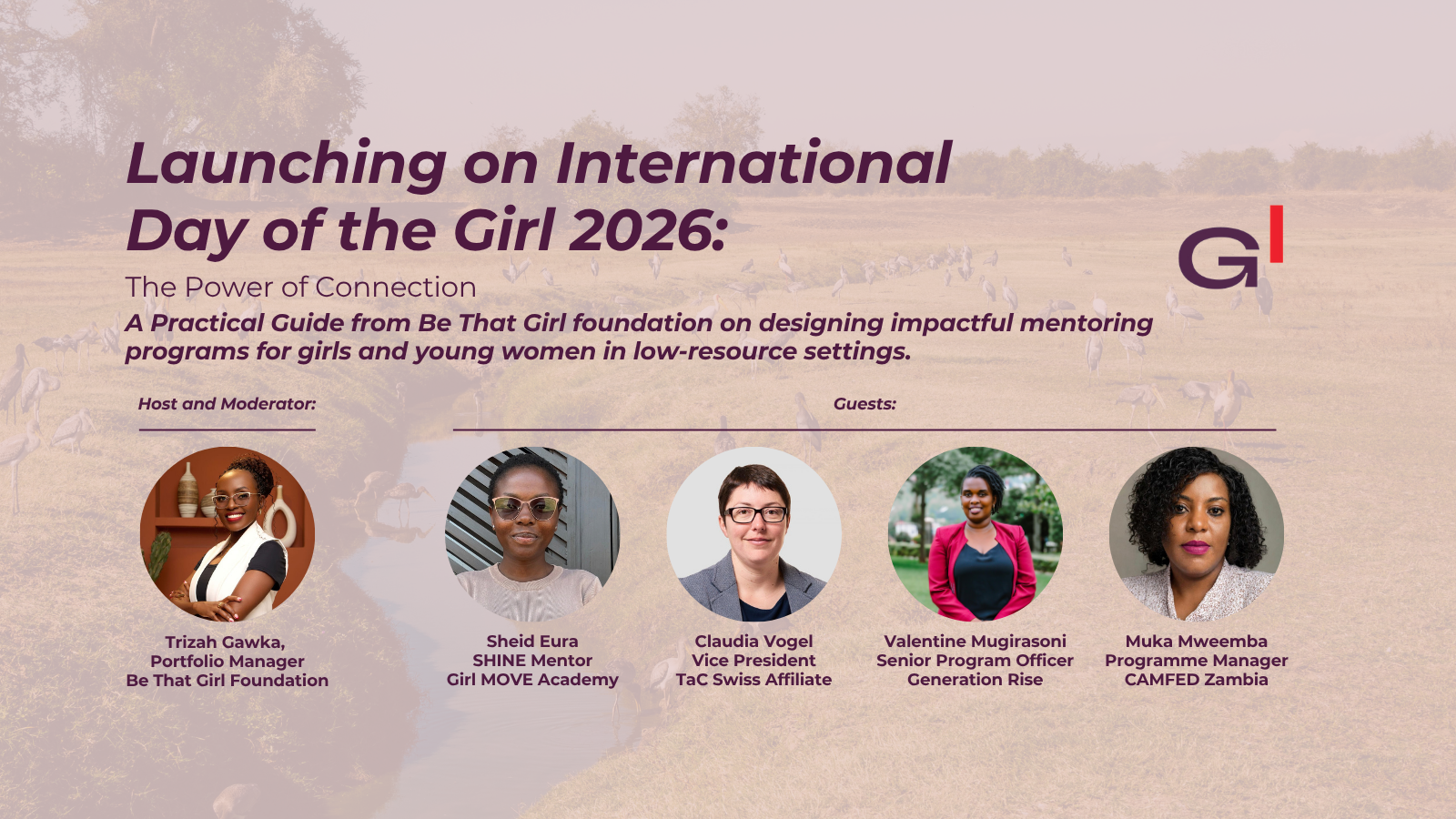
On Monday 12 October 2026, Be That Girl Foundation hosted a webinar to launch The Power of Connection, marking International Day of the Girl, observed on 11 October. The conversation explored what it takes to build mentoring relationships and programmes that listen to girls, strengthen their agency, and expand their choices and opportunities.
The webinar was hosted and moderated by Trizah Gakwa, Portfolio Manager at Be That Girl Foundation, with four guests:
Sheid Eura, SHINE Mentor at Girl MOVE Academy.
Claudia Vogel, Vice President of the TaC Swiss Affiliate, representing Teach A Child Africa.
Valentine Mugirasoni, Senior Program Officer at Generation Rise.
Muka Mweemba, Programme Manager at CAMFED Zambia.
CAMFED, Girl MOVE Academy and Generation Rise joined from BTG’s partner community, bringing direct experience of mentoring girls and young women and learning that contributed to the resource. Teach A Child Africa brought an external perspective as an organization supporting vulnerable children through education and considering how more intentional mentorship and transition support could strengthen its work.
The Power of Connection is a practical resource for organizations starting or strengthening mentoring programmes. It offers questions, considerations, examples and lessons that can be adapted to different contexts, rather than prescribing a single mentoring model.
Roundtable discussion
Trizah Gakwa - Be That Girl Foundation
I am delighted to welcome you to this webinar where we will be launching our mentoring resource “The Power of Connection”. It is also a very special day because we are commemorating the International Day of the Girl which the world marked yesterday. A day where we celebrate girls, we champion their rights, and more than that we recognise that their voices matter when we are designing for them.
And that's really at the centre of everything we do at Be That Girl Foundation. We recognise that adolescent girls and young women have amazing ideas about what they want to build for themselves. This conversation today is going to touch on that.
What we've realised over the years as we've worked with partners across different countries is that whereas it is beautiful and very important to provide education, to provide financial support, to provide economic empowerment for adolescent girls and young women, this is not always enough. Girls need trusting relationships where they can be heard and feel safe to explore the opportunities that they see for themselves, to explore their aspirations, to share the intimate things that they experience, and to have a big sister, somebody else that can walk that journey with them. And that is why we really value mentorship at Be That Girl Foundation.
Today we want to explore a critical question. How can we build mentoring relationships and programmes that listen to girls, strengthen their agency, and expand their choices and opportunities? That's a big question we want to sit with today. And I am honoured to be joined by a group of phenomenal leaders who are leading different programmes.
Part of what they do also is provide mentorship, and we will be learning from their expertise and experiences today. Before we get there, I want to invite them to introduce themselves very quickly, their names, and the organisations they are joining us from. And I will start with myself, actually.
My name is Trizah Gakwa, and I am the portfolio manager at Be That Girl Foundation. Muka, over to you.
My name is Trizah Gakwa, and I am the Portfolio Manager at Be That Girl Foundation. I am honoured to be joined by a phenomenal group of leaders whose organisations are supporting girls and young women through education, mentoring and leadership development.
Joining us today are Muka Mweemba, Programmes Manager at CAMFED Zambia; Valentine Mugirasoni, Senior Programme Officer at Generation Rise in Rwanda; Sheid Eura, Gender and Child Protection Officer at Girl MOVE Academy in Nampula, Mozambique; and Claudia Vogel, Vice President of the Swiss affiliate of Teach A Child Africa, which works in Kenya’s Lake Victoria region.
Thank you so much, Claudia, and thank you all for being part of this launch conversation and joining us as we explore what it takes to build deeply meaningful mentoring programmes and relationships with the adolescent girls and young women we serve.
As I mentioned earlier, Be That Girl Foundation has had the privilege of working alongside several of the incredible organisations represented here today: CAMFED, Girl MOVE Academy and Generation Rise, all of which are BTG partners.
Over time, we realised that each of the organisations implementing mentoring programmes - in one form or another - had valuable insights into what mentorship means, what it requires and how it can be implemented effectively.
They had knowledge about how to navigate difficult situations. They had knowledge about what changes when a young girl is transitioning from one stage of life to the next. And so we thought it is important to put together all the insights from the partners in our portfolio on mentoring and build this resource that we are calling “The Power of Connection”.
And it is a practical resource that supports organisations that have either already started a mentoring programme and are looking to strengthen it, sharpen it, or that are now at a point in their programming, like Teach A Child Africa, as Claudia will share later, where they recognise that actually mentoring could strengthen the programming that they are already providing. So this resource serves that purpose. On the other hand, it is not a prescriptive resource.
It is not a resource with things that are cast in stone. It is a resource that can be contextualised by every organisation depending on who they are serving and on the context that the girls are in. Now it is organised around seven main areas.
I want to quickly mention them as we continue. The first one, and that's why I started at the beginning, is listening to girls and understanding their context. I like to say that girls' issues are similar, but they are not homogeneous.
I've had the privilege of visiting, for example, the three organisations that are represented here from BTG's portfolio. And while it is easy to see similarities between the girls in Huye in Rwanda, and the girls in Nampula, and the girls in Katete, for example, in Zambia, they are similar, but they are not the same.
And so when we are designing for girls, the most important thing is to listen to them and to understand their context. The second thing is to design with intentionality: to be very intentional about how we design the programme, making sure that we are defining every important aspect, how long will the programme take? How often will they meet? When they meet, how will the conversations be structured? That is designing with intentionality. And the third thing is preparing mentors and mentees.
This is the third area in this resource, and this is a very important one because we were talking with Valentine and Tim recently, and we realised how much time we spend preparing mentors and not preparing mentees. And yet a mentoring relationship also requires a high level of ownership from the mentees as well. Then there is developing relevant mentoring content and curriculum.
Our different organisations here have very strong mentoring curricula. Girl MOVE Academy has a very unique curriculum that is digital, and they can share about that later. CAMFED has several mentoring resources, not just one.
For example, the Learner Guide resource and the My Better World curriculum. BTG also has a mentor guide. It is about making sure you have a curriculum that can be used during these mentoring sessions.
The next area is thinking about transitions and what happens beyond the programme. You know, because at the end of that relationship, for example, if a girl is being mentored through secondary school, what happens at the end of secondary school when she's transitioning? How can she be supported through that process? Another very critical one is building safeguarding into our programmes. And this is an area that is extensively covered in the resource because we want to make sure that our programmes do not cause harm and that we uphold a duty of care.
We must also ensure that we do not expose the vulnerabilities of the girls we serve or retraumatise them in any way. So that's very critical. And then finally, it is learning, adapting, and improving over time, because in any good programme, you need to learn from the data that you're collecting, you need to learn about what's working, what's not working, and adapt over time. So those are the seven areas that are covered in the resource, The Power of Connection.
It is a powerful resource that will help any organisation that wants to strengthen their mentoring programmes and we will make it available for free on our website.
So we want to begin our conversation today, not by digging into every one of these areas, but by listening to the wisdom in the room. That really is the essence of today's conversation. And I want to begin by having everybody respond to a question that helps us clarify.
Why mentorship? From your experience, what is something that girls need that education or financial support alone cannot provide? I will start with you, Muka.
Muka Mweemba - CAMFED Zambia
Thank you, Trizah. As you rightly put it, we cannot ignore the fact that education and financial support are essential, but they also do not always address some of the barriers that these girls face.
So a girl may have a bursary and be enrolled in school, but she may still struggle with low self-confidence, family pressures, even fear of failure or uncertainty about her future. So through our mentorship programme at CAMFED Zambia, we've seen the importance of having trusted people who listen to girls and also encourage them and help them recognise their own potential. You talked about our Learner Guide programme earlier where we deliver “My Better World Life Skills”.
That's the curriculum that we use. Through these sessions, we have seen learners build their confidence and understand themselves, as well as become able to set goals and make positive decisions. And we've also seen that mentorship has also helped these girls realise that they're not alone during their day-to-day journeys.
So they're not facing these challenges alone, but there's a person out there who's ready to listen to them. So for us as CAMFED, I think another important aspect is the CAMFED Association. This is an alumni network of young women that we supported at secondary school.
So they've played a key role in ensuring that they're supporting the young girls through this journey and they're mentoring them. Also we've seen that there's improved learner confidence, there's also improved self-esteem, as well as classroom participation.
So, I think it's much more than opening a school gate for a girl. But what's really important is to ensure that we're also developing the confidence and we have the right support systems for the young girls to thrive. Thanks.
Trizah Gakwa - Be That Girl Foundation
Thank you, Muka. I appreciate that so much, especially the transition of the mentees to become mentors through the alumni programme.
Sheid, what would you say is, what is it that you believe young girls need beyond financial support and education?
Sheid Eura - Girl MOVE Academy
Thank you very much for having me and having us in this conversation. This question is very important and that's what we have to look at when we are planning to have or to lead a mentorship programme. For us, above all, it's necessary to have a way to connect girls to the ones they want to become one day.
This is the core of our approach. More than giving lessons or teaching girls, our mentorship programme is centred on our role-model approach, where we create bridges between young girls from Nampula and other places in Mozambique and the women they want to become.
Trizah Gakwa - Be That Girl Foundation
Thank you Sheid. Let’s hear Valentine’s point of view.
Valentine Mugirasoni - Generation Rise
Thank you very much, Trizah. This is a question every intentional educator should ask.
We have seen girls performing very well in primary school, at the top of their classes, and continuing to do well in secondary school. But as they move from their early to their later teenage years, things change.
There is a great deal on their minds, and most do not have someone to talk to. They end up making choices based on whatever options they see around them.
Most relate to what they see in their communities. Even girls who have been performing well in secondary school can end up with low grades in national exams or not make it to university. This is a critical stage when a young woman needs someone who is where she wants to go.
For us, being a mentor means, first of all, being a role model. A mentor needs to be able to guide a girl as she grows older. Many girls around her may have dropped out of school or entered early marriages, but she has aspirations and dreams. Having someone she can relate to - someone who listens intentionally and offers time, encouragement and guidance - can help her become who she wants to be and maximise her potential.
A mentor is someone who not only leads, but also listens and helps girls make choices that allow them to fulfil that potential.
Trizah Gakwa - Be That Girl Foundation
Thank you, what you are sharing is very valuable. Moving to Claudia: you're at a point where you recognise that mentorship may add just that little extra value in your programming. What role do you see it playing beyond the financial support that you're already providing?
Claudia Vogel - Teach A Child Africa
Yeah, thank you for that question. At Teach A Child Africa, we work with orphaned children, vulnerable children from rural Kenya.
We work with boys and girls, so I have both perspectives, but of course, the girls are usually more vulnerable. One thing we see is that very many girls experience through their childhood and youth that life just happens to them and they don't have much control. When they're orphaned, they're put into one house and then something happens there, they're sent somewhere else.
So they don't have a lot of control over where they go. Usually, education is what keeps them going. When we select them into our programme, we usually send them to boarding schools where they find a safer environment than many of them have in their homes.
They find other girls who also have dreams. Here's where we acknowledge what we're lacking so far. But our mandate runs to the end of secondary school. Then what next?
Here, they're lacking role models. They're very often the first ones who have gone to secondary school. Nobody in their family knows what life on campus is like because they already could not imagine secondary, let alone boarding school.
At the same time, there are so many expectations from the family. Like now we have brought you through school, you have to give back even though you don't have anything to give back at that moment. Here is where we see that more mentorship can help them continue on that journey, make themselves count, have control over their lives and go the way they want to go.
They can then give back, before the pressure becomes too much and they start following pathways they have not dreamed of for themselves.
Trizah Gakwa - Be That Girl Foundation
Reflecting on everything you have shared, and starting where you ended, Claudia, the people we serve come from very vulnerable backgrounds and face different kinds of vulnerability. Education is critical - it is an important opportunity you are all giving them - but they still experience many other barriers: low self-esteem, family pressures, family issues, fear of failure and uncertainty about the future.
That brings me back to what Sheid shared earlier: mentorship helps introduce these young women to the person they want to become. I love that statement because you may not have seen someone who represents that future. You have dreams and aspirations, but you may not have a mental picture of what that looks like.
Mentorship helps introduce you to that person, who becomes a safe space: somebody who supports you throughout the journey. Thank you all. I couldn’t agree more.
And now I want to move us along quickly. We all mentioned that, I mean, I think Valentine talked about the transition that happens when a girl is moving through her teenage years. CAMFED, for example, supports adolescent girls and young women through different stages of their lives.
What changes in mentorship as a girl or young woman transitions from secondary school to tertiary education or entrepreneurship?
Muka Mweemba - CAMFED Zambia
So, Trizah, at CAMFED we do recognise that a girl's needs, as you rightly put it, change as she progresses through different stages of her life. So this also tells us that mentorship cannot be a one-size-fits-all approach.
So at secondary school level, the focus basically is on helping build the girl's confidence to develop their skills, also to remain in school, as well as navigate challenges - for example their day-to-day challenges that would interrupt their education. That is what mentorship focuses on. And our learner guides during this period also play an important role in ensuring that they create that supportive space where learners can discuss issues affecting them, as well as develop skills to make important choices.
So as the young woman now approaches the end of secondary school, basically completes her secondary school, the focus is also shifting now towards transition. So this is where their interest is, what happens, what next after I complete my school? So now the mentorship is also now changing. We're also looking at understanding available opportunities.
There's also the issue of setting goals. We're also talking about developing practical skills and preparing them for life beyond school. So during this stage also, we make sure that we're also helping the young women continue navigating this important stage of their life.
Then there are also those that are moving on to tertiary education, and those who may also be going into employment or entrepreneurship. So mentorship at this stage becomes more about supporting independence, resilience, decision-making also still comes in, as well as access to relevant networks and opportunities. And it's also a period where there's a lot of information sharing, what opportunities are there at their local level, in their communities, or beyond.
So this is where there's so much information sharing. Then as the young woman grows, so basically the mentor's role also is to ensure that it should evolve from providing direction to strengthening the young woman's ability to direct her own life. So that's mentorship: it changes stage by stage.
Trizah Gakwa - Be That Girl Foundation
I love how you concluded: moving from providing direction to encouraging self-direction. That’s really powerful.
Valentine, I’d like to bring you in here because you also provide mentorship through secondary school and continue supporting some young women into tertiary education. What changes have you seen during that transition, particularly when a young woman wants to make choices that may differ from what her mentor had hoped?
How does mentorship evolve through that transition?
Valentine Mugirasoni - Generation Rise
Thank you very much Trizah. First of all, what we realise when we start working with these girls is that they don't even know if they need mentorship. They don't even know what mentorship is.
But what we realise is that they have ambitions. They have mixed things that they want to do. They have aspirations but they don't know how to match them with their capacities and their passions. So it's quite mixed.
What we start with at secondary school is give them skills that help them discover themselves first, build that self-awareness, build team support. They know that they have each other to support each other.
They build trust within themselves and with their mentors and we also help them learn how to set goals and develop those leadership skills that they do not know that they have. So that's what we go through with them at secondary school. We realised that knowing they are supported motivates them to work hard and pursue even bigger dreams.
Some go on to university, and we continue supporting them. At that stage, we introduce one-on-one mentorship, tailored to their age and level of education.
The first year, we again help them relate because we select these mentors in relation to what the young girls are learning and what they're planning to become after university. So we pair them with women who have achieved what they want to achieve: they walk them through the journey and help them understand the realities of the journey, they help them even open doors for internships if available.
So the first step is to help them understand and really become familiar with what they have chosen to become and what they have chosen to study. Then, after that one-on-one mentorship, we move forward once they have decided what they want to become. So now we want them to be able to plan for it, to have entrepreneurship skills, to have business development skills, to have all the professional skills that they need so that afterwards they can thrive after university.
So those are the ones that managed to go to university but we also have those who finish high school but do not manage to go to university, we do not leave them out. So how do we work with them? We keep them connected, we keep connected to them and we support them to share what they have learned with the community. They start doing community outreach, and we plan regular check-ins with them to understand how they are getting on and what they are doing. We also organise meetings, including group meetings, where they can meet other mentors and mentees and learn from them.
As you can see, at Generation Rise, we do this step by step.
Trizah Gakwa - Be That Girl Foundation
Thank you, I appreciate that very much and one thing that you shared that I caught is how easy you find it to do group mentorship at secondary school level but then as they progress into post-secondary and they're really trying to clarify their own individual pathways, the need for individual mentorship comes in and this one needs to be aligned to their aspirations. So that's really helpful to hear.
You also hinted at the need to first build a sense of community or of trust and I want to ask that question. Mentorship is about relationships. How do we build mentorship relationships anchored in trust? I’d like to invite anyone who would like to respond to share their thoughts.
Sheid Eura - Girl MOVE Academy
Well, good question. For us, as I was saying, that is the core of our mentorship programme. In which ways do we get that connection with our girls? Here in Mozambique, we use the word mana to refer to an elder sister. It’s a friendly way of addressing someone, a bit like ‘buddy’. Culturally, we use it for older women, but we also use it when welcoming or inviting girls to join us.
Even me, as a mentor, even though I am older than the girl I am inviting, I call her “mana” so that she can see that she has a voice too. She has something to teach me; I have something to learn from her and we have this way of calling each other to represent that all of us are learners and teachers. So, that way of calling each other helps us build that connection and helps strengthen those girls’ agency because it's the time when she recognises too that she can say something, she can have her own space and she has her own voice in this relationship.
And something I love most is how we connect our own lives and experiences with those of our girls. How do we do this? Our programmes are based in schools within our communities. When inviting girls to join, we walk the routes they take between home and school and visit their homes to seek their parents’ permission for them to participate. This experience helps us understand their everyday lives and builds a stronger connection between us.
Another important part of our programme is sharing our stories. As I said earlier, our approach is based on learning from role models. Many of our mentors have faced the same challenges that the girls are experiencing at this stage of their lives. Hearing how their mentors faced and overcame these challenges, including cultural and social barriers, helps girls believe that they can overcome them too.
Sharing these experiences builds trust and connection because girls see their mentors as someone they could become in the future. They think, “If that mana overcame so many challenges, then I can do it too. And she is here to show me that I can.” That relationship as sisters - that feeling of sisterhood - helps us stay connected even after the programme ends.
Girls continue to see their mana, their mentor, as someone they can turn to and feel safe with. They carry with them the stories their mentor shared, what she helped them discover about themselves, and the confidence to make their own choices and pursue the future they dream of.
I’ll leave it there for now. Thank you very much.
Trizah Gakwa - Be That Girl Foundation
Thank you, Sheid. As you began speaking, you brought back a beautiful memory of the first time I visited your programme. Everyone was calling out, “Mana!” and I remember asking, “What does mana mean?” Then, when they were all together, they were manas. I truly experienced that sense of sisterhood.
I also really appreciate what you said about building trusting mentoring relationships: both the mentor and the mentee must recognise that they are teachers as well as learners. We have just as much to learn from the girls we mentor as they have to learn from us. When we build the relationship on that understanding - and make sure the girls genuinely know it - we create a sense of mutual trust that allows us to share our stories and learn from one another.
I also loved your invitation to engage with the wider community. The girls we mentor are part of a community, so we need to involve the entire ecosystem around them. Thank you so much for that, Sheid. I would like to ask others a quick question. Valentine, I’ll come back to you.
Sheid has mentioned the importance of engaging the community in which our mentees come from. None of us is an island, and we have seen situations where girls report very different levels of agency while they are within our programmes, and then when they go home, that changes completely because the context is different and perhaps the barriers still persist. What have you seen being the most valuable way to engage the communities within which our mentees come from?
Valentine Mugirasoni - Generation Rise
Thank you, Trizah. The first thing we do when enrolling our mentees is conduct home visits. We take the time to understand their environment: what support do they already have, and where might additional support and mentorship be needed? From the very beginning, we learn about the context they come from and build relationships with their parents and local leaders.
We explain to the parents what we are doing with the girls and outline everything they will learn so that their families can support them and hold them accountable.
At the very beginning of the mentorship programme, we also train the girls to understand that they are community agents. From the outset, they know that they have a responsibility to contribute to their communities. Throughout the programme, we hold regular meetings with their parents to understand how things are going at home and in the community. Are the girls participating? Are they putting what they have learned into practice, or are those lessons being left behind?
This feedback helps us identify where we need to place greater emphasis in the mentorship programme, while keeping us connected with the girls and their families. The mentees are also given responsibilities during the holidays, and some begin conducting community outreach while they are still in the programme. By the time they graduate, they already have practical experience and are given a platform to continue their work as community agents.
We give them the responsibility to begin leading mentoring and outreach activities in their communities. We are currently working to mobilise public spaces that are available within the communities but are not being used. We want the girls to use these spaces to bring younger girls together, mentor them and share what they have learned.
At the beginning, we engage the girls’ parents and the wider community. As the programme progresses, we make sure the girls are prepared to conduct outreach activities. Later, we hand over the responsibility so that they can continue supporting others in their communities as community agents.
Right now, we are helping to identify spaces where they can practise mentoring and bring girls together. These spaces are already there and are not being used, so why not find something close to the girls that they can use? That is how we engage the community.
Trizah Gakwa - Be That Girl Foundation
Thank you. Thank you for that and I think that's important.
I've seen this programming in all the partnerships at BTG where we engage the communities where the adolescent girls and young women come from. I once went for a community dialogue where we had all manner of community members, teachers, chiefs, elders, parents, everybody was there, even the young people and the moms were so quiet initially, very rural. The mothers were seated on the ground. At first, they were very quiet. Then one mother spoke, and it was as though we had uncovered the real issue. She said:
“My neighbour educated her daughter through secondary school. But now her daughter has graduated and is back home, in exactly the same position as my daughter. So help me understand: why should I spend this money educating my child if she is only going to return home?”
Then a second mom spoke and said and then there's another neighbor who gave away her daughter in marriage and then she named the dowry that was given which is a lot of livestock and how it had changed that family's livelihood. So you see for us, we're busy mentoring this girl, engaging this girl but this girl goes back home to moms that are navigating these very important questions and if we don't engage these moms, if we don't engage the community to overcome those barriers, then the work that we're doing with the girls may be in futility. So that's really the importance of engaging the communities where our mentees come from.
Muka, my final question in this section is for you, and it has two parts.
First, our conversation has made it clear that mentorship is relational - it is fundamentally a relationship. At the same time, effective mentorship requires enough structure to ensure that it achieves the objectives for which it was established. How do we balance the two? How do we put the right structures in place while preserving that sense of relationship?
Second, I would like you to reflect on the role and boundaries of a mentor. We have discussed many of the barriers facing the girls and young women we serve. Which of these barriers can mentors help address? Which fall outside their role - and whose responsibility is it to address them?
Muka Mweemba - CAMFED Zambia
Trizah, as we have said, a mentor’s role is to listen and guide—not to provide all the answers or say, “My life was like this, and this is what I did, so you should do the same.”
Mentors can share their experiences, but they should allow mentees to find the path that is right for them. During these interactions, a mentee may raise an issue that the mentor is not equipped to address. This is where referral systems become essential.
During our mentor training, we emphasise the importance of referral systems and help mentors identify the organisations and individuals to whom they can refer mentees for additional support. This brings us back to our earlier conversation about stakeholder involvement: we cannot do this work alone, and addressing every issue is not the mentor’s responsibility.
From the outset, mentors need to know that there are other people and organisations available to support both them and their mentees. In the school environment, we involve the school leadership. At the community level, we engage traditional leaders, parents and religious leaders, all of whom can offer additional support.
When mentors are clear about where their role begins and ends, they are better equipped to support girls and young women - and to connect them with the appropriate help when an issue falls outside the mentor’s role.
This also helps prevent mentors from burning out because they understand that the responsibility is not theirs alone. They can say, “I have a support system around me, and there are people who can help.”
At CAMFED, we take pride in the investment we have made in building community support and ensuring that every stakeholder understands their role in supporting girls and young women.
When it comes to structured support, our approach combines the mentoring relationship with structured life-skills content. This includes My Better World, as well as content designed to support young women transitioning from secondary school into tertiary education, entrepreneurship or other business pathways.
We use participatory methods that encourage girls to engage, share their experiences and learn from one another. The aim is not simply to deliver content, but to create an environment in which every girl feels heard and can apply what she learns to her own life.
We also ensure that the content is relevant to the girls’ everyday circumstances. We do not want it to feel foreign or disconnected; it should speak directly to their daily lives and experiences.
We must continually ask: Is the content relevant? We have also invested in preparing and supporting those who facilitate the sessions. In addition to the initial mentor training, we provide refresher training, peer-to-peer training, on-site support and regular review meetings.
As I mentioned earlier, we involve school leaders and other stakeholders, including teacher training colleges, to help ensure the quality of the programme. We have also strengthened our documentation and monitoring so that we can identify gaps, learn from them and continually improve the programme.
Safeguarding is another important element. We address it during the initial training, refresher sessions and on-site support to ensure that mentors understand the appropriate boundaries between themselves and their mentees. They need to be clear about where their role begins and where it ends.
At the same time, mentors must remain flexible: they need to listen and respond to the realities that girls bring into the relationship. As I said, it is not about the manual; it is about the girls. What are they taking from the programme, and how are they connecting it to their everyday experiences?
Trizah Gakwa - Be That Girl Foundation
Beautiful. Thank you.
What you have described is that delicate balance between relationship and structure: ensuring that the mentor remains a safe person who listens attentively and responds flexibly to the mentee’s needs, while also putting the necessary structures in place to support effective mentoring and protect both the mentor and the mentee.
Safeguarding, for example, cannot be left to chance. It must be built intentionally into the programme. Effective mentorship therefore requires us to continually balance the relational and structural elements.
I also hope our conversation has made it clear that we are not proposing a single, perfect mentoring model. The Power of Connection does not offer a one-size-fits-all approach. Instead, it brings together practical insights from organisations that have been doing this work for many years - such as the experiences Muka, Valentine and Sheid have shared today. The invitation is for you to consider these insights within your own context: What will work for you? What will you need to adapt or contextualise?
That brings us to the next part of our conversation. We will now hear from Claudia, whose organisation has not yet implemented a mentoring programme.
Claudia, as you have listened to our conversation this morning - and perhaps as you read The Power of Connection - what has resonated most strongly with you?
Claudia Vogel - Teach A Child Africa
We have not yet officially implemented a mentoring programme. Our organisation was initially founded to provide scholarships for talented orphaned students to attend secondary school. Our mandate was mainly to cover school fees, uniforms and everything else they needed to complete their secondary education.
Along the way, however, we began to realise that financial support alone was not enough. We now hold an annual meeting with all our beneficiaries, which includes some mentoring.
We discuss how they are performing at school, the challenges they are facing and what may be happening at home. For example, has a student’s guardian changed, or have they had to move to another home? So, this has become a form of mentoring support.
After every school term, our volunteers also meet with the students and their guardians. That happens three times a year, in addition to the annual meeting. Reading The Power of Connection helped me realise that it is not as though we have nothing in place. We already have some foundations to build on, which means we are not starting from zero.
Because our students attend boarding schools, some mentoring also happens within the school environment. Teachers are involved, and when issues arise during the year, our volunteers speak with them. So, in many ways, we are already providing some of this support.
At the same time, the resource helped me recognise where we can improve - particularly in supporting students after secondary school. Our original mandate ended when a student completed secondary education; after that, they were essentially on their own. We later recognised the financial barriers to tertiary education, so we began finding partners to help bridge that gap, and we have made progress in doing so.
Our next step is to go beyond financial support by providing students with more intentional guidance and mentoring as they transition beyond secondary school. That is the next part of our programme that we want to build.
Trizah Gakwa - Be That Girl Foundation
I love that. I love that engaging with the research helped you realise, “We are not starting from scratch. We already have something to build on.” That is very affirming, and it has also helped you identify the areas you would like to strengthen.
As a follow-up, was there anything in the research that made you reflect on what an intentional, safe and genuinely useful mentoring programme might look like in your context?
Claudia Vogel - Teach A Child Africa
I think there are a few things that we would like to implement and I think structuring some things better and structuring things more is something that we would implement. Now, one challenge for us is that we are completely volunteer based.
So everyone that is working for Teach A Child Africa does so as a volunteer. I have a different day job that I just took time off from to be here. Also, all our volunteers, they are teachers, they are principals, they are retired teachers from the community.
So whenever we take on a new mandate, it really stresses our HR base, let's put it like this, because it means adding more work to people who already do a lot as volunteers. One thing I realised through reading is that we are already doing many of these things. With a few small adjustments - and without significantly increasing the effort required - we could strengthen what we already have and make it more structured.
Organising these activities more systematically could also ease the burden on our volunteers, freeing up some of their time for other responsibilities.
And, I think that's something that I would like to look more into together with the volunteers. Another important area for us is engaging our alumni and bringing them on board. Our programme operates around the Lake Victoria region in Kenya, but many of our alumni and volunteers are now spread across university campuses throughout the country.
Mentoring can still take place in those locations because, as our students progress to university, they may find themselves on the same campuses as former beneficiaries. We had considered this idea before, but it did not work as well as we had hoped.
Using the ideas from The Power of Connection, I hope we can develop a more structured approach - one that enables us to engage our alumni more effectively, expand mentoring support and strengthen our volunteer base.
Trizah Gakwa - Be That Girl Foundation
Thank you. With your permission, I would like us to explore this a little further.
Sheid, let me begin with you. Claudia has raised an important question about how her organisation can bring greater structure to the mentoring support it already provides. Based on your experience, what practical ideas could help them strengthen their approach?
Muka, I would then like you to speak about involving volunteers and alumni in mentorship. What does it take to work effectively with volunteers, and how might Claudia’s organisation engage its alumni more meaningfully?
Valentine, I would also invite you to reflect on Claudia’s questions and share any additional ideas that could help the organisation develop a stronger mentoring programme.
As we respond, let us keep in mind that Claudia’s organisation is entirely volunteer-led—not partly, but 100 per cent. What practical steps could help it build stronger structures, work effectively with volunteers and engage alumni more intentionally in the mentoring process?
The organisation is not starting from zero; it already provides some form of mentoring. Let us build on that foundation and offer a range of ideas that Claudia can select and adapt to her context.
Sheid Eura - Girl MOVE Academy
What Claudia has shared is very challenging. However, drawing on our experience, I can offer a few suggestions, Trizah.
In our mentoring programmes, we take responsibility for creating a sense of belonging among our participants - a sense that they are part of a wider network of people creating change. We do more than teach and inspire; we support girls and young women to see themselves as changemakers whose responsibility continues beyond the programme.
That sense of identity and belonging encourages them to remain involved after they graduate. They are more willing to give back, continue creating change and support those who come after them. Over time, this has helped us build a large database and a strong community of former participants.
The other important lesson is to build relationships with institutions, not only with individuals. For example, when recruiting mentors in Nampula, we work with universities and other educational institutions. We establish formal partnerships with them, and whenever we launch a new programme cycle, we visit those institutions, speak with the students and invite them to join us.
Whenever we identify an institution that could provide suitable mentors, we seek to partner with that institution rather than relying solely on individual relationships. This gives the programme a stronger and more sustainable foundation.
Trizah Gakwa - Be That Girl Foundation
Thank you Sheid. Muka, please move forward.
Muka Mweemba - CAMFED Zambia
Claudia, I think the alumni are a natural starting point. You already have this network in place, and they can give back by supporting others in their communities.
As I mentioned earlier, at CAMFED we have the CAMFED Association, our alumni network, and I think that has been key for us. These young women have experienced many of the same challenges faced by the girls they now support. That is why I would advise you to consider working with your alumni, and I am glad that you also raised that possibility.
The alumni bring valuable lived experience, a strong understanding of their communities and a deep commitment to helping the girls - and even the boys - you work with. Because they have been through the programme themselves, they understand it well and can connect with younger participants in a meaningful and relatable way.
At CAMFED, we have structured programmes through which our alumni provide support. We have the Learner Guide Programme, the Transition Guide Programme and several other guide programmes. First of all, the guides receive training. They are also given guidance and resources to help them support girls and young women with life skills, well-being, decision-making and the transition to further education, employment or entrepreneurship.
Apart from engaging alumni, stakeholder involvement is also important in helping you achieve your objectives. At CAMFED, we work with schools, teachers and school leaders. We also work with community stakeholders, including parents and traditional leaders, as well as other organisations.
We make sure that the volunteers are supported in their roles and that their work complements what CAMFED is already doing. This has helped because we are not creating entirely new structures; we are working with structures that already exist. From our side, we focus on building their capacity so that they can support girls and their communities more effectively.
We also provide ongoing learning opportunities. As I mentioned earlier, these include review meetings, refresher training and peer-to-peer support. All of this helps the volunteers continue growing in their roles.
I think what is especially powerful is that these young women are not only giving back. When working with volunteers, this is something we need to emphasise and help them appreciate: through their service, they are also developing their leadership skills, strengthening their agency and contributing to change in their communities.
We have many testimonies from young women who have stepped into leadership positions because of their community service. It has become easier for them to pursue tertiary education, access opportunities within their communities and even obtain scholarships because of the experience they have gained through volunteering.
They greatly appreciate this. Those who have gone through the experience often return to encourage other young women to understand the importance of giving back. In that way, it begins to happen almost naturally. They look forward to it because they know that they will not only give something to their communities - they will also gain something through the giving back experience.
So, I think that is where you can start.
Trizah Gakwa - Be That Girl Foundation
Very connected to what Sheid also shared. I love the pattern I am seeing. Valentine, over to you!
Valentine Mugirasoni - Generation Rise
Thank you. What I can add, first of all, is the importance of preparing the young girls and boys and listening to them—to understand what they want to do and what they hope to achieve.
Once you understand their aspirations and needs, you can begin by drawing on the alumni. That is key. The alumni have been where these young people are now. Some of the girls and boys may already know and admire them, so they can be very important people to involve.
There is also the option of drawing on your wider network. You may know people who have already achieved something and would genuinely like to give back, but they have simply never been approached. You can also look at organisations doing similar work. Through meetings and other spaces, you meet people who have valuable experience. You can consider inviting them to participate because their stories and achievements can inspire the young people.
It is also important to consider what the young people are studying or hope to pursue. Where possible, try to find mentors whose experience relates to those interests. For example, if a young person is interested in science, it can be helpful to connect them with someone working in a scientific field. The match does not have to be 100 per cent exact, but some connection can help the young person better understand the field they hope to enter.
So those are the three things I would add: prepare and listen to the mentees, draw on your alumni and wider networks, and consider the young people’s interests when identifying mentors.
Trizah Gakwa - Be That Girl Foundation
Amazing. Appreciate that. Claudia, you are free to use this information in whatever way works best for you. I think there are three key things I am hearing from the team.
The first is to create a strong sense of belonging. As Valentine mentioned, that begins with listening attentively to the aspirations of the young people you serve. It also means creating the kind of community Sheid described - one that gives young people a sense of responsibility and makes them want to contribute because they know they belong.
If you ever find yourself in Mozambique, please visit Girl MOVE Academy. That feeling of belonging is palpable - you can almost touch it. Even I found myself thinking, “I want to belong here.” So, create that strong sense of belonging while centring the wisdom and insights of the very people you serve.
The second point - and everyone has said this - is to begin with your alumni. They are a resource you already have. As Muka explained, they bring lived experience from the programme itself and can use that experience to support current participants.
I also love Muka’s point that alumni need to understand that this is not only about giving; they are also receiving. Through mentoring, they strengthen their agency, gain leadership experience and become changemakers within their communities. They have an opportunity to give back - or to pay forward the support they once received.
The third point is that this work is not the responsibility of your organisation alone. It will require engaging the other stakeholders who are important to the programme. As we said earlier, you do not have to do everything yourself; you need a referral system.
Valentine encouraged you to consider the people within your network who already want to give back but may not know how. Sheid also spoke about engaging not only individuals but institutions. When you build strong partnerships with institutions, you create an ongoing connection to a wider pool of people, resources and networks.
So those are three very brief insights we are offering today.
And as we offer them to you, I also want to say to everyone else that this is what The Power of Connection is about. It is not about listening and then saying, “The CAMFED programme is exactly what you need.” No - each context is unique and has its own particular nuances.
Instead, the resource invites you to ask important and powerful questions, and to draw on the insights and ideas that can help you build a mentoring programme that is right for your context.
And that is the invitation we want to leave with you, Claudia. We are excited to see what you build, and we are here to support you. If any of us has shared something that you would like to explore in greater depth, please feel free to reach out. We would be very happy to share more.
Now, as we begin to bring this conversation to a close, I would like to ask each of you one final question. We have all acknowledged the importance and benefits of meaningful mentorship for adolescent girls and young women. In light of that, where do you think organisations, funders and philanthropy should invest? Where do you see opportunities for increased or strengthened investment that could support meaningful mentoring programmes?
Valentine Mugirasoni - Generation Rise
Thank you very much. First of all, I think everyone should understand that every young person needs someone. Mentorship programmes should therefore be implemented across all educational settings, and funding them should be a priority for governments and institutions.
There are three key areas in which I believe greater investment is needed. The first is alumni or graduates - the mentees who have been empowered through these programmes but are often left on their own afterwards. They are valuable resources, and we are losing that potential. We need to consider how they can continue to be empowered, remain connected and be given opportunities to give back in their schools and communities. This needs to be part of a well-structured programme.
The second area is safe spaces. It is not always easy to find a place where young people can meet, talk openly and express themselves. We need to invest in safe spaces that are rooted in the community, rather than limiting them to the premises of an organisation. We need to reach young people where they are, rather than waiting for them to come to us.
The third area is mentoring materials or manuals. These should be accessible, simple and portable - something small and practical that mentors can carry and use wherever they are.
Those are the three main areas that I believe need to be strengthened.
Trizah Gakwa - Be That Girl Foundation
Thank you, Valentine. Claudia, please go ahead.
Claudia Vogel - Teach A Child Africa
I think it is also important to advocate for mentorship itself. Over the past few years, we have asked our alumni what they need to succeed, and money has always come up. Many people believe that once we close the financial gap, the work is done.
But that is not true. We are not finished simply because we have provided the necessary funding. There is much more to success than financial support.
We need to understand what other forms of support are required. What role can organisations play? What role can funders and teachers play? What are our responsibilities, and when do we need to bring other people on board?
We also need to help mentees understand the importance of seeking guidance and being open to advice. Providing the money to attend tertiary education does not automatically guarantee that a student will succeed. Even with the funding in place, they will still face new challenges and problems that they must learn to navigate.
That is why we need to make the value of mentorship more visible and advocate for it much more strongly.
Trizah Gakwa - Be That Girl Foundation
I love that. It underpins what we shared earlier about the importance of educating mentees.
We are always educating mentors about what they should do. Mentees need to understand the importance of mentorship as well. Thank you, Claudia. Sheid, would you like to add anything?
Sheid Eura - Girl MOVE Academy
Thank you very much, Trizah. What I am about to share is related to what Claudia has said and reflects how we approach the question you asked.
Our advocacy work centres on intergenerational mentorship. We call people to action and invite them to reflect on how they can contribute and give back to society. We use this approach across different age groups and through several programmes.
First, we map influential people within our country and beyond who can inspire young women at the beginning of their professional careers by sharing their experiences.
Those young women are then encouraged to become role models and points of reference for younger girls in secondary school. They mentor secondary school students, who are then encouraged to mentor younger girls in the earlier grades.
In this way, we create a pathway that encourages all of us to recognise our responsibility to mentor the next generation and help them overcome challenges and succeed. At the same time, we recognise that we all come from different contexts and have different challenges and stories.
We use this intergenerational approach, and it has been very transformative for us. Thank you very much.
Trizah Gakwa - Be That Girl Foundation
Thank you so much, Sheid. Intergenerational mentorship - such a powerful approach. Muka, over to you.
Muka Mweemba - CAMFED Zambia
I think, in addition to what everyone has said, funders need to recognise that girls’ needs extend beyond a single intervention. A girl may need financial support to remain in school, but she may also need a trusted mentor to strengthen her confidence and further guidance to navigate the transition into adulthood, tertiary education and different career pathways. That is something funders need to appreciate.
There is also a need to invest in preparing mentors, strengthening their facilitation and mentoring skills, and providing them with ongoing support. As we have discussed, this must include establishing strong safeguarding and referral systems.
Thank you, Trizah.
Trizah Gakwa - Be That Girl Foundation
Thank you so much. I love the call for mentorship to be integrated throughout education, supported by investment in safe spaces within the communities where girls and young women live, as well as access to practical mentoring materials.
I also appreciate the call to advocate for the importance of mentorship and the powerful example Sheid shared of intergenerational mentorship within their model. And I really value Muka’s closing reminder that girls’ needs extend beyond a single intervention.
As funders and implementers, it is not enough to decide that we will focus on only one need. We must think about the whole girl, recognise the full range of support she needs and be willing to invest in that support holistically.
Thank you so much, and a very special thank you to each of our panellists. Thank you, Valentine, Muka, Sheid and Claudia, for sharing your insights. Claudia, thank you for allowing us to learn alongside you and explore some of these ideas together.
The insights you have all shared have been incredibly valuable. You will find even more in The Power of Connection. The resource is structured around the seven areas I mentioned earlier, beginning with understanding the needs of the people you serve and ending with learning and adapting as you implement your programme.
We invite you to download the resource from the Be That Girl website. It is available free of charge, and our hope is that it will add real value and help every organisation that uses it to design meaningful mentoring programmes for adolescent girls and young women.
Thank you, everyone.